Request a callbackBook a call
mvp development services

MVP Development Services: go from idea to an investor-ready product in days

You can have a working MVP in as little as 3 days: something real to put in front of users, or in front of investors before the next raise. Not a throwaway prototype, but a usable version of your product, with fuller builds scoped from there depending on how much you need. Scope is not limited to a web app: frontend, backend, mobile, agentic AI flows, and the cloud or private infrastructure underneath are all one engagement. That's the core of my MVP development services: production-grade architecture, real auth, payments and analytics, and AI features where they earn their place. At founder rates, not agency rates, working MVPs start at $1,000, and the final price depends on scope and complexity, so we settle it on a quick call. Proof it holds up: I built AccioMatrix solo from zero, and it now serves 20+ enterprise clients as a revenue-generating B2B SaaS.

Proof point
Working MVP in days, from $1,000
A founder showing a working product on a laptop to two investors across a sunlit meeting-room table, both leaning in
See how this works
Watch it on its own page, with the transcript →
How you pay

Get it built at $0.

That is not a discount. It is when you pay. The work is split into checkpoints with acceptance criteria written down before anything starts, and each checkpoint is invoiced only after you have seen it and accepted it. No deposit.

$0 to start
You hold every dollar until a checkpoint is delivered and you accept it. No approval, no invoice.
Fixed cost, unlimited features
Or hire the team outright: one fixed monthly cost, unlimited feature development, any stack.
The engineer takes your call
The person on your first call is the one who architects and writes it. No account managers, no bench time.

A US agency quotes $50,000 to $150,000 for the same build and asks for 40 to 50% of it before a line is written. Account managers, project managers, sales commission and bench time. None of it appears in your product.

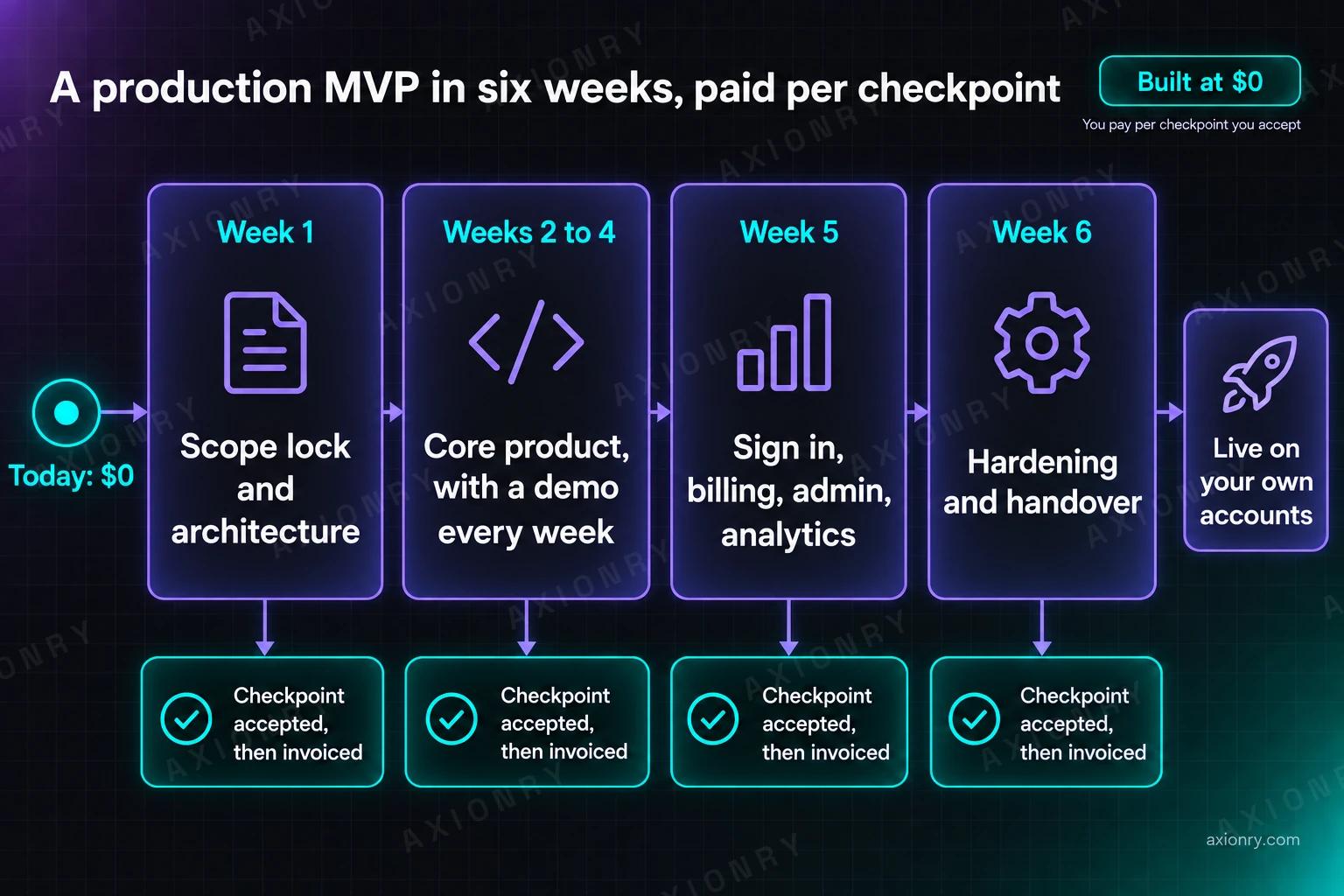
Timeline of a production MVP built in six weeks and paid per checkpoint. Today costs $0. Week 1 locks scope and architecture; weeks 2 to 4 build the core product with a demo every week; week 5 adds sign in, billing, admin and analytics; week 6 hardens the product and hands it over, live on your own accounts. Each stage ends in a checkpoint that is accepted, then invoiced.
Four checkpoints, each invoiced only after you accept it. Nothing is due before the first one.

How long does MVP development take?

The fastest path is a working MVP in as little as 3 days: a real, usable version of your core idea you can put in front of users. From there, a fuller production build typically runs a few weeks. A common shape: week 1 for scope, architecture and a design system; the following weeks for the core build with weekly demo videos; then payments, auth, analytics and admin; then hardening, deployment and handover docs. You get a production system on your own cloud accounts, and with startup credits applied your infrastructure often runs near-free for the first year.

What can you actually build, and how complex can it get?

Frontend, backend, mobile apps, and the AI layer underneath: LLM features, retrieval over your own documents, agentic flows that call real tools, and voice where it fits. Complexity is not the constraint; the constraint is whether the thing is worth building before you have users.

Infrastructure comes with it rather than being a separate project. Deployments across AWS, GCP and Azure, and where the data demands it, private or on-premise model hosting so inference never leaves your network. If your product needs its own LLM running on your own hardware, that is the same team and the same engagement, not a handoff.

What's included in MVP development services?

A full-stack build (Next.js, Node or Python), database and API design that scales past the MVP, and AI features (LLM, voice, RAG) where they create real advantage. It includes Stripe billing, deployment, monitoring and documentation, plus 30 days of post-launch fixes. It's the same architecture whether it's an internal tool or a full app for launch. Every price here is a starting point: final pricing depends on scope, features and complexity, so let's settle it on a quick call. Globally competitive rates mean you get senior, US-grade engineering without inflated agency costs.

Pricing

TierScopePrice
Rapid MVPA working, demoable version of your core product, in as little as 3 daysfrom $1,000
Full MVPProduction SaaS: auth, billing, analytics, admin, one AI featurefrom $12,000
AI-first MVPFull MVP plus a voice, agent or RAG corefrom $22,000

Final pricing depends on scope, features and complexity. Let's settle it on a quick call.
FAQ

Common questions.

Straight answers. If yours isn't here, ask on a 20-minute call.

What is the difference between an MVP development company and a product development company?+

An MVP development company optimises for the fastest credible version you can put in front of users. A product development company optimises for a system that survives growth. Axionry builds the MVP so that the second one is a continuation, not a rewrite.

Can you build the product and host the AI model privately?+

Yes, and it is one engagement rather than two. If your product needs an LLM running on your own hardware or inside your own cloud account for privacy or compliance reasons, the serving layer, the private network path and the application are built together. See private LLM infrastructure for how that side works.

How much do MVP development services cost in 2026?+

Working MVPs start at $1,000 for a fast, demoable build, and fuller production MVPs run into five figures depending on scope. US agencies quote $50K+ for comparable quality. The final number depends on features and complexity, so we set it on a call before any work starts.

How fast can you build an MVP?+

A working MVP can be ready in as little as 3 days: a real, usable version of your core idea, not a throwaway prototype. Fuller production builds take longer as scope grows. The 3-day version exists to get something real in front of users fast, and timelines always depend on what you need.

Will the MVP scale or do we rebuild later?+

It scales. Same event-driven patterns I used for AccioMatrix, which grew from MVP to 20+ enterprise clients without a rewrite. You own clean, documented code on your own infrastructure.

Ready to talk numbers?

Twenty minutes, straight to the engineer. No sales rep, no deck.