Request a callbackBook a call
ai for accounting firms

AI for Tax and Accounting: answers that reconcile, or do not ship

AI for accounting firms fails on one specific thing: a model that is right 95% of the time is useless when the output is a number a client will file. A plausible but wrong figure is worse than no figure, because it looks finished. The fix is not a better prompt. It is a deterministic layer between the model and the reviewer that checks every claim against the source file, rejects anything that does not reconcile, and surfaces a needs-review state instead of a confident answer. Axionry builds tax and accounting AI that way, with the model kept inside your own infrastructure when client data demands it.

Proof point
Numbers that reconcile, or the answer is rejected
How you pay

Get it built at $0.

That is not a discount. It is when you pay. The work is split into checkpoints with acceptance criteria written down before anything starts, and each checkpoint is invoiced only after you have seen it and accepted it. No deposit.

$0 to start
You hold every dollar until a checkpoint is delivered and you accept it. No approval, no invoice.
Fixed cost, unlimited features
Or hire the team outright: one fixed monthly cost, unlimited feature development, any stack.
The engineer takes your call
The person on your first call is the one who architects and writes it. No account managers, no bench time.

A US agency quotes $50,000 to $150,000 for the same build and asks for 40 to 50% of it before a line is written. Account managers, project managers, sales commission and bench time. None of it appears in your product.

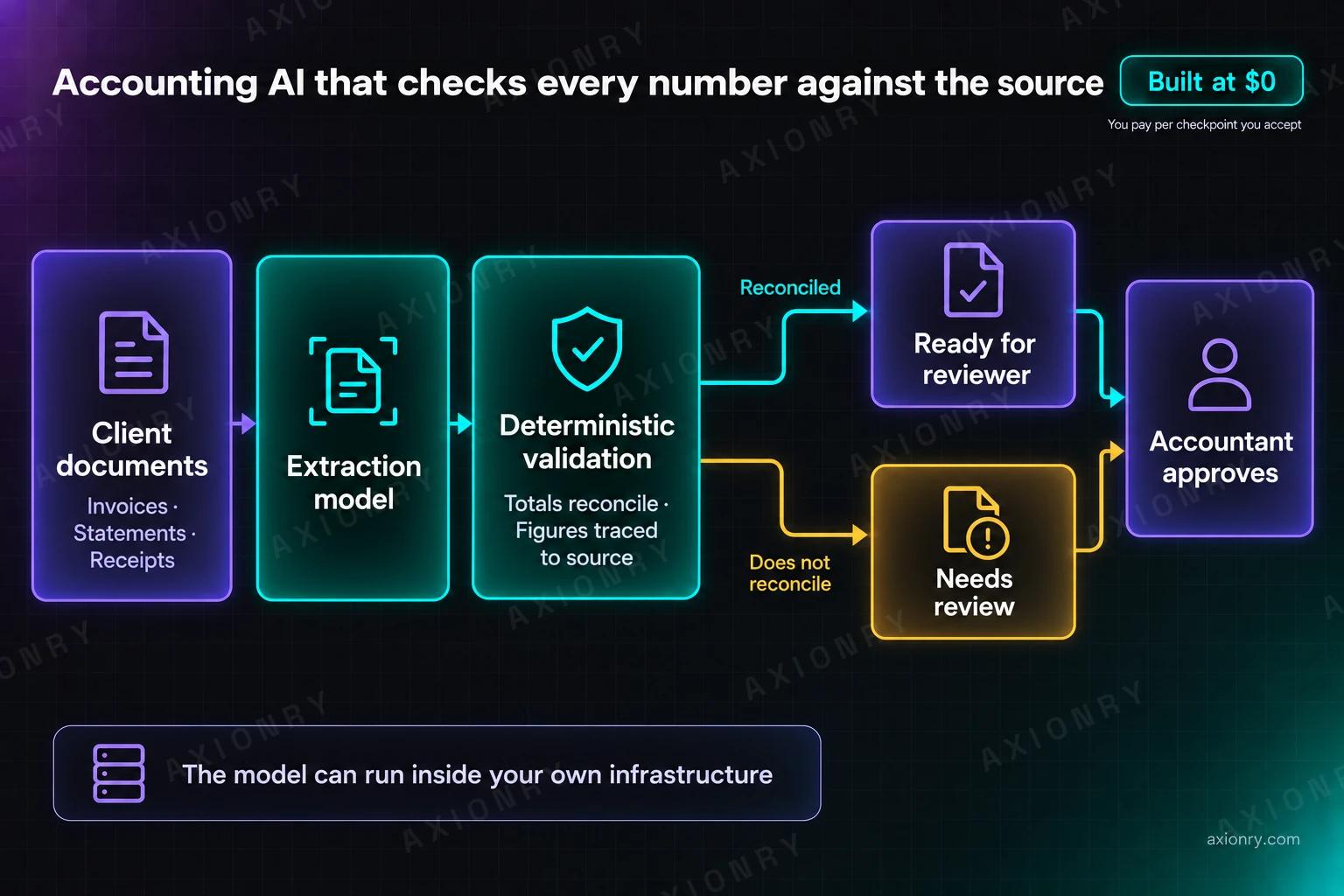
Architecture diagram of accounting AI that checks every number against the source: client documents such as invoices, statements and receipts go to an extraction model, then to deterministic validation that checks totals reconcile and every figure traces to its source. Reconciled items are ready for a reviewer, items that do not reconcile are flagged as needing review, and an accountant approves both. The model can run inside your own infrastructure.
A figure that does not reconcile is flagged for review, never presented as finished.

Why do AI tools keep failing in accounting workflows?

Because the tolerance for a confident wrong answer is effectively zero, and most AI products are built assuming it is merely low. A summary that misreads a column, a total that does not tie to the ledger, a date pulled from the wrong period: each is invisible in a fluent paragraph and expensive downstream.

The second failure is trust collapse. A reviewer who catches two bad numbers stops trusting all of them, and then checks everything manually, at which point the tool costs time instead of saving it. Validation is not a safety feature here, it is the product.

What does deterministic validation actually check?

Code, not a second model, so the same input always gives the same verdict. Totals in the response reconcile against the matching rows in the source file. Every number cited is traceable back to that file. Dates fall inside the selected period. Categories come from your allowed list. Required fields are present, and reasoning text or prohibited content is absent.

A failed rule is never silently corrected. The service retries once with the failure fed back to the model, and if it fails again the response is returned as rejected with the failing rules listed, so your review screen shows a needs-review state rather than an answer. Your existing rules are the starting list, not a replacement for them.

Does client financial data have to stay in our own systems?

Increasingly, yes, and it is usually your clients who decide rather than you. Once an engagement letter or a customer's own policy says financial records cannot be processed by a third-party service, a hosted model API stops being viable no matter how good it is.

The alternative is a model running inside infrastructure you control, reached over a private path that is never publicly exposed. Your data stays where your clients expect it to be, and the question stops coming up in every sales conversation.

Where does AI save time in a practice?

Document intake and structuring, reconciliation support with every figure traced to its source row, categorisation against your own chart of accounts, drafting client-facing explanations a preparer then edits, and flagging anomalies for a human to judge. All review-only, all reconciled, none of it filing anything.

What we will advise against is anything that writes to a return or a ledger without a person approving it. Not because the model cannot do it, but because the liability sits with your firm and review-only output is what keeps it manageable.

How an engagement runs

StageWhat happensTimeline
AssessmentYour workflow, data path and existing review rules examined, with validation rules written as testable statementsAbout one week
BuildModel serving, validation gate, failure handling, and the reviewer-facing surface, delivered as separately accepted checkpointsAbout three weeks
Private deploymentWhere client data cannot leave your systems, the model runs inside your own infrastructureScoped on a call

Work runs on synthetic data throughout, with review-only output and no automatic save or apply. Accounts stay yours and access is removed at handover.

FAQ

Common questions.

Straight answers. If yours isn't here, ask on a 20-minute call.

How do you stop the AI inventing a number?+

By refusing to render one. A deterministic gate checks every figure against the source file before the response reaches your review screen, and anything that does not reconcile comes back marked as rejected with the failing rule named, rather than as an answer.

Will it file or post anything automatically?+

No. Output is review-only by design, with no automatic save or apply. A preparer or reviewer sees the draft and decides. Anything that eventually writes goes through your existing approval path.

Can the model run inside our own environment?+

Yes, and for firms whose clients prohibit third-party processing of financial records it is usually the only workable option. The model runs on your hardware or in your own cloud account, with the endpoint never publicly reachable.

We already have review rules. Do you replace them?+

No, they become the starting list. Existing rules are mapped into the validation gate so the system enforces what your practice already knows, and new rules are added where the workflow needs them.

Ready to talk numbers?

Twenty minutes, straight to the engineer. No sales rep, no deck.