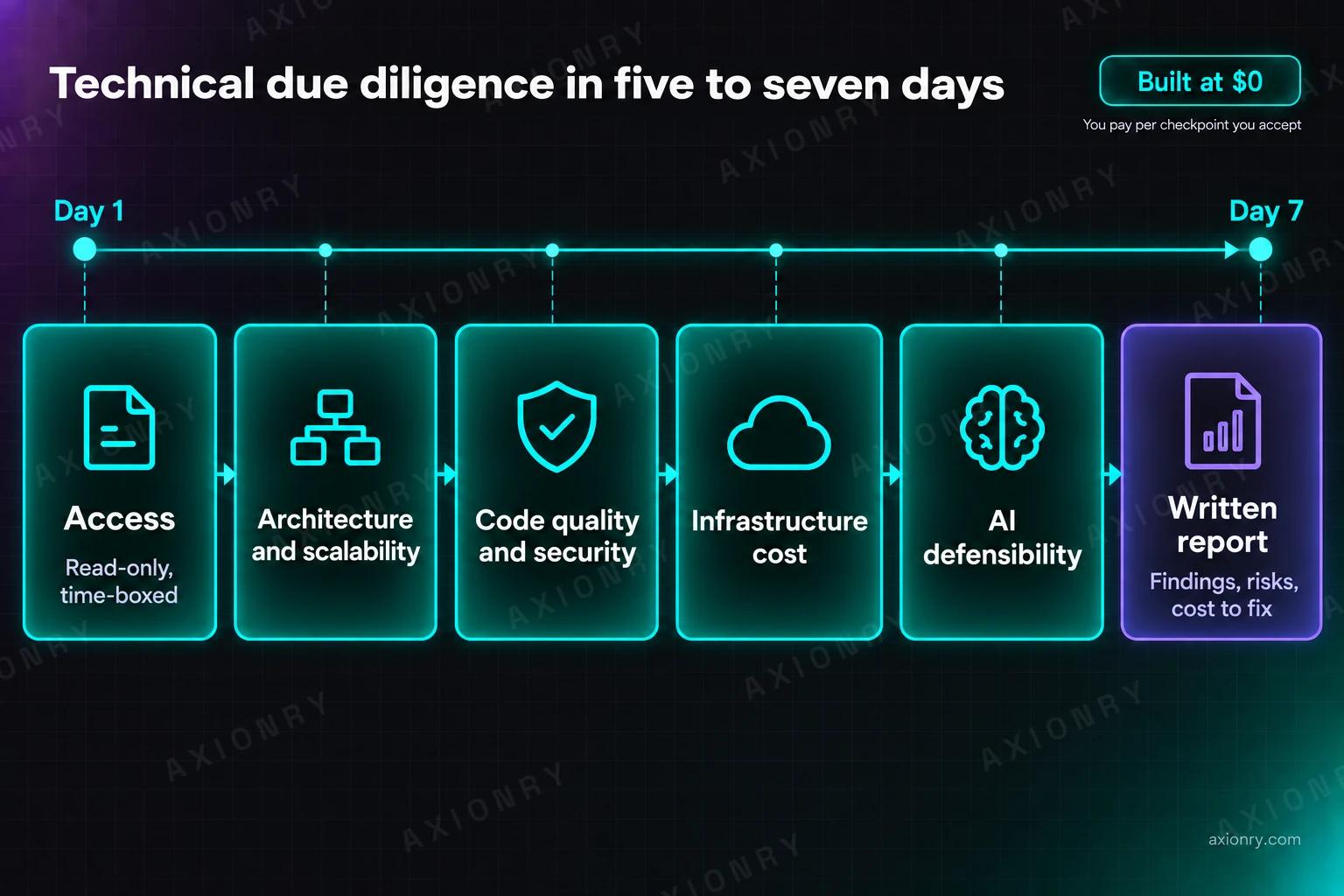
What does technical due diligence cover?+
Architecture, scalability, security posture, AI and data moats, infrastructure cost trajectory, engineering team quality and key-person risk, delivered as a clear verdict with dollar-quantified risks, not a hedge-everything report.
Why use a practitioner instead of a consulting firm?+
Firms send analysts who've read about the systems; I build and run them. When I assess a voice AI startup's claimed unit economics, I compare against my own production numbers, 2.5¢/minute, not a market report.
How much experience do you have as a technical due diligence consultant?+
More than 3 years providing independent technology due diligence and expert consulting for institutional investors and operators, focused on AI products, voice AI, cloud infrastructure and hiring tech. Engaging directly skips the expert-network markup and gets you a practitioner who builds these systems, not an analyst who reads about them.
How long does technical due diligence take?+
A full written diligence report on one target takes 5 to 7 days. If you need a fast read before committing to that, a one-hour expert call can cover a specific question, such as whether the architecture will scale or whether the AI claims hold up. Portfolio retainers give on-call judgment across your investments without a new scoping cycle each time.
How much does a technical due diligence consultant cost?+
My expert calls are $400 an hour for any covered sector. A full technical due diligence report on one target starts at $5,000 and takes 5 to 7 days. Portfolio retainers, with on-call technical judgment across your investments, start at $4,000 a month. Engaging me directly also skips the markup an expert network adds on top of the consultant's rate.
What do I receive at the end of a technical due diligence report?+
A written report with a clear verdict and the main risks quantified in dollars. It covers architecture and scalability, security posture, how defensible the AI really is, unit economics such as inference and cloud spend per user, and engineering team quality including key-person risk. It is written for the investment decision, so every finding ends with what it means for the deal.
How do you tell if a startup's AI is a real moat or an API wrapper?+
I look at what would remain if the underlying model provider changed tomorrow: proprietary data, workflows, evaluation and integration depth, or only a prompt on a public API. I also check the unit economics, because a thin wrapper usually shows up as inference cost rising in step with usage. Since I build AI products myself, I compare their claims against systems I run in production.
When in a deal should investors order technical due diligence?+
Before capital is committed, once a target is serious enough to justify a closer look. A practical sequence is a one-hour expert call to test the riskiest technical claim, then a full report on a shortlisted target, which takes 5 to 7 days. Starting early leaves time to negotiate on what the report finds instead of discovering it after closing.
What red flags do you look for in technical due diligence?+
The common ones are architecture that will not survive 100x users, proprietary AI that turns out to be a thin API wrapper, unit economics the founders hand-wave, and key-person risk where one engineer holds the system in their head. I also check whether the hiring plan is sane and whether infrastructure costs are growing faster than revenue, because those problems land on the investor after closing.
Can you assess a voice AI startup's unit economics?+
Yes, voice AI is one of my covered sectors. I run a production voice AI stack at 2.5¢ a minute, down from 10¢, so I compare a target's claimed cost per minute against real numbers instead of a market report. I break their figure into speech-to-text, LLM, text-to-speech, telephony and infrastructure, and show where the margin story holds or breaks.
Do you help portfolio companies after the investment closes?+
Yes. Post-investment value creation is part of the work, through a portfolio retainer from $4,000 a month. The usual lever is cost: the same playbook I used to cut a $200K a year infrastructure bill by more than 70%, applied to portfolio companies whose cloud or AI spend is growing faster than revenue. Retainers also cover on-call technical judgment on new deals.
How should a startup prepare for technical due diligence?+
Have honest answers ready on four things: whether the architecture scales, what makes the AI defensible, what inference, voice and cloud costs look like per user, and who on the team holds critical knowledge. Investors notice hand-waved unit economics quickly. Founders preparing for a round can book a one-hour call at $400 to rehearse those answers with someone who runs diligence for investors.
Can I book a single expert call instead of a full report?+
Yes. One-hour expert calls are $400 and cover any sector I work in: AI products, voice AI economics, cloud infrastructure, SaaS and hiring tech. It is the format I have delivered to institutional investors for more than 3 years. A call suits a single sharp question, while a full report suits a target you are close to backing.