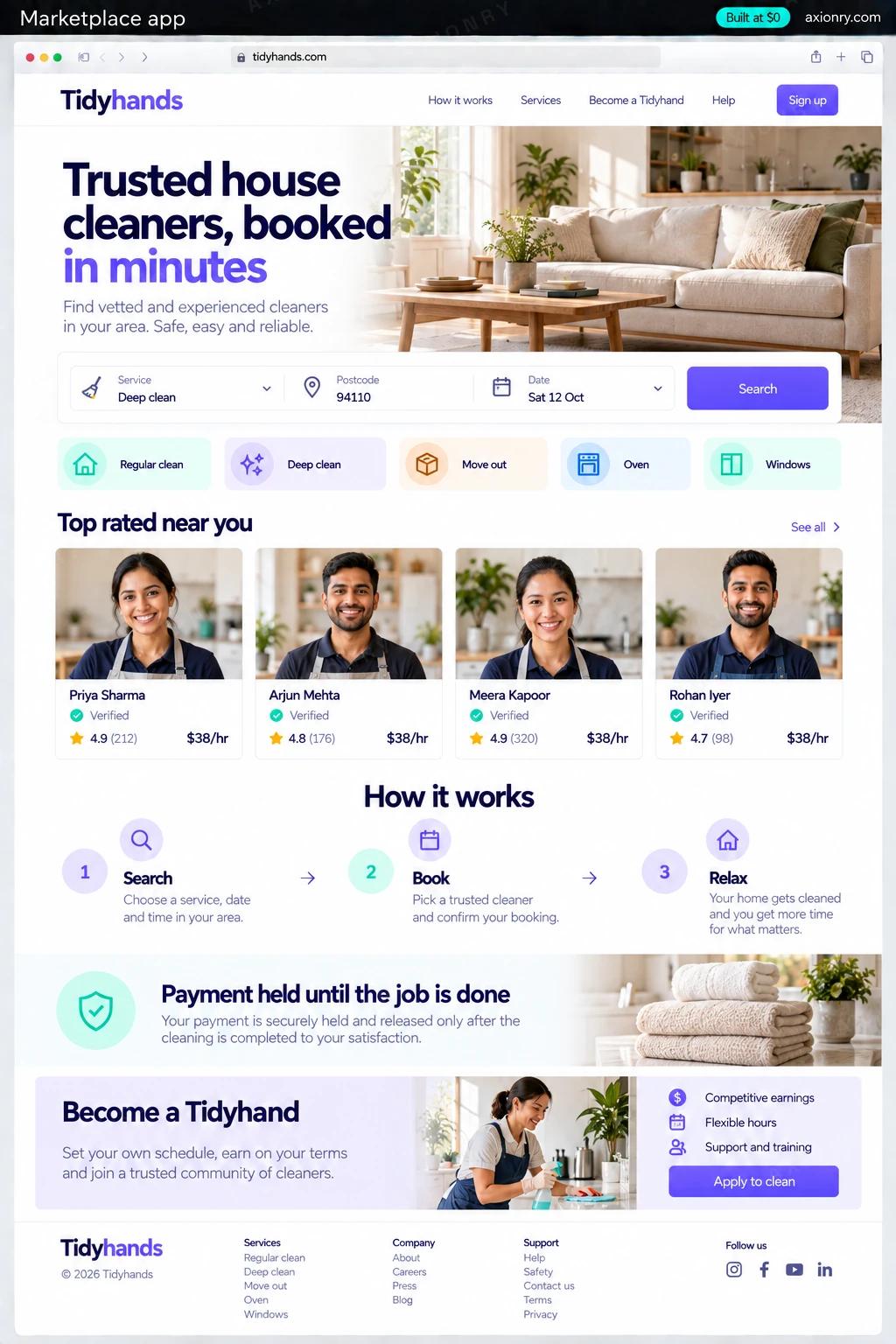
What is a marketplace app?
A marketplace app connects people who offer something with people who want it, and takes a cut when they transact. This version is for services: providers list what they do and when they are free, customers search and book, payment is held until the job is done, and both sides review each other afterward.
Marketplaces are worth building where supply is fragmented and hard to trust: local trades, tutors, pet care, event staff, equipment rental. Customers pay the fee for curation and protection, so vetting, reviews, held payments and dispute handling are not extras. They are the product.
You would run it as your own business and earn a commission or booking fee on each transaction. The version priced here is a web marketplace for one category in one region, with provider onboarding, Stripe Connect payouts and an operator console. It starts on the web so listings can rank on Google; native apps follow once repeat use shows which side needs them first.
Vetted providers with reviews from real bookings, prices and availability up front, and money held until the job is done.
A profile that brings bookings, a calendar that prevents double-booking, and payouts to their bank on a predictable schedule.
Approvals, disputes, refunds and payouts in one console, with the take rate and repeat-booking numbers that show whether the market works.
What features does a marketplace app need?
A marketplace app needs 8 core features: provider onboarding and vetting, listings and search, booking with availability, held payments and payouts, messaging with guardrails, two-way reviews, disputes and refunds and trust and safety console.
Provider onboarding and vetting
Providers apply with ID, qualifications and insurance, your team approves them, and optional background checks run before a profile goes live.
Listings and search
Search by service, location, price, rating and availability, with listing pages built to rank for searches like 'house cleaner in Austin'.
Booking with availability
Customers pick a time from the provider's live calendar, and providers accept, decline or propose another slot.
Held payments and payouts
Stripe Connect charges the customer, holds the provider's share until the job is marked complete, and pays out on schedule minus your fee.
Messaging with guardrails
Customers and providers message in the app, with phone numbers and emails masked before booking so deals stay on the platform.
Two-way reviews
Both sides review each other only after a completed, paid booking, so every rating comes from a real transaction.
Disputes and refunds
A structured claim flow with photos and messages attached, deadlines for each side to respond, and refunds or partial payouts decided in the console.
Trust and safety console
Flags for reported users, suspicious messages and repeat cancellations, with suspensions and case notes in one place.
What screens does a marketplace app have?
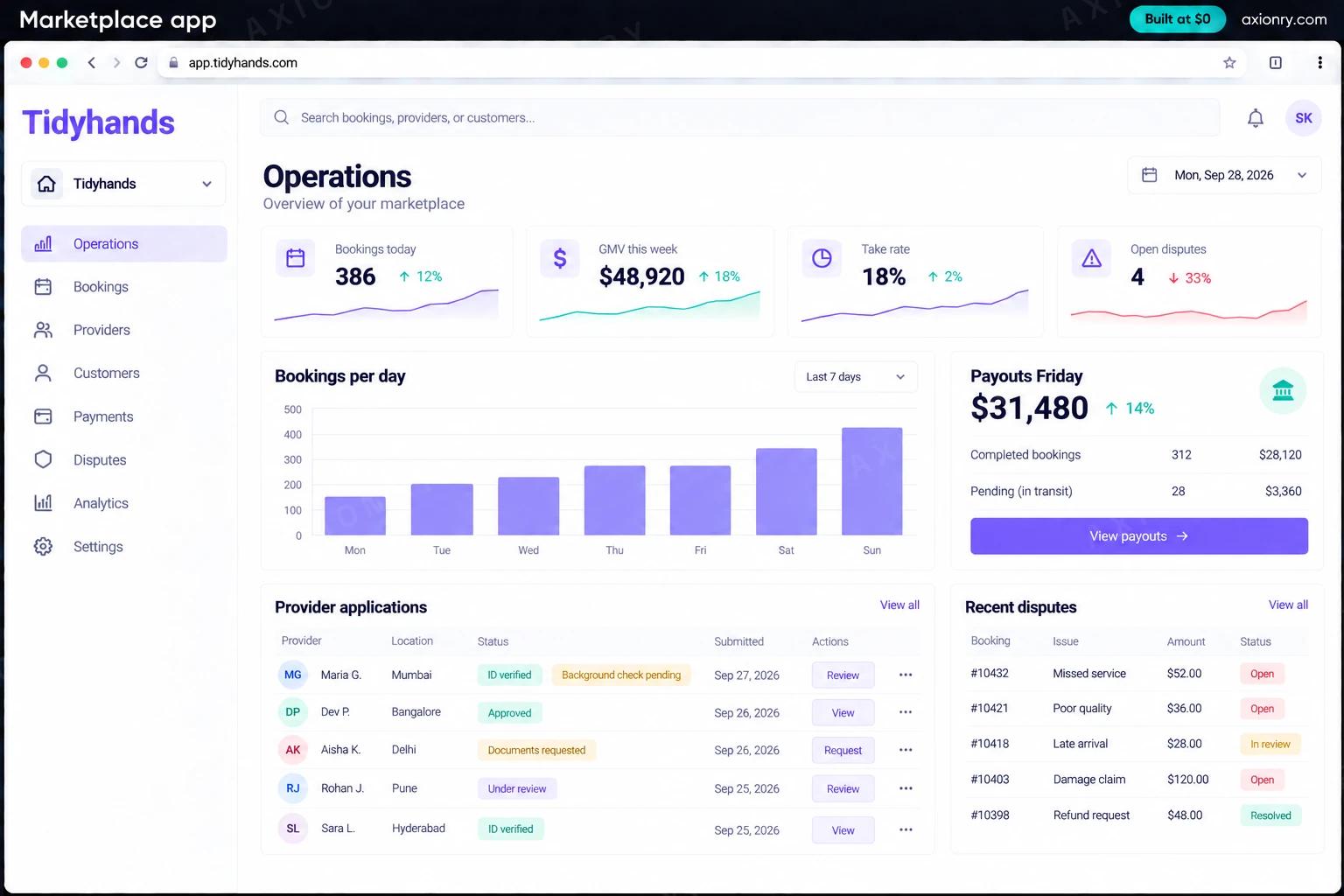
It is built around 4 screens: search results, booking confirmation, provider dashboard and marketplace console.
- 1Search resultsProviders near the customer with ratings, completed jobs, prices and next free slot, plus filters for service, date and price.
- 2Booking confirmationThe confirmed booking with its time, total and a note that payment is held until the job is done.
- 3Provider dashboardThe provider's week with a request waiting for acceptance and the next payout.
- 4Marketplace consoleBookings, take rate, open disputes and providers waiting for approval.
How does a marketplace app work?
End to end, in 5 steps: providers apply and get approved, customers search and book, the job happens, payment is released and reviews and disputes.
- 1
Providers apply and get approved
They create a profile, set services, prices and availability, and upload documents. Your team reviews them, and Stripe Connect verifies identity and bank details before any payout.
- 2
Customers search and book
Search filters by location, service, date and price. The customer picks a slot and pays, and the provider has a set time to accept before the request lapses and the hold is released.
- 3
The job happens
Addresses and contact details are shared once the booking is confirmed, and reminders go out the day before. Either side can reschedule or cancel under the policy shown at checkout.
- 4
Payment is released
When the job is marked complete, and after a short window for complaints, the provider's share is transferred and paid out on their schedule, minus your fee.
- 5
Reviews and disputes
Both sides are asked to review. A complaint opens a dispute with evidence from both sides, and your team decides on a refund, a partial payout or a ban.
What is the architecture and tech stack of a marketplace app?
It has 8 layers: web app (Next.js on Vercel, shadcn/ui), booking API (Node.js + TypeScript, REST), payments (Stripe Connect with Express accounts), search (Typesense or Algolia), database (Postgres), workflows (Inngest), messaging (In-app messages, Resend email, Twilio SMS) and trust and safety (Stripe Identity or Persona, Checkr for background checks). The diagram shows how a request moves through them.
| Layer | What we use | Why |
|---|---|---|
| Web app | Next.js on Vercel, shadcn/ui | Listing and category pages are rendered on the server, so they can rank on Google from the first week. |
| Booking API | Node.js + TypeScript, REST | Bookings, availability and payment state in one typed service, ready to serve native apps later. |
| Payments | Stripe Connect with Express accounts | Stripe verifies providers, holds funds between charge and transfer, pays out to banks and prepares US tax forms, so the licensed payments company moves the money, not you. |
| Search | Typesense or Algolia | Filters by location, price, rating and availability that respond as the customer types. |
| Database | Postgres | Listings, bookings, reviews and a ledger of every charge, hold, fee and payout, so any dispute can be traced to the cent. |
| Workflows | Inngest | A booking that waits for acceptance, then for the job, then for the complaint window before paying out is a process that runs for days and must survive restarts. |
| Messaging | In-app messages, Resend email, Twilio SMS | Conversations stay on the platform, with reminders by email and text and contact details masked until a booking exists. |
| Trust and safety | Stripe Identity or Persona, Checkr for background checks | Identity checks for every provider, and background checks where the category calls for them, such as work inside people's homes. |
How much does it cost to build a marketplace app?
A launch-ready marketplace app costs $25,000 to $49,500 to build and takes 7 to 11 weeks. A clickable demo costs $3,000 to $6,000 (2 to 4 weeks), and running it costs $95 to $470 a month at the usage below. You start at $0 and pay per checkpoint you accept.
Priced with the same model as our AI product cost estimator, from the features above. Your price is fixed in writing after a 20-minute call, before any work starts.
| Version | Build cost | Timeline | What it is |
|---|---|---|---|
| Clickable demo | $3,000 to $6,000 | 2 to 4 weeks | Clickable and real where it matters, on test data. Built to show users and investors, not to carry production traffic, so compliance work starts at launch. |
| Launch-ready | $25,000 to $49,500 | 7 to 11 weeks | Production architecture, tests on the risky paths, monitoring, and a handover your team can run. |
| Enterprise-grade | $32,500 to $64,500 | 8 to 13 weeks | Load tested, highly available, audited and documented for a larger team. |
What it costs to run
About 2,500 monthly customers and providers in one region; Stripe Connect fees are charged per payment and payout, and are priced into your commission rather than your hosting bill.
| Line | Per month | Assumes |
|---|---|---|
| Hosting and database | $80 to $210 | Vercel + managed services, sized for 2,500 monthly users |
| Email, monitoring, analytics | $20 to $260 | Free tiers cover most products at launch |
| Total | $95 to $470 | List prices, before any volume discount |
Build at $0: how you pay
$0 is when you pay, not what you pay. The launch-ready build is split into checkpoints with acceptance criteria agreed before work starts, and each one is invoiced only after you have seen it and accepted it.
- 1Scope and acceptance criteriaBefore work startsA call, then a written plan: every checkpoint with acceptance criteria you agree to before work starts.$0
- 2Architecture and first flowBy week 2Data model, service boundaries and one real flow working end to end.$5,000 to $10,000
- 3Core productBy week 6The main flows on production architecture, with a demo at the end of every week.$7,500 to $15,000
- 4The rest of v1By week 9Billing, admin and the flows that let you charge money and support users.$7,500 to $15,000
- 5Launch and handoverBy week 11Deployed on your accounts and documented, with 30 days of defect correction included.$5,000 to $10,000
What can you add to a marketplace app after launch?
The additions most teams make next: AI matching and ranking, fraud and off-platform detection, listing assistant and AI dispute summaries.
AI matching and ranking
Ranks providers for each request by fit, distance, reliability and response time, learned from which bookings lead to five-star reviews and repeat customers.
Fraud and off-platform detection
Scores new accounts, payments and messages for stolen cards, fake reviews and attempts to take the deal elsewhere, and queues the risky ones for review.
Listing assistant
Helps providers write a clear profile and price their services against similar providers nearby, so new supply looks credible on day one.
AI dispute summaries
Reads the booking, messages and photos in a dispute and drafts a timeline and a suggested outcome for your team to accept or change.
What are the risks when building a marketplace app?
Three things decide whether it works in production: worker classification, seller and tax reporting and trust before growth.
Worker classification
If you set providers' prices, hours or methods, US law may treat them as employees rather than contractors, and California's ABC test is the strictest. Let providers set their own terms where you can, and take legal advice before you standardize pricing.
Seller and tax reporting
US platforms and their payment providers issue 1099 forms to providers, and the EU's DAC7 rules require platforms to collect sellers' tax details and report their earnings. Collect those details during onboarding, not at year end.
Trust before growth
A single serious incident can undo a local marketplace's reputation. Verify identity before the first booking, run background checks where providers enter homes, keep payments and messages on the platform, and answer every safety report within hours.