What does a private LLM deployment actually involve?
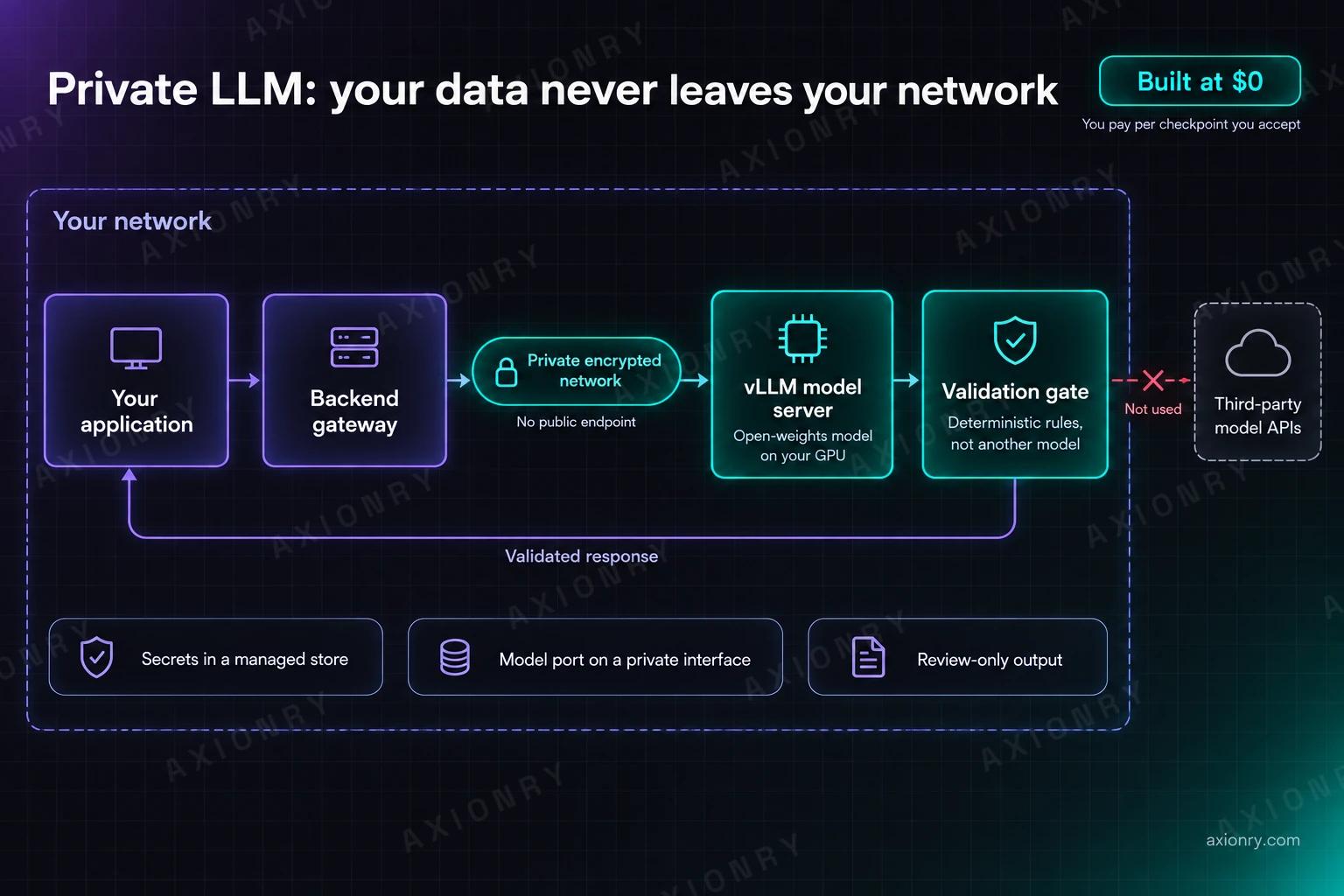
The path is always the same shape: your application, a controlled backend gateway, a private encrypted transport, the self-hosted model service, a validated response, and the result rendered back in your product. Each hop is a place the project stalls. Teams usually have the model running locally and the application built, and are stuck joining the two in a way that is secure, survives a reboot, and returns well-formed data every time.
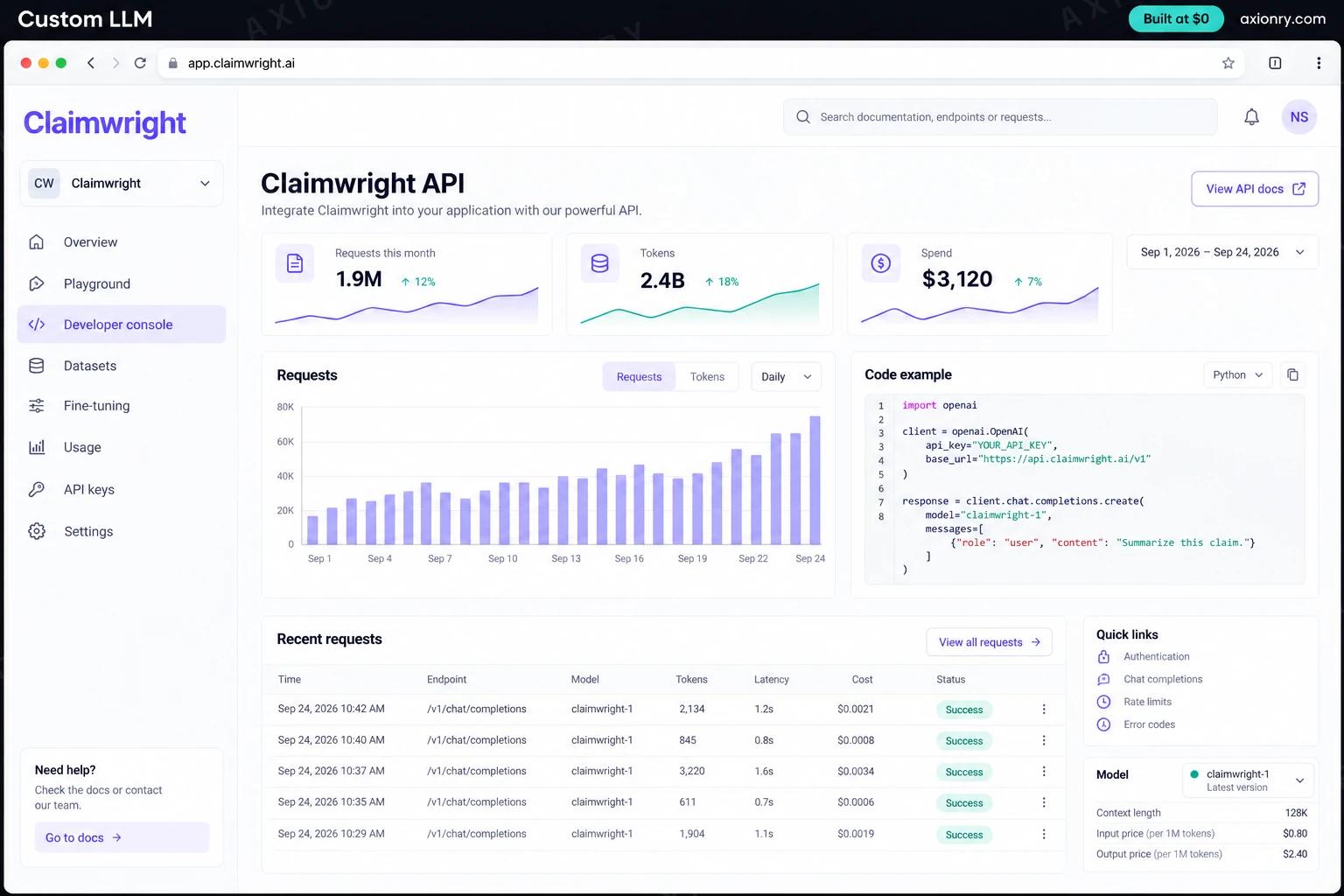
Concretely, the work is: expose the model as a private OpenAI-compatible API through vLLM so your backend talks to it like any hosted provider; put the GPU host and your backend on a private network so the model endpoint is never publicly reachable; tune the serving layer for your specific hardware; constrain the output so responses are well-formed by construction; and prove it with one real request through the real application.
How do you tune an LLM serving layer for on-premise hardware?
Quantisation matched to the GPU's native kernel path, KV cache configuration sized to your real context lengths, continuous batching so concurrent requests share the GPU properly, and prefix caching where prompts share a common head. Together these move tokens-per-second under concurrency far more than swapping models does.
Then it gets measured, not assumed: tokens per second, time to first token, and how many concurrent requests the box actually holds before latency degrades. You get those numbers as a documented baseline, so later changes can be compared against something real.
How do you keep a self hosted LLM private and secure?
The model port binds to a private interface only and is never exposed to the internet. A private overlay network joins the GPU host to your application infrastructure, verified as a direct peer connection rather than a relayed one, with access rules limiting which machine may reach the model port and which named people may reach SSH. Secrets live in a managed secret store and are read at runtime, never in code or environment files.
The service layer holds no write credentials to your database or storage, so unauthorised writes are structurally impossible rather than merely blocked. Output can be review-only, with no automatic save or apply, which is usually what regulated buyers need in order to approve a first deployment at all.
How do you stop a private model returning wrong answers?
With a deterministic gate between the model's answer and your application: code, not another model. A fixed list of rules, each returning pass or fail, giving the same verdict for the same input every time. Totals in the response reconcile against the source rows. Every number cited is traceable to the input. Dates fall inside the selected period. Categories come from your allowed list. Required fields are present, reasoning text and prohibited content are absent.
A failed rule is never silently corrected. The service retries once with the failure fed back to the model, and if it fails again the response is returned as rejected with the failing rules listed, so your interface can show a needs-review state instead of a confident wrong answer. A second model critiquing the output is a useful layer on top of this, never a substitute for it.
When does self hosting an LLM actually make sense?
Three situations. Data that legally or contractually cannot leave your network, which is most healthcare, tax, legal, defence and public-sector work. Volume, where consistent five-figure monthly inference spend starts to beat per-token pricing. And control, where you need a model version pinned for years or latency that does not depend on someone else's queue.
Outside those three, an API is usually the right answer and we will say so. A private deployment you did not need is an expensive way to acquire operational burden.
What hardware do you need to run an LLM on premise?
It depends on model size, concurrency and latency targets, and getting it wrong is the most expensive error in the project. A quantised mid-size model serving a handful of internal users runs on a single workstation-class GPU. A desktop AI supercomputer such as NVIDIA's DGX Spark covers small-team inference and fine-tuning without a datacentre. Serving a large model to hundreds of concurrent users means multi-GPU nodes, fast interconnect, and real power and thermal planning.
If you have already bought hardware, we work with what you have. If you have not, sizing comes out of the assessment, against measured throughput rather than a vendor spec sheet.
How an engagement runs
| Stage | What happens | Timeline |
|---|---|---|
| Assessment | Your stack examined end to end, existing work classified as preserved or replaced with reasons, connection design, implementation plan, and acceptance criteria written as testable statements | Five business days from access |
| Implementation | Delivered as separately accepted checkpoints, each with criteria agreed before work starts and invoiced only after you accept it | About three weeks |
| Handover | One real request through your real application, runbook, recorded handoff, all access removed with written confirmation | Included |
Fixed-fee assessment, credited in full against the build. No upfront payment and no escrow required: you hold every dollar until a checkpoint is delivered and accepted, and thirty days of defect correction is included. Scope and price are set on a call once we know your hardware, model and concurrency.