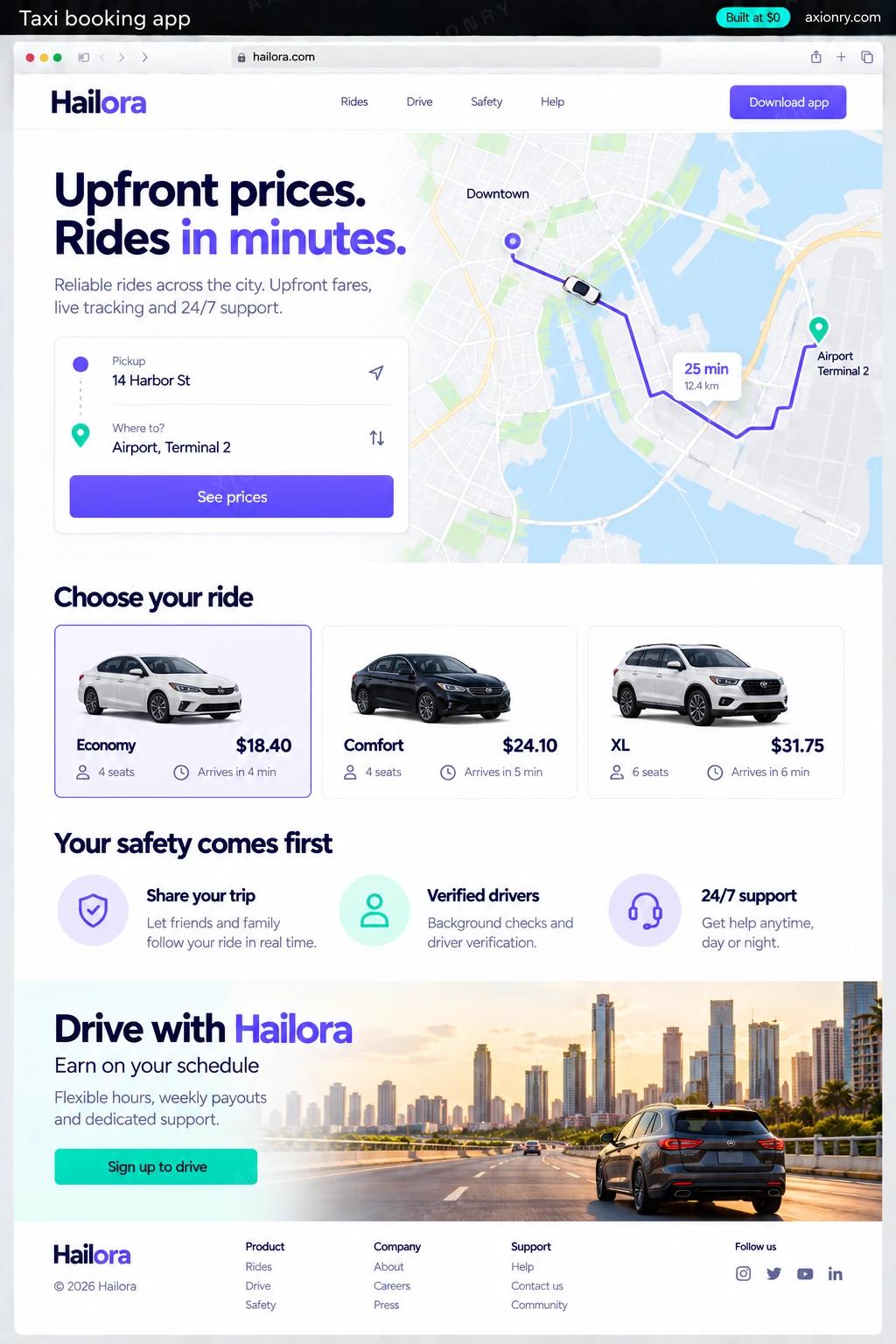
What is a taxi booking app?
A taxi booking app matches a rider with the nearest available driver and handles the trip from request to payment. It is four pieces working together: a rider app, a driver app, a dispatch service that matches and prices every trip, and a console where your team approves drivers, sets fares and handles support.
It is built for taxi and black-car fleets that want bookings in their own app rather than from a street corner or a phone line, for airport and corporate transfer companies, and for founders launching rides in a city or niche the big platforms serve badly, such as school runs, wheelchair-accessible rides or non-emergency medical trips. Owning the app keeps the booking fee and the rider relationship in-house.
You can run it for a fleet you control or open it to independent drivers. Opening it up brings rideshare permits, background checks and insurance that covers drivers whenever they are logged in, which is why this page prices the fleet version first: rider and driver apps on iOS and Android, matching and pricing, payouts, and the fleet console.
A fixed fare before booking, the driver's name, car and plate, a live map of the approach, and a receipt the moment the trip ends.
Ride requests with pickup distance and fare, turn-by-turn navigation in one tap, and earnings with payouts they can track.
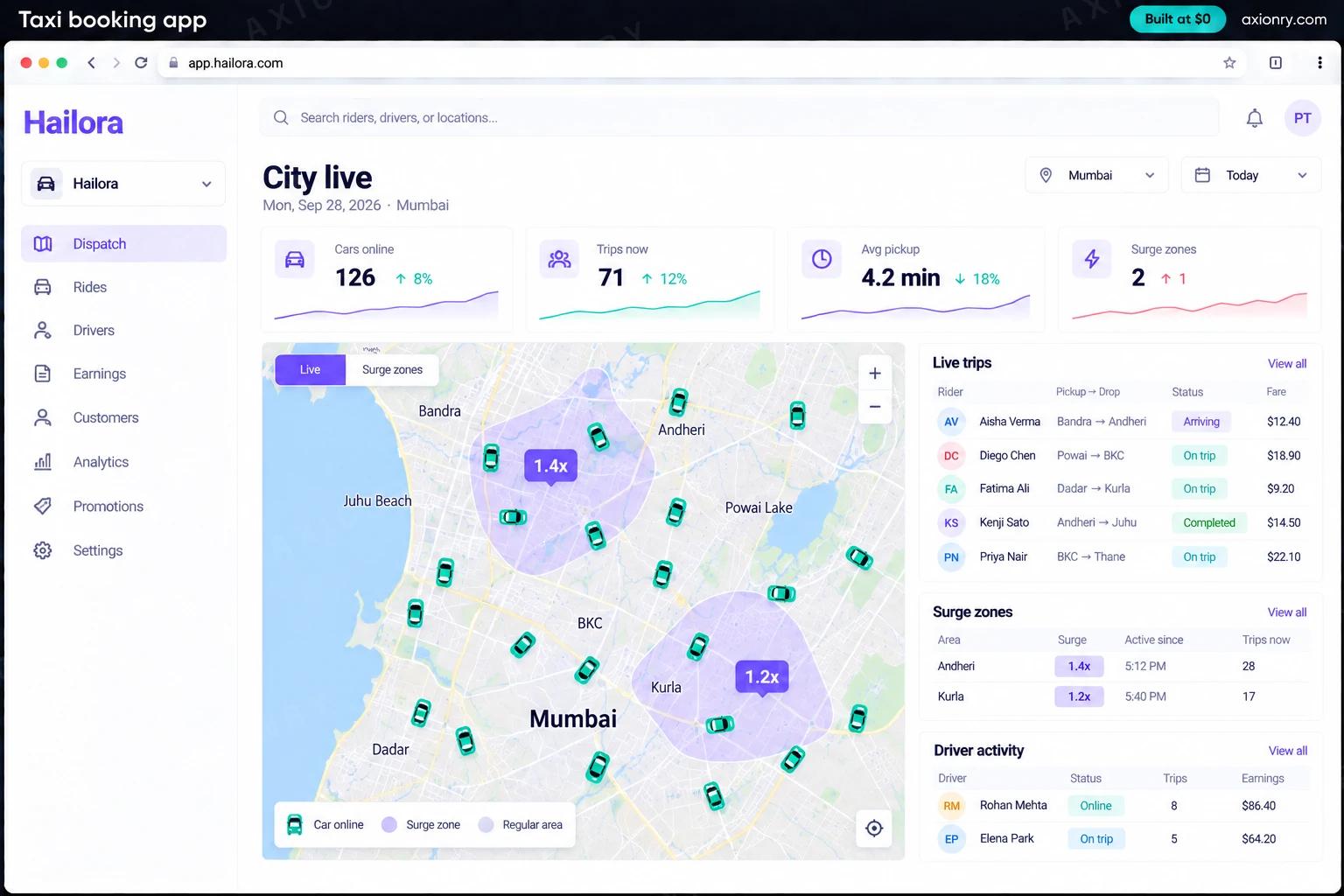
Every car on one map, driver approvals with documents checked, fares and surge rules they set, and trip history for every complaint.
What features does a taxi booking app need?
A taxi booking app needs 8 core features: upfront fares, nearest-driver matching, surge you control, live trip tracking, driver onboarding and documents, fares charged, drivers paid, safety tools and fleet console.
Upfront fares
The fare is calculated from route distance, time, base rate and any surge before the rider confirms, so the price never surprises them at drop-off.
Nearest-driver matching
Requests go to the closest available driver by road time, not straight-line distance, and pass to the next driver if declined or left unanswered.
Surge you control
Prices rise by zone when requests outrun available drivers, up to a cap you set, with the multiplier shown to riders before they book.
Live trip tracking
Riders watch the car approach and the trip progress, and can share a live trip link with a friend or family member.
Driver onboarding and documents
Drivers upload their license, insurance and vehicle papers, the console flags expiry dates, and background checks run through a provider such as Checkr.
Fares charged, drivers paid
Riders pay by card or wallet after the trip, and drivers are paid out weekly or on demand through Stripe Connect.
Safety tools
An in-app emergency button, trip sharing, masked phone numbers between rider and driver, and a PIN check before the trip starts.
Fleet console
A live map of cars and trips, driver approvals, fare and zone settings, refunds and lost-item tickets in one place.
What screens does a taxi booking app have?
It is built around 3 screens: rider booking, driver request and dispatch console.
- 1Rider bookingThe rider's phone: pickup and destination, ride options with upfront fares, and the button that confirms the ride.
- 2Driver requestAn incoming request on the driver's phone with pickup distance, trip length, fare and a countdown to accept.
- 3Dispatch consoleCars online, trips in progress and average pickup time on a live city map, with surge zones highlighted.
How does a taxi booking app work?
End to end, in 5 steps: the rider requests a ride, matching finds a driver, the driver picks up, the trip is tracked and payment and payout.
- 1
The rider requests a ride
They set pickup and destination, see an upfront fare for each ride type and confirm. A hold is placed on the card before any driver is asked.
- 2
Matching finds a driver
Live driver positions sit in Redis. The matching service ranks nearby drivers by road time to the pickup and sends the request to the best one, then to the next if it is declined.
- 3
The driver picks up
The driver navigates in their preferred maps app. The rider watches the car approach, gets a notice on arrival, and gives the driver a four-digit PIN to start the trip.
- 4
The trip is tracked
The driver app records the route. A changed destination recalculates the fare, and the rider can share the live trip or press the emergency button at any time.
- 5
Payment and payout
At drop-off the card is charged the final fare plus tip, the rider gets a receipt, and the driver's share joins their balance for the weekly or on-demand payout.
What is the architecture and tech stack of a taxi booking app?
It has 9 layers: rider and driver apps (React Native with Expo, two app builds from one codebase), fleet console (Next.js with shadcn/ui), trip API and matching (Node.js + TypeScript in containers on AWS ECS Fargate), live positions (Redis GEO on Amazon ElastiCache), trips and fares (Postgres with PostGIS on Amazon RDS), maps and routing (Google Maps Platform or Mapbox), payments (Stripe Connect), driver checks (Checkr or a local screening provider) and notifications (Firebase Cloud Messaging, APNs, Twilio). The diagram shows how a request moves through them.
| Layer | What we use | Why |
|---|---|---|
| Rider and driver apps | React Native with Expo, two app builds from one codebase | Rider and driver apps share maps, payment and trip code, and the driver app reports its location in the background so matching always knows where drivers are. |
| Fleet console | Next.js with shadcn/ui | A web console for the dispatch desk: live map, driver approvals, fares, zones and refunds. |
| Trip API and matching | Node.js + TypeScript in containers on AWS ECS Fargate | Matching runs continuously and the service keeps a live connection open to every online driver, which suits long-running containers better than serverless functions. |
| Live positions | Redis GEO on Amazon ElastiCache | Drivers report every few seconds, and 'drivers within a mile of this pickup' is a single fast GEOSEARCH call. |
| Trips and fares | Postgres with PostGIS on Amazon RDS | The record of every trip, fare, zone and payout, with spatial queries for surge zones and airport pickup areas. |
| Maps and routing | Google Maps Platform or Mapbox | Routes, ETAs and fare distances. Matching by road time instead of straight-line distance is what stops a driver being sent across a river. |
| Payments | Stripe Connect | Riders are charged after the trip, drivers are onboarded and verified by Stripe, and payouts run weekly or on demand. |
| Driver checks | Checkr or a local screening provider | Background and driving-record checks with the consent steps the law requires, with results posted back to the console. |
| Notifications | Firebase Cloud Messaging, APNs, Twilio | Ride requests and arrival alerts by push, plus masked calls and texts between rider and driver. |
How much does it cost to build a taxi booking app?
A launch-ready taxi booking app costs $30,000 to $59,500 to build and takes 7 to 13 weeks. A clickable demo costs $3,600 to $7,000 (2 to 5 weeks), and running it costs $200 to $1,050 a month at the usage below. You start at $0 and pay per checkpoint you accept.
Priced with the same model as our AI product cost estimator, from the features above. Your price is fixed in writing after a 20-minute call, before any work starts.
| Version | Build cost | Timeline | What it is |
|---|---|---|---|
| Clickable demo | $3,600 to $7,000 | 2 to 5 weeks | Clickable and real where it matters, on test data. Built to show users and investors, not to carry production traffic, so compliance work starts at launch. |
| Launch-ready | $30,000 to $59,500 | 7 to 13 weeks | Production architecture, tests on the risky paths, monitoring, and a handover your team can run. |
| Enterprise-grade | $39,000 to $77,000 | 9 to 15 weeks | Load tested, highly available, audited and documented for a larger team. |
What it costs to run
About 5,000 monthly riders and drivers in one city on AWS; card fees, routing requests, texts and background checks are billed per use on top.
| Line | Per month | Assumes |
|---|---|---|
| Hosting and database | $160 to $660 | AWS, sized for 5,000 monthly users |
| Email, monitoring, analytics | $40 to $390 | Free tiers cover most products at launch |
| Total | $200 to $1,050 | List prices, before any volume discount |
Build at $0: how you pay
$0 is when you pay, not what you pay. The launch-ready build is split into checkpoints with acceptance criteria agreed before work starts, and each one is invoiced only after you have seen it and accepted it.
- 1Scope and acceptance criteriaBefore work startsA call, then a written plan: every checkpoint with acceptance criteria you agree to before work starts.$0
- 2Architecture and first flowBy week 3Data model, service boundaries and one real flow working end to end.$6,000 to $12,000
- 3Core productBy week 7The main flows on production architecture, with a demo at the end of every week.$9,000 to $18,000
- 4The rest of v1By week 10Billing, admin and the flows that let you charge money and support users.$9,000 to $18,000
- 5Launch and handoverBy week 13Deployed on your accounts and documented, with 30 days of defect correction included.$6,000 to $12,000
What can you add to a taxi booking app after launch?
The additions most teams make next: demand forecasting, smarter pickup points, AI support for trip issues and fraud and account-sharing checks.
Demand forecasting
Predicts requests by zone and hour from your trip history, so you can nudge drivers toward the airport before the evening flights land.
Smarter pickup points
Learns where pickups at stations, malls and airports actually happen and suggests the exact spot, to cut the 'where are you' phone calls.
AI support for trip issues
Resolves fare disputes, lost items and route complaints from the trip record and GPS trace, and passes every safety report straight to a person.
Fraud and account-sharing checks
Scores sign-ups and trips for stolen cards, faked GPS and drivers sharing one approved account, and holds risky payouts for review.
What are the risks when building a taxi booking app?
Three things decide whether it works in production: licensing and insurance, driver checks done lawfully and fare and surge rules.
Licensing and insurance
Rideshare and taxi rules are set by city and state. US rideshare laws require background checks and insurance that covers drivers from the moment they log in, with higher limits once a trip is accepted. Confirm the permits and the insurer before you sign up a single driver.
Driver checks done lawfully
In the US, background checks fall under the FCRA: a standalone disclosure, the driver's written consent, and a notice with a copy of the report before rejecting anyone because of it. Use a provider that builds these steps in, and track document expiry dates.
Fare and surge rules
Some cities and countries cap surge or require the fare to be shown before booking. Keep fare rules in configuration per city, log the price every rider was shown, and cap surge automatically during declared emergencies, when many US states apply price-gouging laws.