Request a callbackBook a call
legacy application modernization

Legacy Application Modernization: cut the system down, not just the version number

Legacy application modernization usually gets sold as a port: same system, newer framework, same operating burden, eighteen months later. That is why so many of these programmes end with a modern-looking system nobody can run any cheaper. The version worth paying for reduces what exists. Fewer services, fewer moving parts, fewer people needed to keep it alive. I have done exactly that at scale, restructuring an engineering organisation from 20 people to 7 and taking its run rate from $60K a month to $12K, and separately cutting a $200K/year cloud bill to under $1K a month by re-architecting rather than re-hosting.

Proof point
20-person org to 7, $60K/mo to $12K/mo
How you pay

Get it built at $0.

That is not a discount. It is when you pay. The work is split into checkpoints with acceptance criteria written down before anything starts, and each checkpoint is invoiced only after you have seen it and accepted it. No deposit.

$0 to start
You hold every dollar until a checkpoint is delivered and you accept it. No approval, no invoice.
Fixed cost, unlimited features
Or hire the team outright: one fixed monthly cost, unlimited feature development, any stack.
The engineer takes your call
The person on your first call is the one who architects and writes it. No account managers, no bench time.

A US agency quotes $50,000 to $150,000 for the same build and asks for 40 to 50% of it before a line is written. Account managers, project managers, sales commission and bench time. None of it appears in your product.

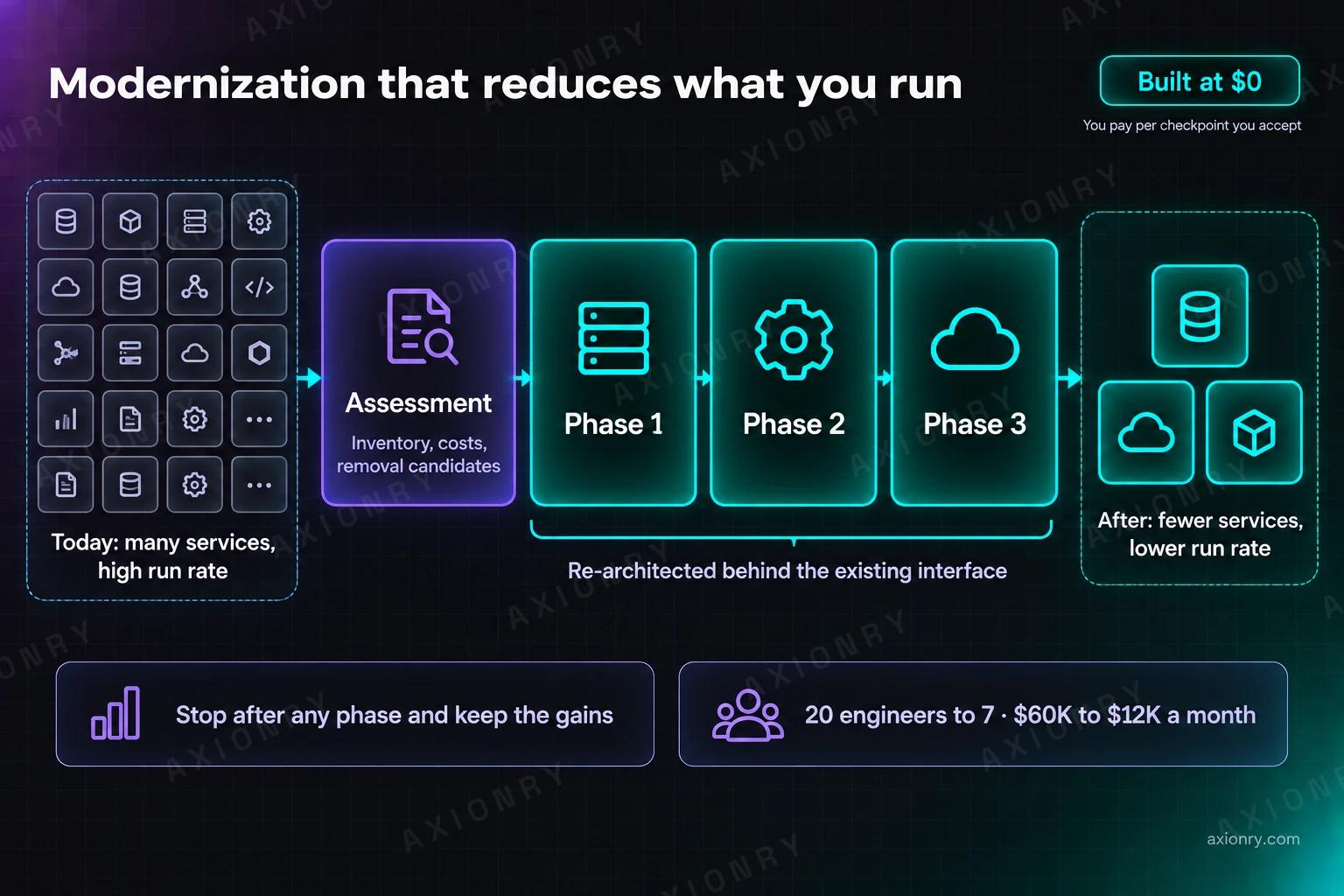
Diagram of modernization that reduces what you run: a dense cluster of legacy services with a high run rate goes through an assessment of inventory, costs and removal candidates, then three phases, each re-architected behind the existing interface, ending in a small set of services with a lower run rate. You can stop after any phase and keep the gains; the same approach took an engineering org from 20 people to 7 and $60K to $12K a month.
Each phase stands on its own, so you can stop after any of them and keep what it saved.

Why do modernization projects so often fail to change the numbers?

Because they move the system rather than reduce it. A lift-and-shift to containers, or a rewrite that faithfully reproduces every existing behaviour, arrives with the same service count, the same operational surface and the same headcount requirement. The stack is newer and the bill is the same or higher.

The savings live in the decisions people avoid: which services should not exist, which features nobody uses, which queue exists because of a problem solved three years ago, and which managed service is being paid for twice. Those are uncomfortable conversations, which is exactly why an outside engineer is often the one who can have them.

Where does AI actually help with legacy code?

In comprehension far more than in generation. Reading a codebase nobody remembers writing, mapping call paths and data flow, producing an accurate inventory of what exists and what is dead, and drafting characterisation tests around behaviour before you touch it. That work used to take months of an expensive engineer's time and is now dramatically faster.

Where it helps less than people hope is the rewrite itself. A model will happily reproduce a bad abstraction in a new language. The architectural decisions, what to drop, what to merge, what to leave alone, are still the part that determines whether the project pays for itself.

How do you modernise without stopping the business?

Incrementally, behind the existing interface. New implementations run alongside the old ones with traffic moved in slices, so every step is reversible and nothing depends on a single cutover weekend. Characterisation tests capture current behaviour first, including the behaviour that is technically wrong but that customers now rely on.

Each phase has to stand on its own: a measurable reduction in cost, operational load or delivery time, delivered before the next phase starts. A modernization programme whose value arrives only at the end is a programme that gets cancelled halfway.

What does the assessment actually produce?

An inventory of what runs, what it costs and what it is for. A map of what can be removed outright, merged, or left alone because it works. The infrastructure spend broken down by service with the waste identified. An honest view of which parts are load-bearing and which are just old.

Then a sequenced plan where each phase has a measurable outcome, so you can stop after any of them and still be ahead.

How an engagement runs

StageWhat happensTimeline
AssessmentCodebase and infrastructure inventory, cost breakdown, removal candidates, and a sequenced plan with measurable outcomes per phaseTwo to three weeks
Phase deliveryIncremental re-architecture behind the existing interface, each phase standing on its ownScoped per phase
Cost engineeringThe infrastructure and operational reduction that usually funds the rest of the programmeRuns alongside

Scoped and priced per phase, so you can stop after any phase and keep the gains. Assessment findings are delivered in writing before any implementation is agreed.

FAQ

Common questions.

Straight answers. If yours isn't here, ask on a 20-minute call.

Is this a rewrite?+

Usually not, and a full rewrite is the most common way these projects fail. The default is incremental re-architecture behind the existing interface, with traffic moved in slices so every step is reversible.

What kind of reduction is realistic?+

It depends entirely on what you are running, and any number quoted before an assessment is guesswork. For reference, two engagements I ran personally took an engineering org from 20 people to 7 with run rate falling from $60K to $12K a month, and a $200K/year cloud bill to under $1K a month. Your system is not those systems.

Can you work with our existing team rather than replacing them?+

That is the normal arrangement. The assessment and architecture are the outside contribution; your team knows the domain and usually does much of the implementation, which is also what makes the result maintainable after handover.

What if the assessment says we should not modernise?+

Then it says so, and you have saved a programme budget. Some legacy systems are stable, cheap and nearly finished being useful, and the right answer is to leave them alone and spend the money elsewhere.

Ready to talk numbers?

Twenty minutes, straight to the engineer. No sales rep, no deck.