AI Product & MVP Development in Cambridge
Ship your MVP without hiring a £28k in-house team in Cambridge.
A real, production-grade build you can put in front of users or investors.
Cambridge, at the centre of what is often called Silicon Fen, has a long record of turning university research into companies, from chip design to biotech and AI. Founders are frequently scientists or engineers commercialising research, with deep technical skill and less experience shipping software products.
Cambridge founders usually have a breakthrough, not a product. The build wraps the research in software customers can use and investors can evaluate.
What you get
- Full-stack build on Next.js, Node or Python, with a database and API design that survives past the MVP
- AI where it earns its place: LLM features, retrieval over your own documents, agent flows that call real tools, voice
- Auth, payments, analytics and an admin surface, not a demo that breaks on the second user
Final pricing depends on scope, features and complexity, so we settle it on a call before any work starts.
Invoiced in USD or GBP, payable by Wise or bank transfer.
Request a callback
You speak to the engineer who does the work. No sales rep, no deck.
Cambridge, in numbers
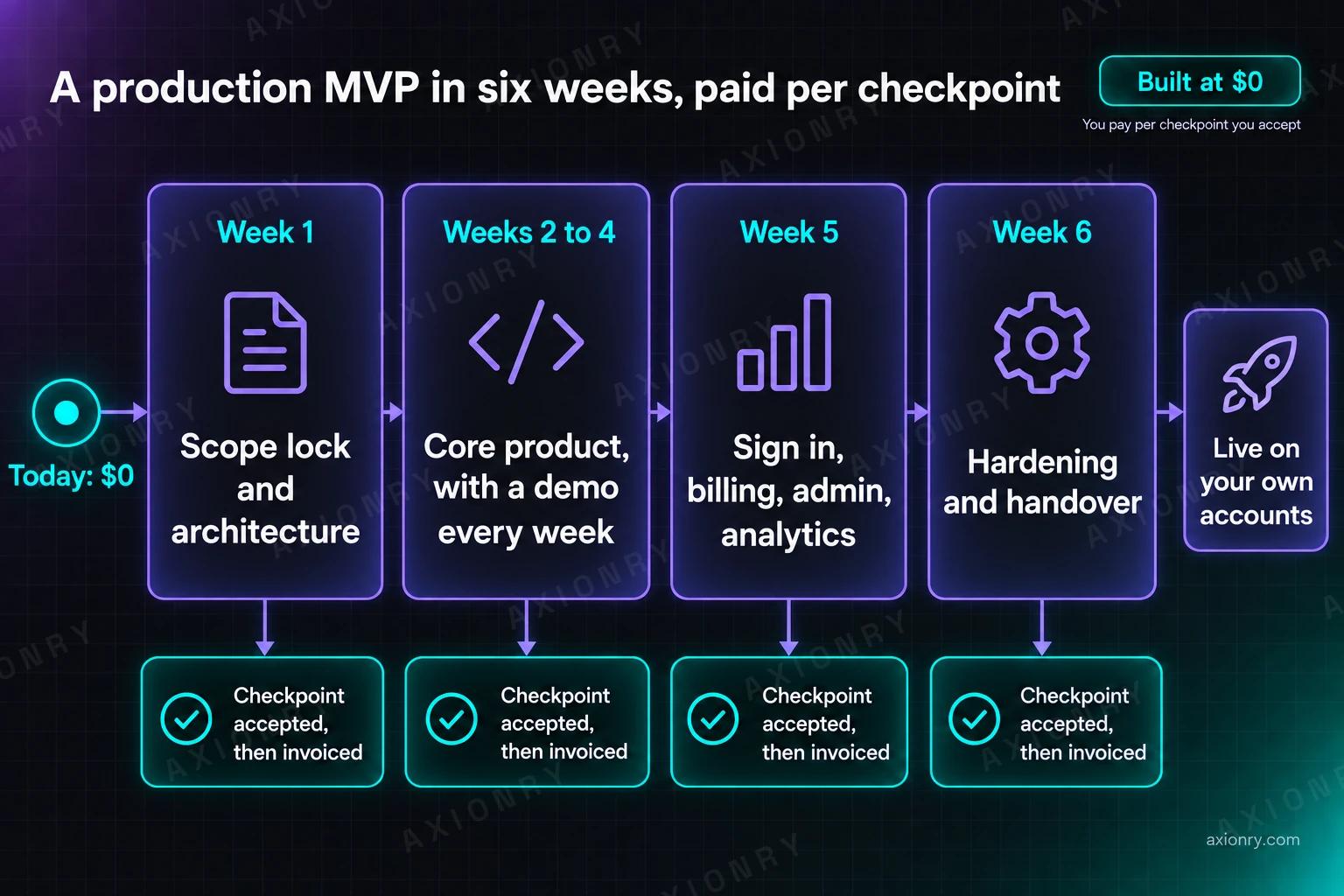
Two in-house developers in East cost about £28,149 in salary for a 12-week MVP, before the months it takes to hire them. We build the same MVP with $0 upfront and invoice each checkpoint only after you accept it.
Who builds here
Fractional CTO Services
Cambridge spinouts are usually led by scientists with deep technical skill but no software leadership experience, which is exactly the gap a part-time CTO fills.

What Cambridge companies build with us
Get it built at $0.
That is not a discount. It is when you pay. The work is split into checkpoints with acceptance criteria written down before anything starts, and each checkpoint is invoiced only after you have seen it and accepted it. No deposit.
- $0 to start
- You hold every dollar until a checkpoint is delivered and you accept it. No approval, no invoice.
- Fixed cost, unlimited features
- Or hire the team outright: one fixed monthly cost, unlimited feature development, any stack.
- The engineer takes your call
- The person on your first call is the one who architects and writes it. No account managers, no bench time.
A US agency quotes $50,000 to $150,000 for the same build and asks for 40 to 50% of it before a line is written. Account managers, project managers, sales commission and bench time. None of it appears in your product.
What actually applies here.
Working hours
Full UK working-day overlap. Calls at whatever hour suits your team, and no waiting a day for an answer.
What would an in-house MVP team cost in Cambridge?
Software developers in East earn a full-time median £60,989 a year. Two of them for 12 weeks comes to about £28,149 in salary alone, and that is after recruiting.
Can you work on software that may be a medical device?
We build with the documentation, traceability and testing a medical device route needs. Regulatory classification and submission are led by your regulatory team or adviser.
Can you help a spinout prepare for investor technical due diligence?
Yes. Typical work is documenting the architecture, tightening security and making sure the product does not depend on one person.
MVP Development
A working MVP in as little as 3 days, from $1,000. Production-grade, not a throwaway prototype.