AI Product & MVP Development in Charlotte
The best AI Product & MVP Development in Charlotte, at the best available price.
A real, production-grade build you can put in front of users or investors. Frontend, backend, mobile, the agentic AI underneath, and the cloud or private infrastructure it runs on, as one engagement rather than four vendors.
Charlotte is the second-largest banking centre in the US, home to major bank headquarters and large operations of others, with a growing fintech scene around them. Much of the software demand comes from banks, their vendors and the startups selling to them, so vendor risk reviews shape almost every project.
Fintech founders in Charlotte usually sell to a bank first. The build includes the access controls, audit trails and documentation a bank's vendor review will ask for.
What you get
- Full-stack build on Next.js, Node or Python, with a database and API design that survives past the MVP
- AI where it earns its place: LLM features, retrieval over your own documents, agent flows that call real tools, voice
- Auth, payments, analytics and an admin surface, not a demo that breaks on the second user
- Deployment across AWS, GCP or Azure, or private and on-premise hosting where the data demands it
- Clean, documented code on your own infrastructure, written to make us replaceable on purpose
Final pricing depends on scope, features and complexity, so we settle it on a call before any work starts.
Invoiced in USD, payable by Wise or bank transfer.
Request a callback
You speak to the engineer who does the work. No sales rep, no deck.
Who builds here
On-Premise LLM Deployment
Charlotte's banks and the vendors selling to them need AI that passes third-party risk and model risk reviews, and a model inside the bank's own environment is the cleanest route.

What Charlotte companies build with us
Get it built at $0.
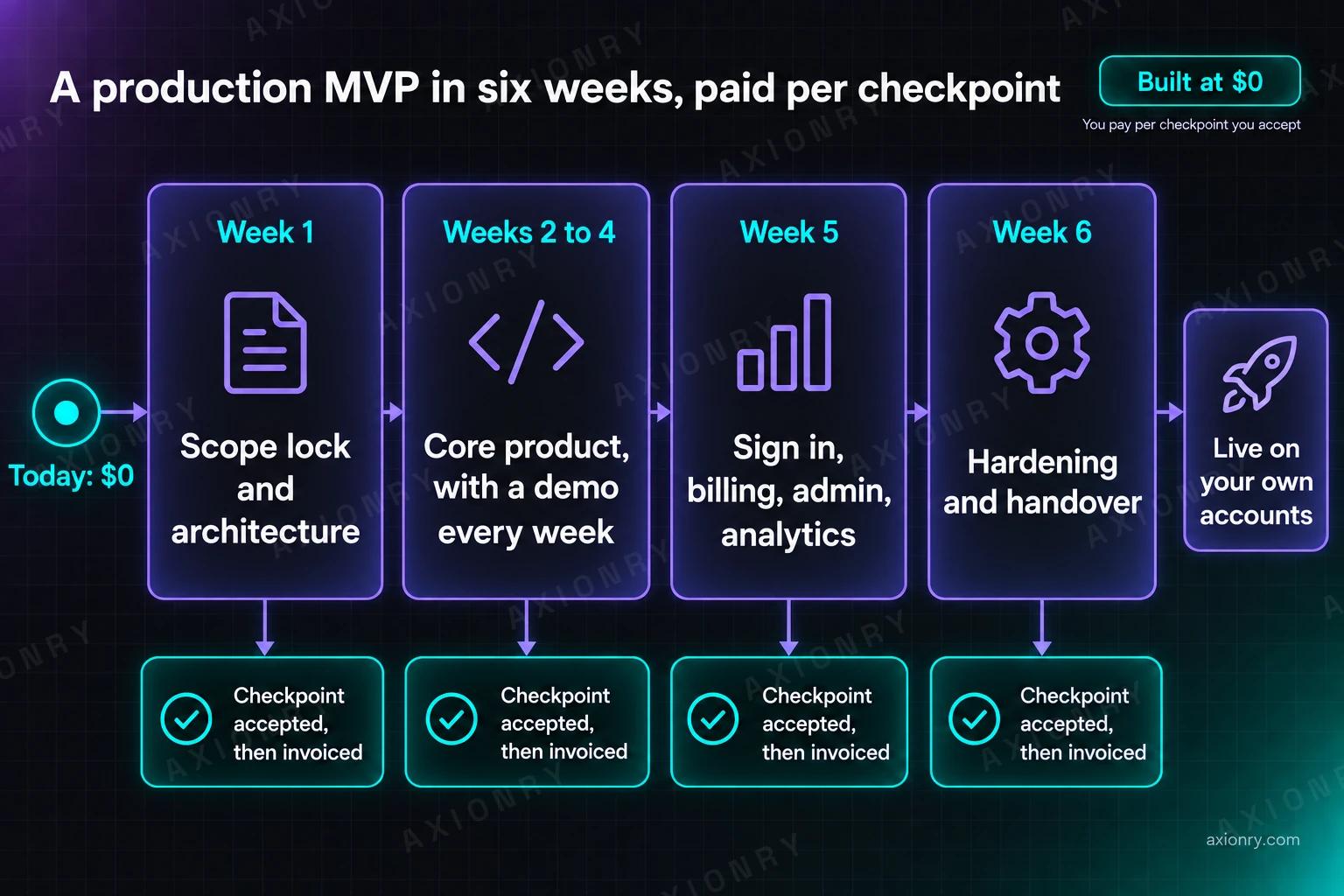
That is not a discount. It is when you pay. The work is split into checkpoints with acceptance criteria written down before anything starts, and each checkpoint is invoiced only after you have seen it and accepted it. No deposit.
- $0 to start
- You hold every dollar until a checkpoint is delivered and you accept it. No approval, no invoice.
- Fixed cost, unlimited features
- Or hire the team outright: one fixed monthly cost, unlimited feature development, any stack.
- The engineer takes your call
- The person on your first call is the one who architects and writes it. No account managers, no bench time.
A US agency quotes $50,000 to $150,000 for the same build and asks for 40 to 50% of it before a line is written. Account managers, project managers, sales commission and bench time. None of it appears in your product.
Three stages, nothing hidden.
Twenty-minute call
You talk to the engineer who will build it, not a sales rep. We scope the problem and you get told plainly if this is the wrong fit.
Fixed proposal in 48 hours
Fixed price, fixed timeline, defined deliverables, in writing. No hourly billing surprises and no open-ended scope.
Weekly demos until it ships
Working software every week, direct access over Slack or WhatsApp, and documentation handed over at the end.
What actually applies here.
Regulation and data
Banks follow the federal banking regulators' interagency guidance on third-party risk management, issued in 2023, which shapes the due diligence, contracts and monitoring they require of every technology vendor. Model risk management guidance means any AI used in a bank's decisions needs documented validation and oversight. North Carolina has no comprehensive consumer privacy law yet, so federal financial privacy rules and the state's breach notification law do most of the work.
Contracting and payment
You contract with an individual consultant based in India rather than a US entity. Invoices are issued in USD and paid by Wise or bank transfer, with no payroll and no benefits load on your side. Whatever documentation your finance team or counsel needs from an overseas contractor is provided before work starts.
Working hours
Four or more hours of daily overlap with Eastern time, calls in your morning, and same-day replies on working days.
Can you help us pass a bank's third-party risk review?
Yes. We build the controls they ask about, such as access logging, encryption and incident response, and help prepare the documentation. Formal certifications such as SOC 2 come from an auditor.
What does model risk management mean for an AI feature?
Documenting what the model is for, its limits, how it was tested and how it is monitored, with a person accountable for it. We build those records alongside the feature.
Is three days realistic?
For a working, demoable version of a core idea, yes, and that is what the three-day build is. A full production system with billing, admin and hardening takes weeks, not days. We will tell you which one your situation actually needs.
Do we own the code?
Entirely. It ships into your repository on your own cloud accounts, documented so your team or your next hire can pick it up without us.
Can you also host the AI model privately?
Yes, and as part of the same engagement. If compliance means inference cannot leave your network, the serving layer and the application are built together rather than handed between vendors.
MVP Development
A working MVP in as little as 3 days, from $1,000. Production-grade, not a throwaway prototype.