Request a callbackBook a call
healthcare ai development

Healthcare AI Development: models that never leave your infrastructure

Healthcare AI development has one constraint that decides the architecture before anything else: patient data usually cannot be sent to a third-party model API, because your own customers will not permit it. That single fact rules out the approach most AI products are built on. Axionry builds healthcare AI the other way round, with the model running inside infrastructure you control, a private path from your application to it, and a validation layer that rejects a malformed clinical answer rather than rendering it. A recent engagement was exactly this: a client processing patient medical reports who needed inference to stay entirely inside their own environment.

Proof point
Models that stay inside your own infrastructure
How you pay

Get it built at $0.

That is not a discount. It is when you pay. The work is split into checkpoints with acceptance criteria written down before anything starts, and each checkpoint is invoiced only after you have seen it and accepted it. No deposit.

$0 to start
You hold every dollar until a checkpoint is delivered and you accept it. No approval, no invoice.
Fixed cost, unlimited features
Or hire the team outright: one fixed monthly cost, unlimited feature development, any stack.
The engineer takes your call
The person on your first call is the one who architects and writes it. No account managers, no bench time.

A US agency quotes $50,000 to $150,000 for the same build and asks for 40 to 50% of it before a line is written. Account managers, project managers, sales commission and bench time. None of it appears in your product.

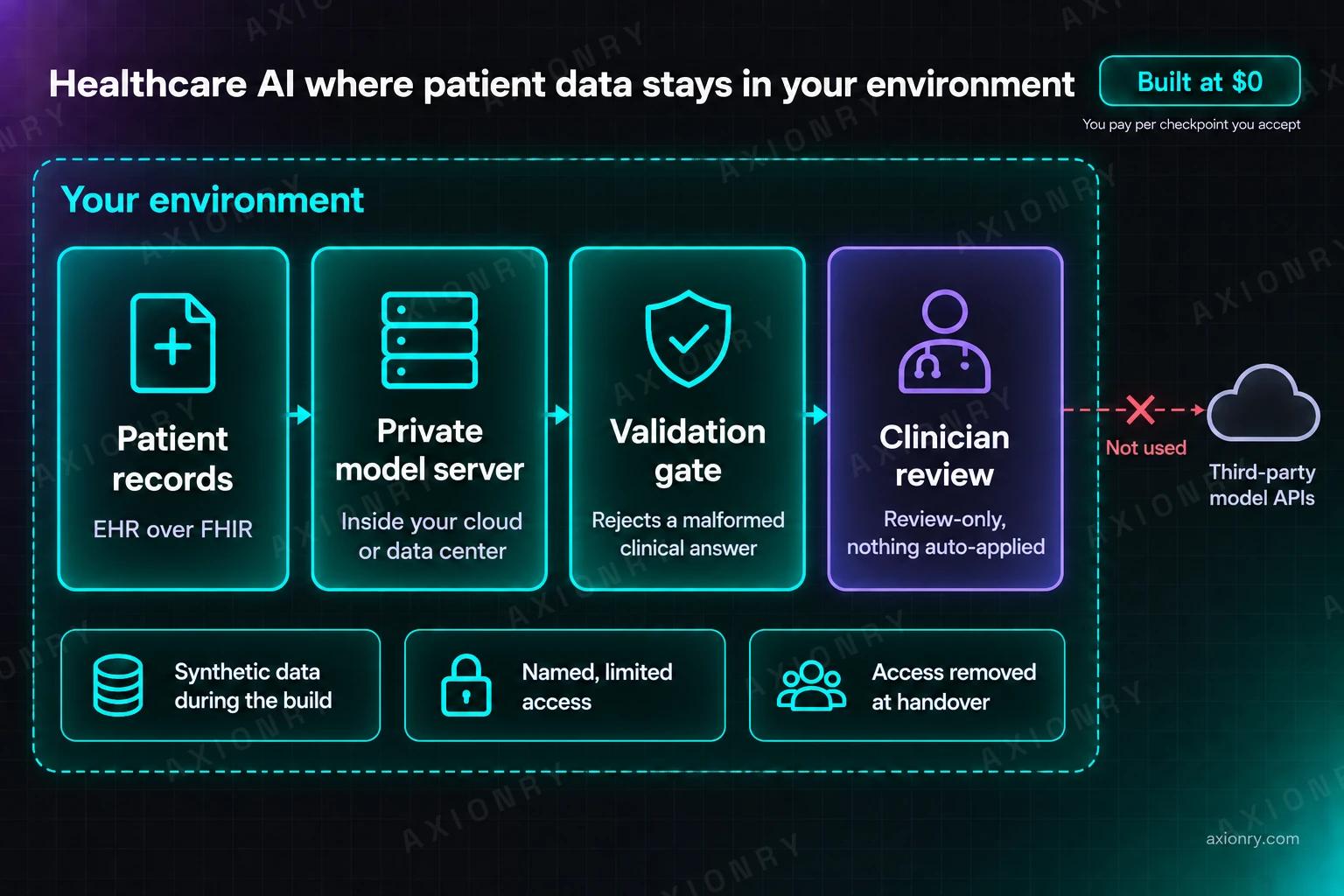
Architecture diagram of healthcare AI where patient data stays in your environment: patient records from the EHR over FHIR go to a private model server inside your cloud or data center, then to a validation gate that rejects a malformed clinical answer, then to clinician review that is review-only, with nothing applied automatically. Synthetic data is used during the build, access is named and limited and removed at handover, and third-party model APIs are not used.
Patient data never leaves your environment, and a clinician reviews every output.

Why can't healthcare products just use a hosted model API?

Occasionally they can. More often the blocker arrives from a customer rather than a regulator: a hospital, insurer or clinic writes data-handling terms into the contract that a shared model API cannot satisfy, and no amount of vendor documentation changes their answer. The deal stalls at security review with a product that works perfectly.

Once that happens, the question stops being about model quality and becomes an infrastructure question. Running inference on hardware or in a cloud account you control removes the objection rather than arguing with it.

What does a private healthcare AI deployment look like?

The shape is consistent: your application, a controlled backend gateway, a private encrypted path, the model running as a service inside your environment, a schema-validated response, and the result rendered back to a clinician or reviewer. Nothing in that path reaches a public endpoint, and the model service holds no credentials to write to your records.

That architecture is what a recent healthcare engagement used, for a client processing patient medical reports who needed the model to stay entirely inside their own infrastructure. The work is the serving layer, the private connectivity and the validation, rather than the model itself.

How do you stop the model producing a wrong clinical answer?

You do not rely on the model to police itself. A deterministic gate sits between the answer and your application: a fixed list of rules, each returning pass or fail, identical verdict for identical input. Values cited must be traceable to the source document. Required fields must be present. Anything outside an allowed list is rejected.

A failed rule is never quietly corrected. The response comes back marked as rejected with the failing rules named, so the interface shows a needs-review state and a human decides. Output is review-only by default, with no automatic write into a patient record.

What can AI usefully do in a healthcare product today?

Extraction and structuring of clinical documents, summarisation that cites its source line by line, retrieval across a body of internal guidance, coding and billing support with a reviewer in the loop, and intake or triage workflows where the model drafts and a person approves. All of it with a validation layer, and all of it review-only.

What we will tell you not to build is anything that acts autonomously on a patient record. The constraint is not technical caution; it is that review-only output is what gets through your customers' procurement, and an autonomous write is what stops it.

How an engagement runs

StageWhat happensTimeline
AssessmentYour data path, deployment options and validation requirements examined, with acceptance criteria written as testable statementsAbout one week
Private deploymentModel serving inside your environment, private connectivity, validation gate, tenant isolation, observability, infrastructure as codeAbout three weeks
Product buildThe clinical-facing application on top, built with the same review-only disciplineScoped on a call

Work runs on synthetic data throughout. Accounts stay yours, access is named and limited-privilege, and it is removed at handover with written confirmation.
FAQ

Common questions.

Straight answers. If yours isn't here, ask on a 20-minute call.

Have you built healthcare AI before?+

Yes. A recent engagement was for a client processing patient medical reports who needed the model to stay entirely inside their own infrastructure: application, controlled backend gateway, private encrypted transport, self-hosted model service, schema-validated response.

Can patient data stay entirely within our own environment?+

Yes, and that is the default design. The model runs on your hardware or in your own cloud account, the endpoint is never publicly reachable, and the service handling inference holds no write access to your records.

Will the AI write into patient records automatically?+

Not by default, and we would advise against it. Output is review-only, surfaced to a clinician or reviewer who decides. Anything that eventually writes goes through your existing application logic and its existing permission checks.

Our customer's security review is blocking us. Where do we start?+

With the assessment. It establishes what your current architecture actually guarantees versus what the review assumes, and produces the specific changes that turn each answer from aspirational into verifiable.

Ready to talk numbers?

Twenty minutes, straight to the engineer. No sales rep, no deck.