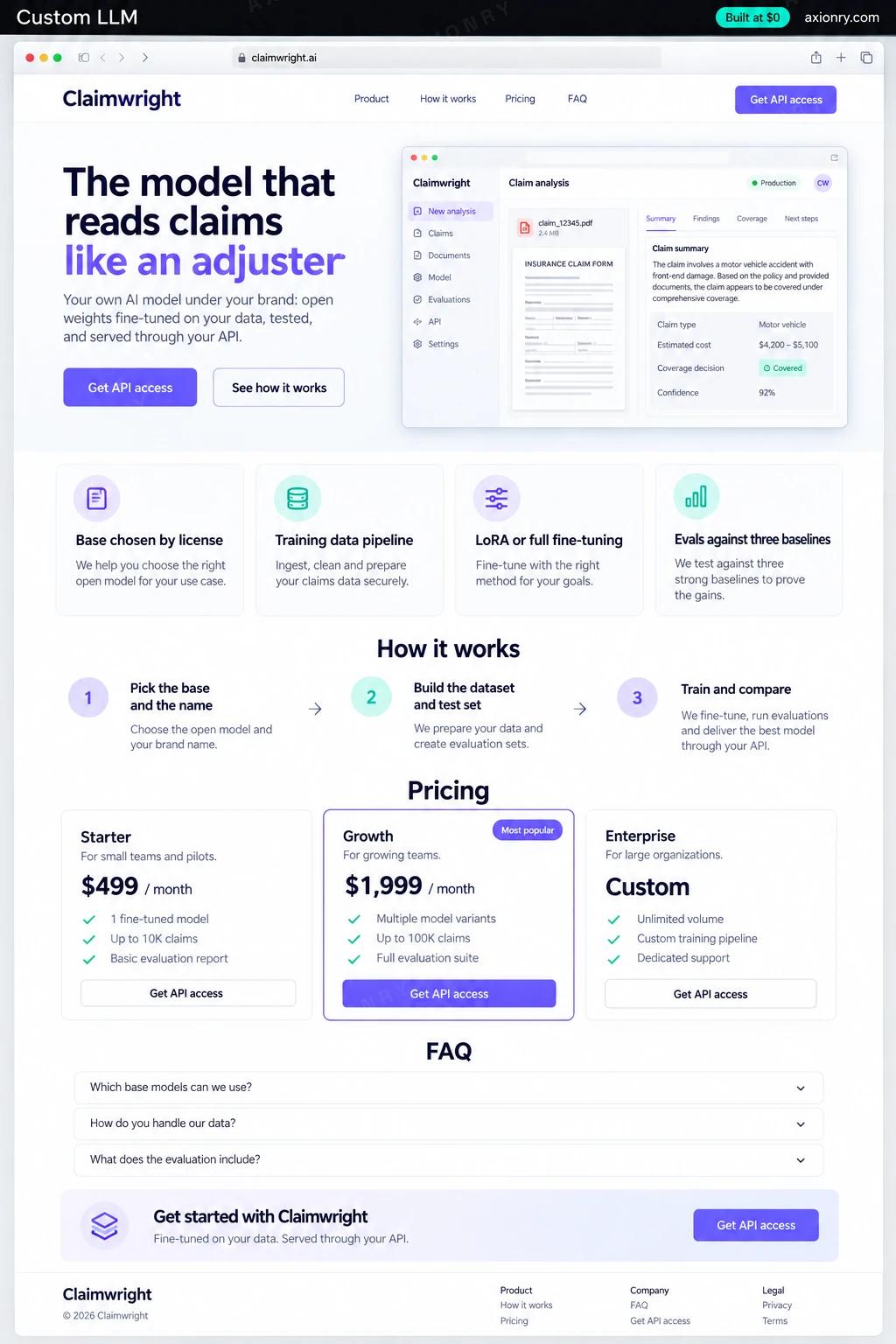
What is a custom LLM?
A custom LLM is a language model with your name on it, trained to do your domain's work better than a general model with a good prompt. In practice it is an open-weights base model, fine-tuned on your examples, evaluated against frontier APIs, and served on GPUs you control through an API you meter and sell.
It makes sense for companies that hold years of labeled domain work nobody else has, such as claims decisions, clinical notes, contract reviews or support resolutions, and want a model customers can buy by name, a lower cost per request at steady volume, or weights held in their own jurisdiction. Be clear about what it is: a fine-tune of an existing model. Training one from scratch runs from hundreds of thousands to millions of dollars in compute alone, and is almost never right for a product company.
You can use it inside your own product or sell API access to it. This page prices a first branded model: a LoRA or full fine-tune of an Apache 2.0 base such as Qwen3.8-27B, an evaluation suite against frontier baselines, a model card, and serving on one GPU behind a branded API with keys, metering and usage billing.
A model they call by your name through an API or your app, with published evals on their kind of work and a stable version they can pin.
Their judgment turned into training examples and a test set, and a model that follows your formats and terminology.
Weights you hold, a version history with the data behind each release, and per-customer usage you can bill.
What features does a custom LLM need?
A custom LLM needs 8 core features: base chosen by license, training data pipeline, LoRA or full fine-tuning, evals against three baselines, safety tests on every release, your name on every response, keys, metering and billing and model card and registry.
Base chosen by license
Apache 2.0 bases such as Qwen3.8-27B or gpt-oss-120b let you rename and sell a fine-tune, provided you keep the required notices.
Training data pipeline
Your examples deduplicated, stripped of personal data and traced to their source, then reviewed by your experts before training.
LoRA or full fine-tuning
Adapters for format, tone and task skill, a full fine-tune when evals show adapters fall short, and distillation where a teacher model's terms allow it.
Evals against three baselines
Each candidate is scored on a held-out test set against the untouched base, the base with a good prompt and retrieval, and a frontier API.
Safety tests on every release
A red-team set runs on each candidate, because fine-tuning can weaken safety behavior, and a guard model screens live traffic.
Your name on every response
vLLM serves the model under your model name, so your API returns acme-1 and never the base model's name.
Keys, metering and billing
Customers get API keys, rate limits and usage billed per million tokens, the unit they already buy from API providers.
Model card and registry
A public model card with the base, license, data summary, evals and limits, and a registry of what changed in each version.
What screens does a custom LLM have?
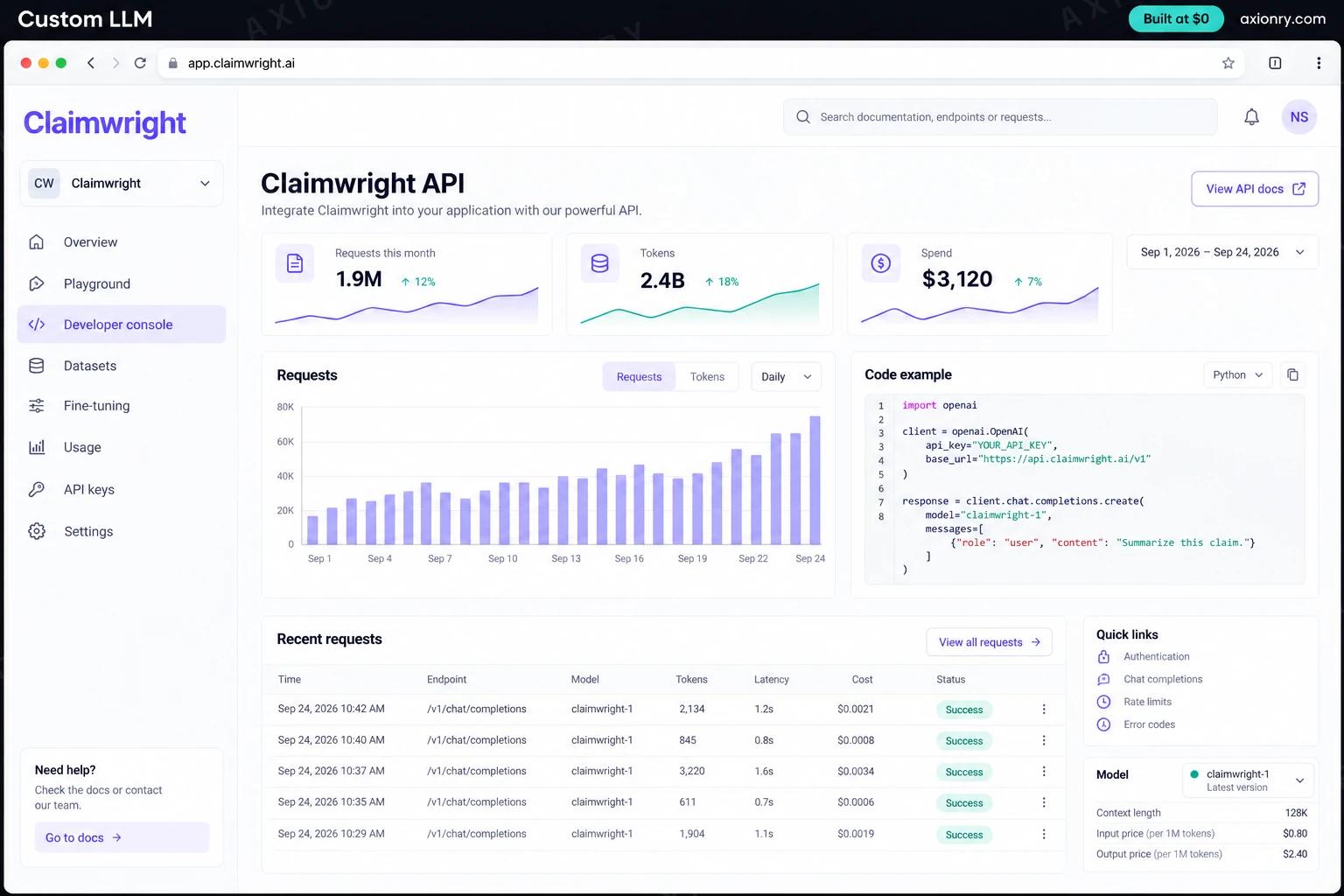
It is built around 3 screens: developer console, playground and eval report.
- 1Developer consoleA customer's requests, tokens and spend this month, with a code sample that calls the model by its brand name.
- 2PlaygroundThe branded model's answer to a claims question side by side with a frontier API's answer.
- 3Eval reportThe release candidate's score against the base model, the base with retrieval and a frontier API, with the release decision.
How does a custom LLM work?
End to end, in 5 steps: pick the base and the name, build the dataset and test set, train and compare, release the winner and serve and meter it.
- 1
Pick the base and the name
Shortlist Apache 2.0 or MIT base models that fit your GPUs, and confirm the name you want is one the license and trademark rules allow.
- 2
Build the dataset and test set
Your experts' past work becomes a few thousand reviewed training examples, plus a separate held-out test set the model never trains on.
- 3
Train and compare
A LoRA run on one GPU takes hours, so many variants get tried. Each is scored against the base, the base with retrieval and a frontier API, plus a safety suite.
- 4
Release the winner
The candidate that clears every threshold is registered with hashes of its data and base, and its model card is published with the evals and license notices.
- 5
Serve and meter it
vLLM serves it under your model name behind an API gateway with keys, rate limits, a guard model and per-customer metering into billing.
What is the architecture and tech stack of a custom LLM?
It has 8 layers: base model (Qwen3.8-27B (Apache 2.0), or gpt-oss-120b for reasoning-heavy work), fine-tuning (Axolotl, TRL or Unsloth; one 80GB GPU for LoRA, an 8-GPU node for full fine-tunes), data (Postgres and S3, with a review tool for your experts), evals (Your golden set, EleutherAI lm-evaluation-harness, a model judge checked against human grades), serving (vLLM with a served model name and LoRA adapters), API and billing (API gateway with keys and rate limits, Stripe metered billing), safety (gpt-oss-safeguard-20b as a guard model, plus a red-team suite) and GPUs (AWS, Azure or Google Cloud GPUs in your own account). The diagram shows how a request moves through them.
| Layer | What we use | Why |
|---|---|---|
| Base model | Qwen3.8-27B (Apache 2.0), or gpt-oss-120b for reasoning-heavy work | Permissive licenses let you rename and sell the fine-tune; Llama's license, by contrast, requires the name to begin with Llama. |
| Fine-tuning | Axolotl, TRL or Unsloth; one 80GB GPU for LoRA, an 8-GPU node for full fine-tunes | Public, well-tested recipes, so the budget goes into data and evals rather than training code. |
| Data | Postgres and S3, with a review tool for your experts | Every example is traceable to its source and reviewer, which a customer's security review will ask about. |
| Evals | Your golden set, EleutherAI lm-evaluation-harness, a model judge checked against human grades | Proves the model beats a well-prompted base without losing general ability or safety. |
| Serving | vLLM with a served model name and LoRA adapters | Customers see your model name, and one base can host several adapters for different products. |
| API and billing | API gateway with keys and rate limits, Stripe metered billing | Priced per million tokens, with usage tracked per customer. |
| Safety | gpt-oss-safeguard-20b as a guard model, plus a red-team suite | Screens live traffic and tests each release, since fine-tuning can erode safety behavior. |
| GPUs | AWS, Azure or Google Cloud GPUs in your own account | Weights and customer traffic stay in infrastructure and a jurisdiction you choose. |
How much does it cost to build a custom LLM?
A launch-ready custom LLM costs $33,500 to $69,000 to build and takes 9 to 15 weeks. A clickable demo costs $3,700 to $7,500 (2 to 5 weeks), and running it costs $1,200 to $1,750 a month at the usage below. You start at $0 and pay per checkpoint you accept.
Priced with the same model as our AI product cost estimator, from the features above. Your price is fixed in writing after a 20-minute call, before any work starts.
| Version | Build cost | Timeline | What it is |
|---|---|---|---|
| Clickable demo | $3,700 to $7,500 | 2 to 5 weeks | Clickable and real where it matters, on test data. Built to show users and investors, not to carry production traffic, so compliance work starts at launch. |
| Launch-ready | $33,500 to $69,000 | 9 to 15 weeks | Production architecture, tests on the risky paths, monitoring, and a handover your team can run. |
| Enterprise-grade | $40,500 to $83,000 | 10 to 17 weeks | Load tested, highly available, audited and documented for a larger team. |
What it costs to run
Serving for about 250 API customers from a single 80GB GPU billed every hour of the month at GPU-cloud prices, plus hosting; hyperscaler GPUs cost more.
| Line | Per month | Assumes |
|---|---|---|
| Hosting and database | $60 to $250 | AWS, sized for 250 monthly users |
| GPUs for your model | $1,150 to $1,350 | 1 x A100 80GB, running around the clock |
| Email, monitoring, analytics | $0 to $150 | Free tiers cover most products at launch |
| Total | $1,200 to $1,750 | List prices, before any volume discount |
Build at $0: how you pay
$0 is when you pay, not what you pay. The launch-ready build is split into checkpoints with acceptance criteria agreed before work starts, and each one is invoiced only after you have seen it and accepted it.
- 1Scope and acceptance criteriaBefore work startsA call, then a written plan: every checkpoint with acceptance criteria you agree to before work starts.$0
- 2AssessmentBy week 3Your data, stack and hardware examined end to end. A fixed fee, credited in full against the build.$6,500 to $14,000
- 3Core productBy week 8The main flows on production architecture, with a demo at the end of every week.$10,000 to $20,500
- 4AI on your real dataBy week 12Models, agents or voice working on real inputs, with evals and guardrails in place.$10,000 to $20,500
- 5Launch and handoverBy week 15Deployed on your accounts and documented, with 30 days of defect correction included.$6,500 to $14,000
What can you add to a custom LLM after launch?
The additions most teams make next: a distilled small model, continued pre-training, high-availability serving and a chat app on your model.
A distilled small model
Train a smaller student model on your large model's answers for lower latency and a cheaper serving bill.
Continued pre-training
When the base lacks your field's vocabulary and you hold billions of words of domain text, extend its training before fine-tuning.
High-availability serving
Two GPUs across zones behind a load balancer, so the API stays up through restarts and upgrades.
A chat app on your model
A branded assistant for end users on top of the same API, with sign-in and history.
What are the risks when building a custom LLM?
Three things decide whether it works in production: the license decides the name, claims you can defend and it must beat the cheap option.
The license decides the name
Apache 2.0 and MIT bases allow renaming with notices, Llama requires the name to begin with Llama, and some newer licenses restrict selling hosted API access. Read the license file of the exact checkpoint before you choose a name.
Claims you can defend
Say 'fine-tuned from Qwen3.8-27B', never 'trained from scratch' or 'our own foundation model'. Overstated AI claims have drawn SEC and FTC action, and a buyer's technical due diligence will find the base model anyway.
It must beat the cheap option
If a frontier API with a good prompt and retrieval matches your fine-tune on the test set, the branded model is an expensive way to ship the same answers. Set the release bar before training, and re-run it when a new base appears.