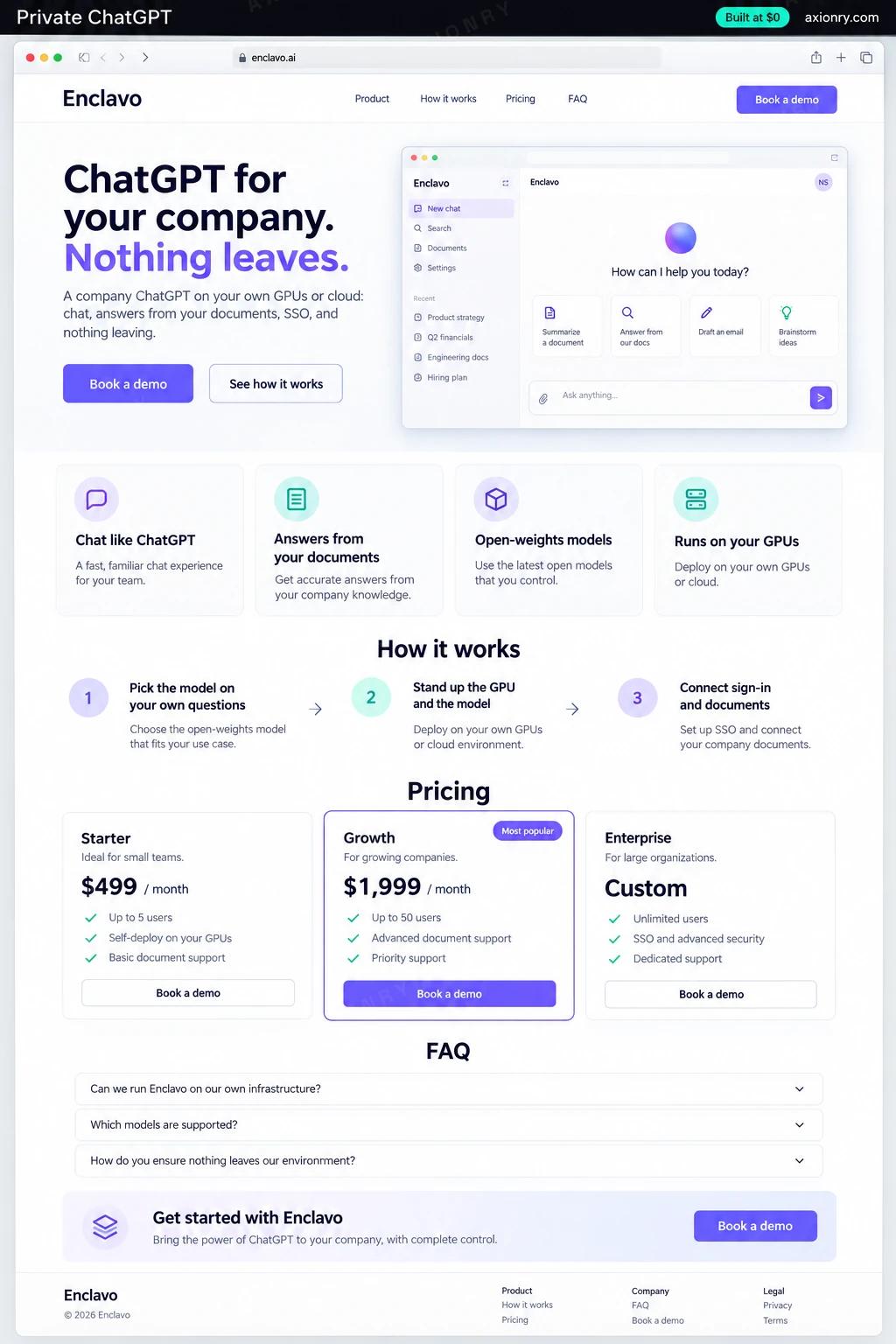
What is a private ChatGPT?
A private ChatGPT is an assistant that works like ChatGPT but runs an open-weights model on GPUs you control. Staff sign in with company SSO, draft, summarize and ask questions, get answers from internal documents with sources, and every prompt and reply stays inside your network, recorded in your own audit log.
It is for organizations that cannot send client or patient data to an outside model provider: law firms, healthcare, financial services, the public sector, and any company whose contracts forbid it. It is also how a ban on pasting client data into public chatbots actually holds, because staff get an approved tool good enough to use. On price alone, per-seat plans from OpenAI and Anthropic stay cheaper for smaller teams, so self-hosting is a data decision first.
You can deploy it for your own staff, or as a product for clients who need a private assistant, such as a platform for law firms. This page prices one company's deployment: an open-weights model on one 80GB GPU in your cloud account, chat with history, answers from Google Drive and SharePoint, SSO, admin and an audit log. A naming note: ChatGPT is OpenAI's product, and here the phrase means the same experience on a model you host.
A capable assistant for drafting, summarizing and questions about internal documents, which they are allowed to use with client data.
SSO and groups, per-group access to models and document collections, an audit log you retain, and no outside model provider in the data path.
A written answer to 'where does our data go', a model version nobody can change under you, and usage by team.
What features does a private ChatGPT need?
A private ChatGPT needs 8 core features: chat like ChatGPT, answers from your documents, open-weights models, runs on your GPUs, company sign-in, audit log you own, guardrails on every message and usage and admin.
Chat like ChatGPT
Conversations with history, file uploads, drafting and summarizing, in a familiar interface carrying your branding.
Answers from your documents
Connect Google Drive and SharePoint, and answers quote and link their sources, limited to what each person can open.
Open-weights models
gpt-oss-120b or Qwen3.8-27B, both Apache 2.0, chosen by testing them on your own questions before anything is built around them.
Runs on your GPUs
Served with vLLM or SGLang in your AWS, Azure or Google Cloud account, or on hardware in your own data center.
Company sign-in
SSO through Okta, Microsoft Entra ID or Google, with groups deciding who can use which models and document collections.
Audit log you own
Every prompt, answer, document used and model version is recorded, kept for a period your legal team sets.
Guardrails on every message
A small safety model screens prompts and replies against a policy you write, and blocks or flags what breaks it.
Usage and admin
Usage by team, per-user rate limits, model versions and document collections, managed from one admin screen.
What screens does a private ChatGPT have?
It is built around 3 screens: chat, access admin and audit log.
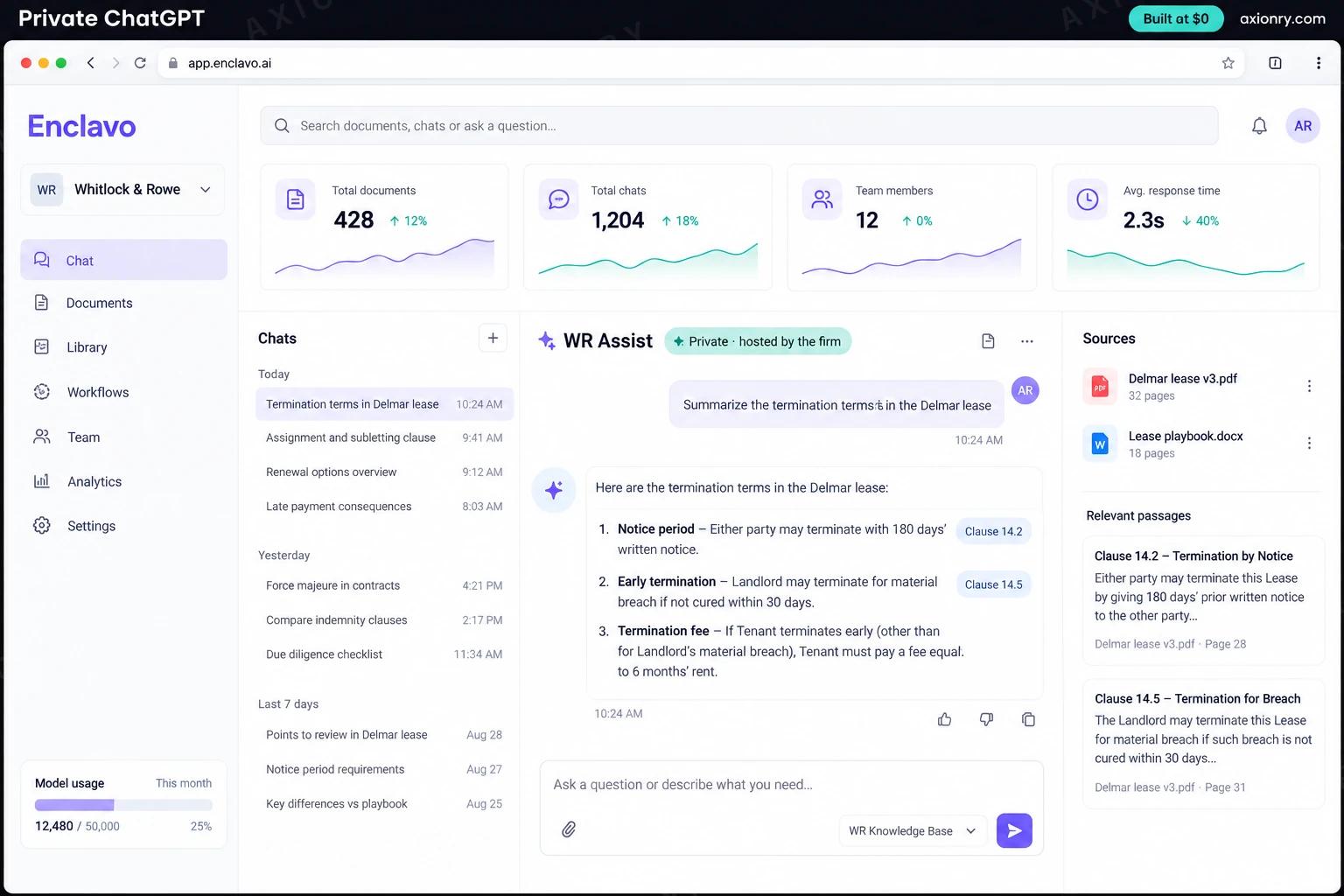
- 1ChatA lawyer asks for the termination terms in a lease and gets three points citing two clauses, with a badge showing the firm hosts the model.
- 2Access adminGroups from SSO with their user counts, the model each group uses, and the document collections they can search.
- 3Audit logRecent prompts with the user's initials, the time and the number of documents used.
How does a private ChatGPT work?
End to end, in 5 steps: pick the model on your own questions, stand up the GPU and the model, connect sign-in and documents, staff chat inside your network and everything is logged and reviewed.
- 1
Pick the model on your own questions
About 200 of your real questions run through candidate open-weights models and a frontier API baseline, so you see the quality gap before choosing.
- 2
Stand up the GPU and the model
The model is served with vLLM in your cloud account or data center, sized for your peak users, behind a gateway with per-user keys and limits.
- 3
Connect sign-in and documents
SSO brings in users and groups. Drive and SharePoint documents sync with their access lists, so answers draw only on what each person can open.
- 4
Staff chat inside your network
Prompts go from the chat app through the gateway and the safety model to your GPU and back. Nothing crosses your network boundary except sign-ins.
- 5
Everything is logged and reviewed
Each prompt, answer, source and model version lands in the audit store. Usage, blocked prompts and answer ratings show what to fix and when to add capacity.
What is the architecture and tech stack of a private ChatGPT?
It has 8 layers: model (gpt-oss-120b or Qwen3.8-27B (Apache 2.0)), serving (vLLM, or SGLang where it measures faster on your hardware), GPUs (One 80GB GPU in your AWS, Azure or Google Cloud account, or your own server), chat interface (LibreChat (MIT license) or a custom Next.js app), gateway and audit (LiteLLM proxy, append-only audit table in Postgres), documents (Qwen3-Embedding-8B, Postgres with pgvector, Drive and SharePoint connectors), guardrails (gpt-oss-safeguard-20b) and identity and infrastructure (Okta or Entra ID over SAML, Terraform, Grafana). The diagram shows how a request moves through them.
| Layer | What we use | Why |
|---|---|---|
| Model | gpt-oss-120b or Qwen3.8-27B (Apache 2.0) | Both fit one 80GB GPU and allow commercial use; the choice is made on your own test questions. |
| Serving | vLLM, or SGLang where it measures faster on your hardware | An OpenAI-compatible API with continuous batching, so many people share one GPU efficiently. |
| GPUs | One 80GB GPU in your AWS, Azure or Google Cloud account, or your own server | Sized to your peak users, with a second GPU added for capacity and failover. |
| Chat interface | LibreChat (MIT license) or a custom Next.js app | LibreChat brings SSO, history and file uploads under a license that lets you brand it; custom suits a tailored experience. |
| Gateway and audit | LiteLLM proxy, append-only audit table in Postgres | Per-user keys, rate limits and a record of every prompt, answer and model version. |
| Documents | Qwen3-Embedding-8B, Postgres with pgvector, Drive and SharePoint connectors | Embeddings run on your hardware too, and every search is filtered by the asker's access inside the query. |
| Guardrails | gpt-oss-safeguard-20b | A small open model that checks prompts and replies against a policy you write. |
| Identity and infrastructure | Okta or Entra ID over SAML, Terraform, Grafana | Sign-in and groups from your identity provider, and a deployment that is reproducible and monitored. |
How much does it cost to build a private ChatGPT?
A launch-ready private ChatGPT costs $35,500 to $72,500 to build and takes 9 to 16 weeks. A clickable demo costs $3,900 to $8,000 (2 to 5 weeks), and running it costs $1,200 to $1,750 a month at the usage below. You start at $0 and pay per checkpoint you accept.
Priced with the same model as our AI product cost estimator, from the features above. Your price is fixed in writing after a 20-minute call, before any work starts.
| Version | Build cost | Timeline | What it is |
|---|---|---|---|
| Clickable demo | $3,900 to $8,000 | 2 to 5 weeks | Clickable and real where it matters, on test data. Built to show users and investors, not to carry production traffic, so compliance work starts at launch. |
| Launch-ready | $35,500 to $72,500 | 9 to 16 weeks | Production architecture, tests on the risky paths, monitoring, and a handover your team can run. |
| Enterprise-grade | $42,500 to $87,000 | 10 to 18 weeks | Load tested, highly available, audited and documented for a larger team. |
What it costs to run
About 250 employees on one 80GB GPU running around the clock at GPU-cloud rates, plus hosting; the same GPU in AWS, Azure or Google Cloud costs more per hour.
| Line | Per month | Assumes |
|---|---|---|
| Hosting and database | $60 to $250 | AWS, sized for 250 monthly users |
| GPUs for your model | $1,150 to $1,350 | 1 x A100 80GB, running around the clock |
| Email, monitoring, analytics | $0 to $150 | Free tiers cover most products at launch |
| Total | $1,200 to $1,750 | List prices, before any volume discount |
Build at $0: how you pay
$0 is when you pay, not what you pay. The launch-ready build is split into checkpoints with acceptance criteria agreed before work starts, and each one is invoiced only after you have seen it and accepted it.
- 1Scope and acceptance criteriaBefore work startsA call, then a written plan: every checkpoint with acceptance criteria you agree to before work starts.$0
- 2AssessmentBy week 3Your data, stack and hardware examined end to end. A fixed fee, credited in full against the build.$7,000 to $14,500
- 3Core productBy week 8The main flows on production architecture, with a demo at the end of every week.$10,500 to $22,000
- 4AI on your real dataBy week 13Models, agents or voice working on real inputs, with evals and guardrails in place.$10,500 to $22,000
- 5Launch and handoverBy week 16Deployed on your accounts and documented, with 30 days of defect correction included.$7,000 to $14,500
What can you add to a private ChatGPT after launch?
The additions most teams make next: a second GPU for failover, agents and tools, hybrid routing and a fine-tuned house model.
A second GPU for failover
Two GPUs across availability zones keep chat up when one restarts, and roughly double the users you can serve at once.
Agents and tools
Let the assistant search your CRM or file tickets through approved tools, still on the private model.
Hybrid routing
Send work that touches client data to the private model and everything else to a frontier API, under rules you set.
A fine-tuned house model
Adapt the open model to your firm's formats and vocabulary with LoRA fine-tuning, once evals show prompting has reached its limit.
What are the risks when building a private ChatGPT?
Three things decide whether it works in production: the quality gap is real, licenses and data rules and someone must run it.
The quality gap is real
Open-weights models trail the best closed models on hard reasoning. Test candidates on a few hundred of your real questions against a frontier baseline, and send work that needs frontier quality elsewhere where the rules allow.
Licenses and data rules
Use models whose licenses permit your use, such as Apache 2.0 or MIT, keep the license files, and map the deployment to HIPAA, GDPR or client contracts, including where logs are stored and for how long.
Someone must run it
A private model is a service with GPUs, upgrades and an on-call rota. New open models arrive every few months, so budget for re-testing, engine upgrades and capacity planning, not only the launch.