Fractional CTO Services in St. Louis
CTO-level leadership for St. Louis teams, without the $167k salary.
You have engineers, or contractors, or an agency, and no one whose job is to decide whether the architecture, the spend and the hiring plan are right.
St. Louis has strengths in agriculture technology and plant science, health care, financial services and geospatial intelligence, with the National Geospatial-Intelligence Agency's western headquarters anchoring a growing geospatial cluster. Its startup scene is supported by research institutions and a low cost base.
Research-led and agricultural companies here often need someone to own software architecture and hiring part time.
What you get
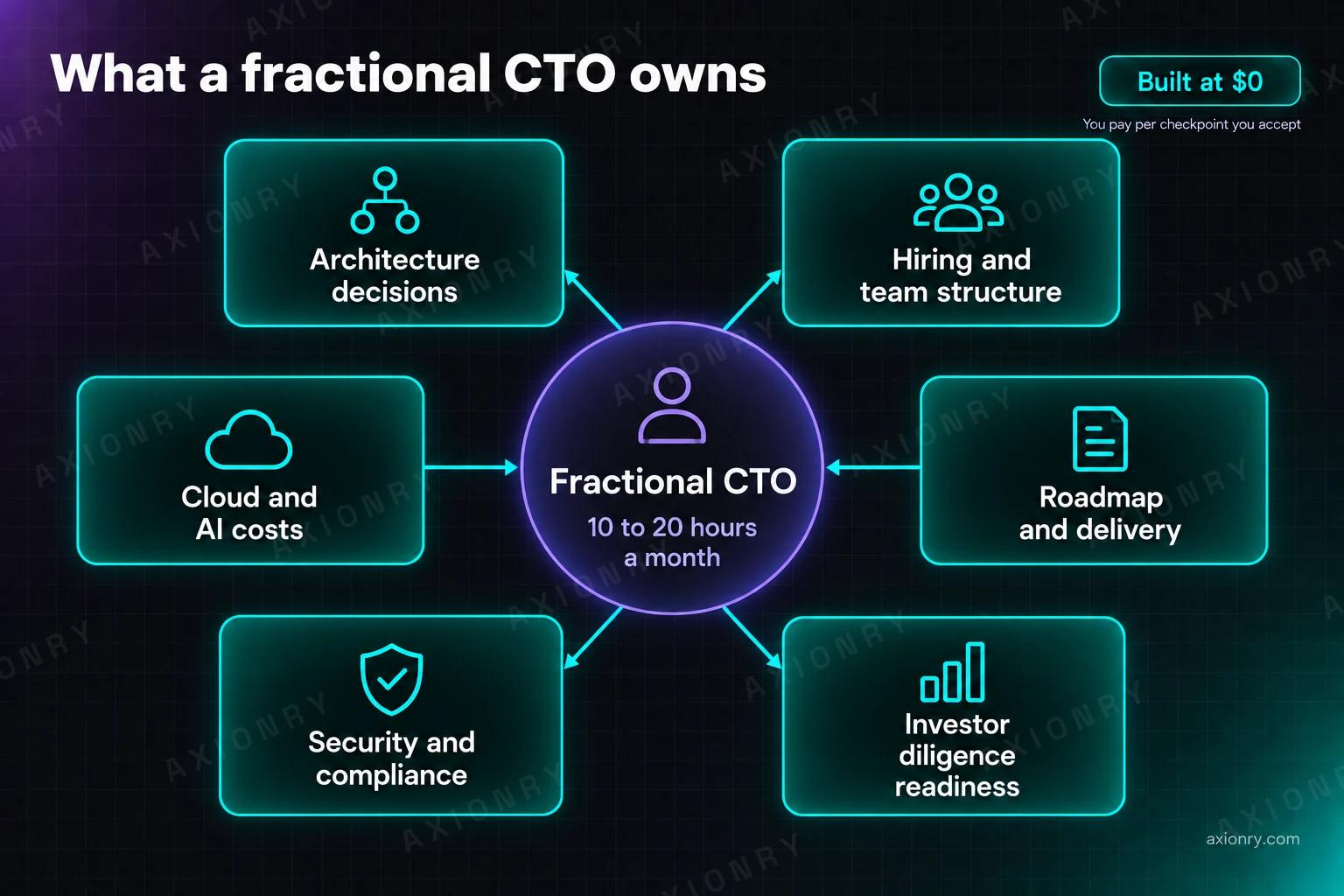
- Architecture decisions made and written down, with the trade-offs stated rather than assumed
- Infrastructure and AI spend reviewed against what you actually use, not what you provisioned
- Hiring: what roles you need next, what to test for, and which hires to delay
Scoped to the hours you actually need. Month to month, with no long lock-in, because a fractional CTO you cannot leave is just an expensive employee.
Invoiced in USD, payable by Wise or bank transfer.
Request a callback
You speak to the engineer who does the work. No sales rep, no deck.
St. Louis, in numbers
A full-time head of technology in the St. Louis area earns a median $167,130 a year (about $238,757 with benefits and payroll costs). A fractional CTO gives a St. Louis business that experience for a few days a month, with the same ownership of architecture, vendors, security and hiring.
Who builds here
AI Product & MVP Development
St. Louis founders in agtech, health and geospatial usually have deep domain expertise and need a production product built around it.

What St. Louis companies build with us
Get it built at $0.
That is not a discount. It is when you pay. The work is split into checkpoints with acceptance criteria written down before anything starts, and each checkpoint is invoiced only after you have seen it and accepted it. No deposit.
- $0 to start
- You hold every dollar until a checkpoint is delivered and you accept it. No approval, no invoice.
- Fixed cost, unlimited features
- Or hire the team outright: one fixed monthly cost, unlimited feature development, any stack.
- The engineer takes your call
- The person on your first call is the one who architects and writes it. No account managers, no bench time.
A US agency quotes $50,000 to $150,000 for the same build and asks for 40 to 50% of it before a line is written. Account managers, project managers, sales commission and bench time. None of it appears in your product.
What actually applies here.
Working hours
Three or more hours of daily overlap with Central time, calls in your morning, and same-day replies on working days.
What does a full-time CTO cost in St. Louis?
Computer and information systems managers in the St. Louis area earn a median $167,130 a year (about $238,757 with benefits and payroll costs), before recruiting fees and equity. A fractional CTO is paid per accepted checkpoint, with nothing upfront.
Do you work with agtech companies?
Yes. Field data platforms, grower-facing apps and analytics over agronomic data are common starting points.
Can you work on geospatial projects for government?
Only on commercial or unclassified work. We do not hold a security clearance.
Fractional CTO
Senior technical leadership, 10-20 hrs/month: architecture, AI strategy, cost control.