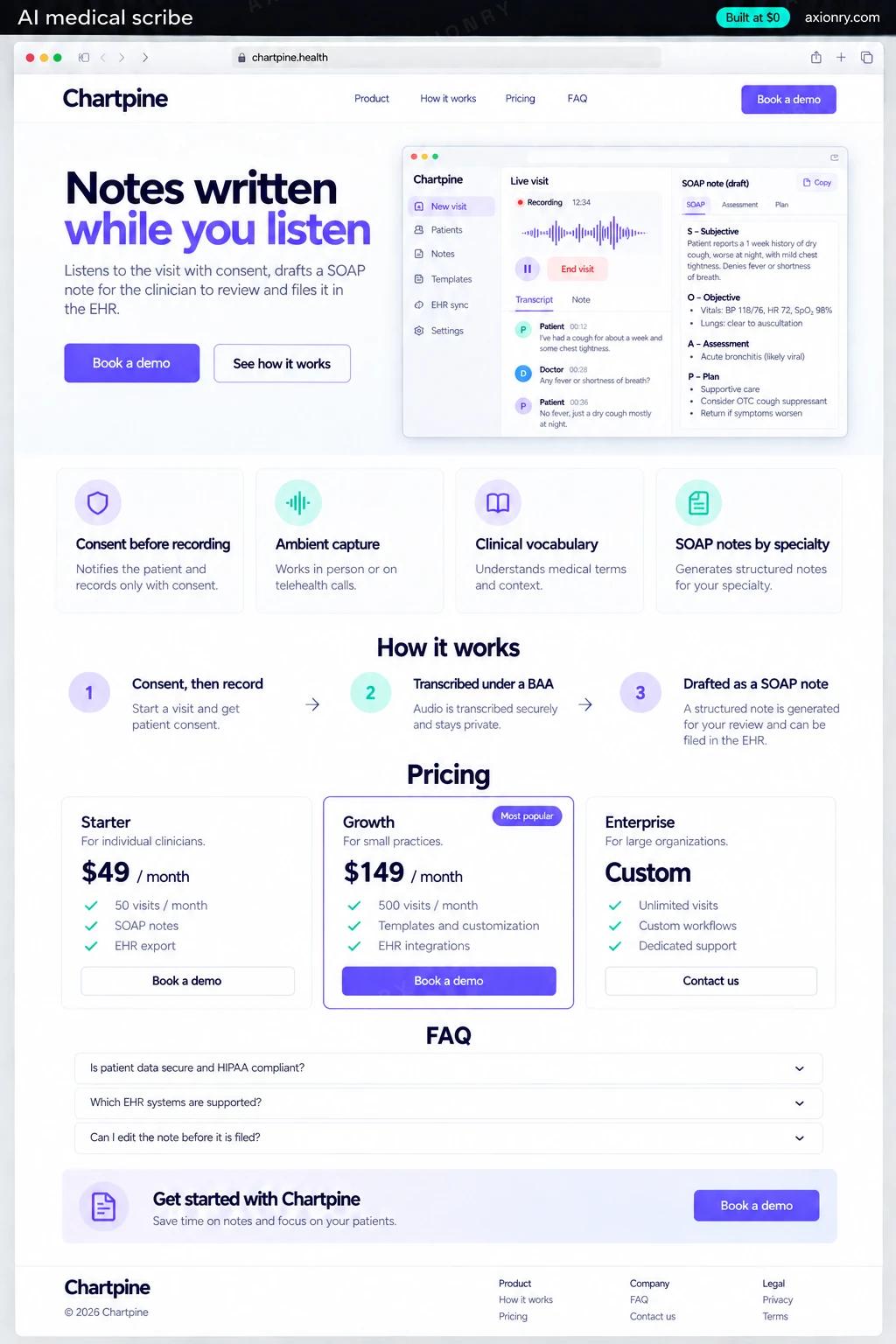
What is an AI medical scribe?
An AI medical scribe is software that listens to a patient visit, with the patient's consent, and drafts the clinical note so the clinician does not have to type it. It turns the conversation into a structured SOAP note, the clinician reviews and signs it, and the signed note is filed in the EHR over FHIR.
It is for primary care and specialty practices, urgent care, telehealth providers and health systems whose clinicians finish notes after hours. The value is clinician time and attention: eyes on the patient instead of the keyboard, and a note ready to sign minutes after the visit. It only works if clinicians trust the draft, which is why every sentence should trace back to what was said.
Practices and health systems build it for their own clinicians; health tech founders build it as a product for many practices. The price on this page is for one organization's production scribe: HIPAA safeguards, BAAs with every vendor that touches PHI, specialty templates, clinician review and write-back to Epic or Oracle Health over FHIR. Selling it to many practices adds tenant isolation and more EHR integrations.
Is asked before anything is recorded, gets the clinician's full attention, and can say no without it affecting their care.
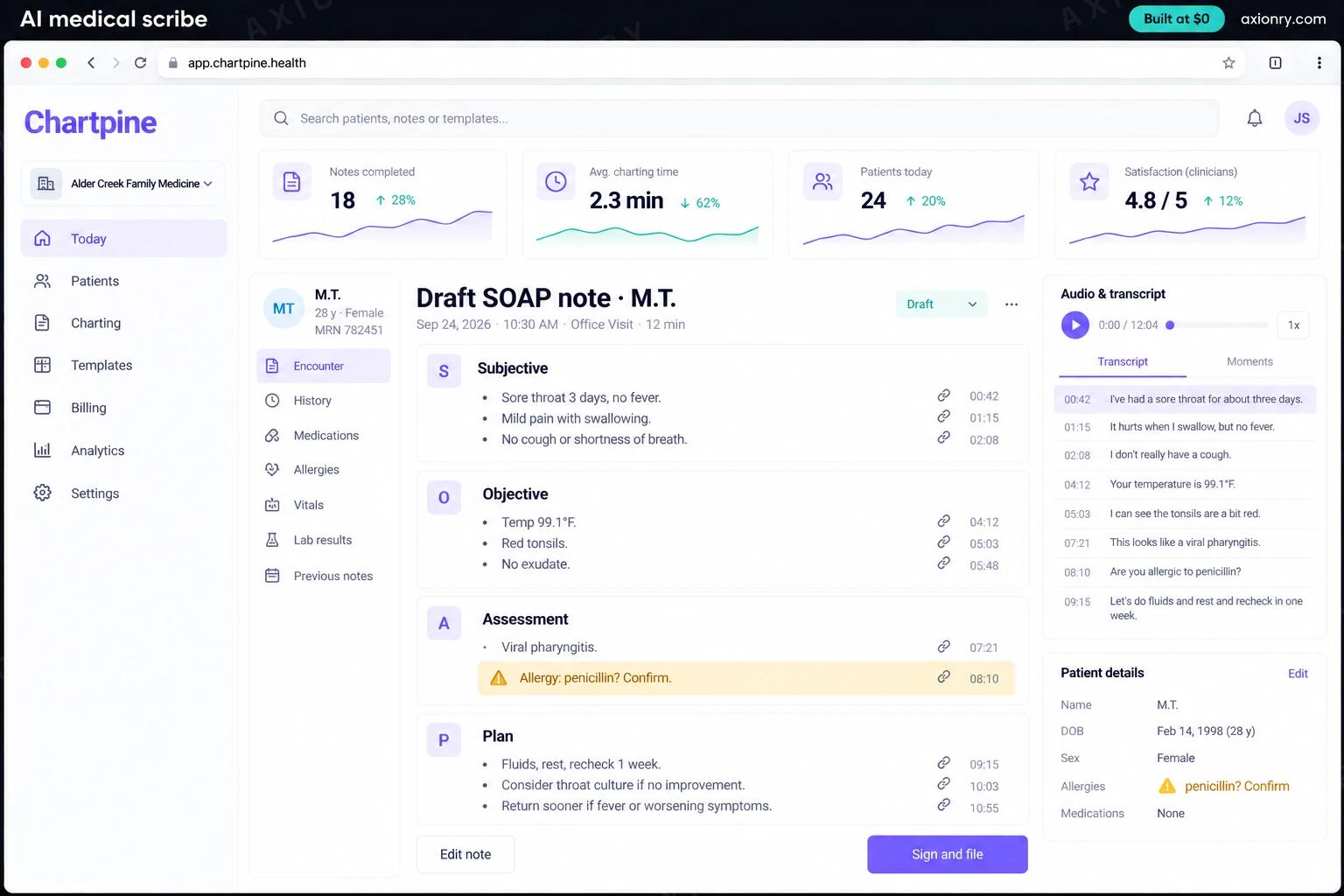
Reviews a draft SOAP note after the visit, where every statement jumps to the part of the recording it came from, then edits and signs in a few clicks.
Sets consent wording, retention and access rules, sees who opened which note, and holds a BAA for every vendor that touches PHI.
What features does an AI medical scribe need?
An AI medical scribe needs 8 core features: consent before recording, ambient capture, clinical vocabulary, SOAP notes by specialty, every line traceable, clinician signs, always, files to the EHR and HIPAA by design.
Consent before recording
The clinician confirms the patient's consent on screen before audio starts, and the consent is stored with the encounter.
Ambient capture
Records the visit on a phone, tablet or exam-room laptop, in person or on a telehealth call, without the clinician driving the software.
Clinical vocabulary
Transcription tuned for drug names, doses and anatomy, with keyterms from your formulary and specialty.
SOAP notes by specialty
Subjective, objective, assessment and plan in your templates, with sections for specialties such as orthopedics or behavioral health.
Every line traceable
Each statement links to the transcript moment behind it, and a section nobody discussed is marked as such, not filled in.
Clinician signs, always
Nothing reaches the chart without review and signature, and the clinician's edits are tracked to improve future drafts.
Files to the EHR
The signed note is written to Epic or Oracle Health over FHIR, against the right patient and encounter.
HIPAA by design
Encryption, role-based access, access logs, retention rules and BAAs with the cloud, speech and model vendors.
What screens does an AI medical scribe have?
It is built around 3 screens: visit recording, draft SOAP note and signed and filed.
- 1Visit recordingThe exam-room tablet: consent confirmed, the visit timer running, and pause and stop controls.
- 2Draft SOAP noteThe note for review, each line linked to its transcript moment, with an allergy line flagged for the clinician to confirm.
- 3Signed and filedConfirmation that the clinician signed the note and it was written to the patient's chart in the EHR.
How does an AI medical scribe work?
End to end, in 5 steps: consent, then record, transcribed under a BAA, drafted as a SOAP note, reviewed and signed and filed and cleaned up.
- 1
Consent, then record
The clinician opens the encounter, confirms the patient's consent and starts recording on the device in the room or on the telehealth call.
- 2
Transcribed under a BAA
Audio goes to a medical speech-to-text service covered by a BAA, with speaker labels that separate clinician and patient.
- 3
Drafted as a SOAP note
A model covered by the same safeguards drafts the note in your template, linking every statement to the transcript and marking what was not discussed.
- 4
Reviewed and signed
The clinician checks the flagged lines, edits what needs editing and signs; an unsigned draft never leaves the scribe.
- 5
Filed and cleaned up
The signed note is written to the patient's chart over FHIR, and audio is deleted on your retention schedule.
What is the architecture and tech stack of an AI medical scribe?
It has 8 layers: capture (Next.js web app with browser recording, on AWS), speech to text (Deepgram Nova-3 Medical or Amazon Transcribe Medical), note model (Claude Sonnet 5 through Amazon Bedrock), source check (Deterministic matching plus a Claude Haiku 4.5 second read), EHR integration (FHIR R4 DocumentReference with a SMART on FHIR launch, for Epic and Oracle Health), PHI storage (AWS with KMS encryption, S3 for audio, Postgres for notes), access and audit (Team roles and an audit log of every view and edit) and evaluation (A test set of consented, de-identified visits scored by clinicians). The diagram shows how a request moves through them.
| Layer | What we use | Why |
|---|---|---|
| Capture | Next.js web app with browser recording, on AWS | Runs on the phones, tablets and laptops clinics already have; a native app can follow if clinicians need offline capture. |
| Speech to text | Deepgram Nova-3 Medical or Amazon Transcribe Medical | Both target clinical vocabulary; confirm each vendor's BAA terms and test both on your own clinicians' recordings before choosing. |
| Note model | Claude Sonnet 5 through Amazon Bedrock | Runs under your AWS BAA, and the prompt carries your templates and the rule to mark anything not discussed. |
| Source check | Deterministic matching plus a Claude Haiku 4.5 second read | Every line must point to transcript text, and medications, doses and allergies get a stricter match. |
| EHR integration | FHIR R4 DocumentReference with a SMART on FHIR launch, for Epic and Oracle Health | Notes land against the right patient and encounter, and clinicians can open the scribe from inside the chart. |
| PHI storage | AWS with KMS encryption, S3 for audio, Postgres for notes | All PHI stays in your own account under the AWS BAA, with access logs and a retention rule for each data type. |
| Access and audit | Team roles and an audit log of every view and edit | HIPAA's Security Rule requires audit controls, so you can show who opened which note and when. |
| Evaluation | A test set of consented, de-identified visits scored by clinicians | Measures omissions and unsupported statements per note before any model or prompt change ships. |
How much does it cost to build an AI medical scribe?
A launch-ready AI medical scribe costs $31,500 to $67,000 to build and takes 8 to 14 weeks. A clickable demo costs $3,300 to $7,000 (2 to 5 weeks), and running it costs $210 to $780 a month at the usage below. You start at $0 and pay per checkpoint you accept.
Priced with the same model as our AI product cost estimator, from the features above. Your price is fixed in writing after a 20-minute call, before any work starts.
| Version | Build cost | Timeline | What it is |
|---|---|---|---|
| Clickable demo | $3,300 to $7,000 | 2 to 5 weeks | Clickable and real where it matters, on test data. Built to show users and investors, not to carry production traffic, so compliance work starts at launch. |
| Launch-ready | $31,500 to $67,000 | 8 to 14 weeks | Production architecture, tests on the risky paths, monitoring, and a handover your team can run. |
| Enterprise-grade | $39,500 to $84,000 | 9 to 16 weeks | Load tested, highly available, audited and documented for a larger team. |
What it costs to run
About 100 clinicians each signing roughly 250 notes a month, with hosting on AWS; medical speech-to-text is billed per audio minute on top.
| Line | Per month | Assumes |
|---|---|---|
| Hosting and database | $60 to $250 | AWS, sized for 100 monthly users |
| Model usage | $150 to $380 | Claude Sonnet 5, 250 requests per user a month |
| Email, monitoring, analytics | $0 to $150 | Free tiers cover most products at launch |
| Total | $210 to $780 | List prices, before any volume discount |
Build at $0: how you pay
$0 is when you pay, not what you pay. The launch-ready build is split into checkpoints with acceptance criteria agreed before work starts, and each one is invoiced only after you have seen it and accepted it.
- 1Scope and acceptance criteriaBefore work startsA call, then a written plan: every checkpoint with acceptance criteria you agree to before work starts.$0
- 2Architecture and first flowBy week 3Data model, service boundaries and one real flow working end to end.$6,500 to $13,500
- 3Core productBy week 7The main flows on production architecture, with a demo at the end of every week.$9,500 to $20,000
- 4AI on your real dataBy week 11Models, agents or voice working on real inputs, with evals and guardrails in place.$9,500 to $20,000
- 5Launch and handoverBy week 14Deployed on your accounts and documented, with 30 days of defect correction included.$6,500 to $13,500
What can you add to an AI medical scribe after launch?
The additions most teams make next: coding suggestions, after-visit summary, orders and referral letters and native mobile capture.
Coding suggestions
Proposed ICD-10-CM and CPT codes from the signed note for a coder or clinician to confirm; commercial use of CPT codes needs an AMA license.
After-visit summary
A plain-language summary for the patient, in their language, drafted from the same visit for the clinician to approve.
Orders and referral letters
Lab orders and referral letters prepared from the plan for the clinician to review and send from the EHR.
Native mobile capture
An iOS and Android app that keeps recording with the screen locked and uploads when the connection returns.
What are the risks when building an AI medical scribe?
Three things decide whether it works in production: HIPAA and BAAs, consent to record and plausible but wrong notes.
HIPAA and BAAs
Every vendor that stores, processes or transmits PHI is a business associate and needs a signed BAA: cloud, speech-to-text, the model provider, logging and email included. Keep PHI out of analytics and error-tracking tools unless they are covered, and log every access to a note.
Consent to record
Ask the patient before recording, store that they agreed, and make declining easy. Several states, California among them, need the agreement of everyone in a confidential conversation before it is recorded, and a patient who later learns they were recorded without being asked loses trust in the practice.
Plausible but wrong notes
A fluent note that includes an exam finding nobody mentioned, or drops an allergy, is worse than no note. Link every line to the transcript, mark sections not discussed, check medications and allergies strictly, and measure omissions with clinicians before each change.