On-Premise LLM Deployment in Mumbai
The best On-Premise LLM Deployment in Mumbai, at the best available price.
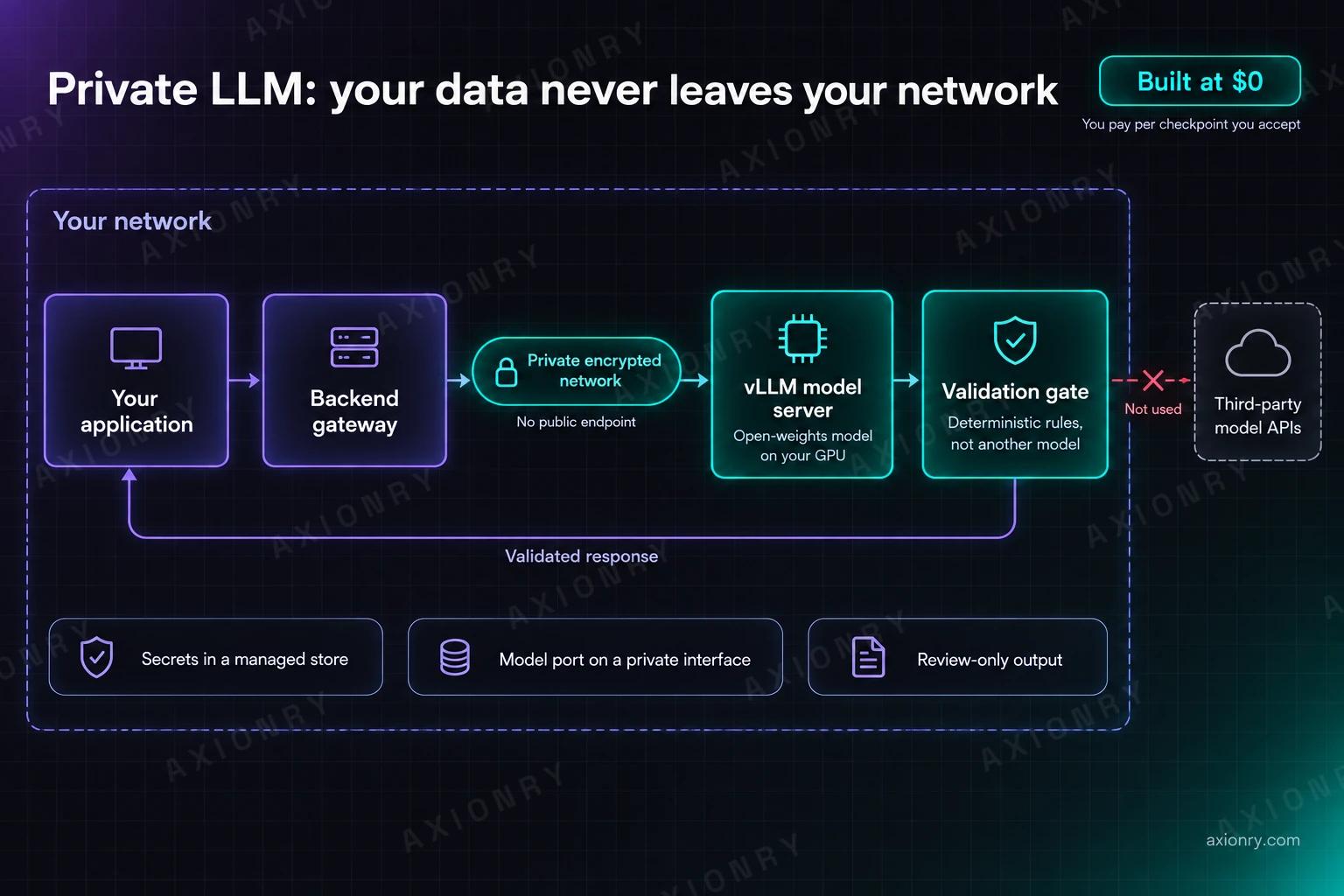
You have the GPU and you have the model. What is missing is the leg in between: the model exposed as a reliable private API, reached securely from your application, returning data you can trust. That is the whole engagement.
Mumbai is India's financial capital, home to the RBI, SEBI, the NSE and the BSE and to the head offices of many large banks, insurers, brokers and asset managers, with film, television and streaming as its other defining industry. Software sold here almost always passes through an information security review shaped by those regulators, and the person signing off is as likely to be a risk officer as a technologist.
In Mumbai a private deployment is usually what a bank's or broker's infosec team asks for before they will sign. The model runs in your own account, in an Indian region or a Navi Mumbai colocation facility, with the logs, access controls and audit trail an RBI or SEBI inspection would expect to see.
What you get
- vLLM serving tuned to your GPU: quantisation on the native kernel path, KV cache sizing, continuous batching, prefix caching
- A private network path with no public exposure, verified as a direct peer connection rather than a relay
- Schema-constrained responses plus a deterministic QA gate, so a wrong answer is rejected rather than rendered
- Documented baseline: tokens per second, time to first token, real concurrent capacity
- Infrastructure as code in your repository, a runbook, and every credential held by you
No upfront payment and no escrow required. You hold every dollar until a checkpoint is delivered and accepted, and thirty days of defect correction is included. Scope and price are set on a call.
Invoiced in INR, with GST as applicable.
Request a callback
You speak to the engineer who does the work. No sales rep, no deck.
Who builds here
On-Premise LLM Deployment
Mumbai's banks, brokers, insurers and the vendors that sell to them are the buyers most likely to reject a product because prompts leave for a third-party model API. Running inference inside their own Indian cloud region or data centre removes the objection that most often stalls the deal.

What Mumbai companies build with us
Get it built at $0.
That is not a discount. It is when you pay. The work is split into checkpoints with acceptance criteria written down before anything starts, and each checkpoint is invoiced only after you have seen it and accepted it. No deposit.
- $0 to start
- You hold every dollar until a checkpoint is delivered and you accept it. No approval, no invoice.
- Fixed cost, unlimited features
- Or hire the team outright: one fixed monthly cost, unlimited feature development, any stack.
- The engineer takes your call
- The person on your first call is the one who architects and writes it. No account managers, no bench time.
A US agency quotes $50,000 to $150,000 for the same build and asks for 40 to 50% of it before a line is written. Account managers, project managers, sales commission and bench time. None of it appears in your product.
Three stages, nothing hidden.
Fixed-fee assessment
Five business days from the day access is in place. Your stack examined end to end, existing work classified as preserved or replaced with reasons, the connection design, and acceptance criteria written as testable statements.
Implementation in checkpoints
Around three weeks. Each checkpoint has written acceptance criteria agreed before work starts, and is invoiced only after you accept it. Appoint an independent technical reviewer if you want one.
Handover and closeout
One real request through your real application, on synthetic data, passing every QA rule. Runbook, recorded handoff, and all our access removed with written confirmation.
What actually applies here.
Regulation and data
The DPDP Act 2023 sits on top of sector rules that matter more day to day here. RBI-regulated entities follow its 2023 Master Direction on outsourcing of IT services, which requires audit and inspection rights over vendors and incident reporting within hours, and its 2018 direction that payment system data be stored only in India. SEBI's Cybersecurity and Cyber Resilience Framework, issued in August 2024, applies to brokers, depositories, asset managers and other regulated entities, though its data localisation requirement was put in abeyance in December 2024. Insurers follow IRDAI's Information and Cyber Security Guidelines, 2023. Maharashtra's IT and ITeS Policy, 2023 gives data centres essential service status, and Navi Mumbai has become one of the country's main data centre locations.
Contracting and payment
Simple domestic contracting. Invoices in INR with GST as applicable, under a standard services agreement. No cross-border payment friction, no forex conversion cost, and no time spent on paperwork for an overseas supplier.
Working hours
Same time zone. I work from India on IST, so calls, reviews and replies all happen inside your normal working day.
Can you work within RBI or SEBI vendor requirements?
Yes. That means completing your vendor risk assessment, agreeing audit and inspection rights in the contract, working through named, limited-privilege access, and keeping data in Indian regions of your own accounts. Your compliance team decides how the engagement is classified under your outsourcing policy.
Does SEBI's framework require data to stay in India?
CSCRF originally included a localisation requirement, but SEBI put it in abeyance in December 2024 pending further consultation, so check the current position with your compliance team. We deploy into Indian regions by default, which keeps you covered if the requirement returns.
Do you work with media and production companies?
Yes. Typical projects are transcription and subtitles, search over footage and script archives, and internal tools for scheduling and rights tracking. Content stays in your own storage, and nothing is sent to a model provider you have not approved.
We already have hardware and a model running. Is that a problem?
It is the ideal starting point. Existing work is classified during the assessment as preserved unchanged, preserved with changes, or replaced, with reasons, and nothing is replaced without your written agreement.
Can it be fully air gapped?
Yes, including model and dependency mirroring, offline updates and local evaluation, with no outbound network access at all.
Who holds the accounts?
You do, throughout. Cloud accounts are created and held by you, our access is named and limited-privilege, and it is removed at handover with written confirmation.
Private LLM Infrastructure
Self-hosted LLM deployment on hardware you own. vLLM serving, private networking, validated output.