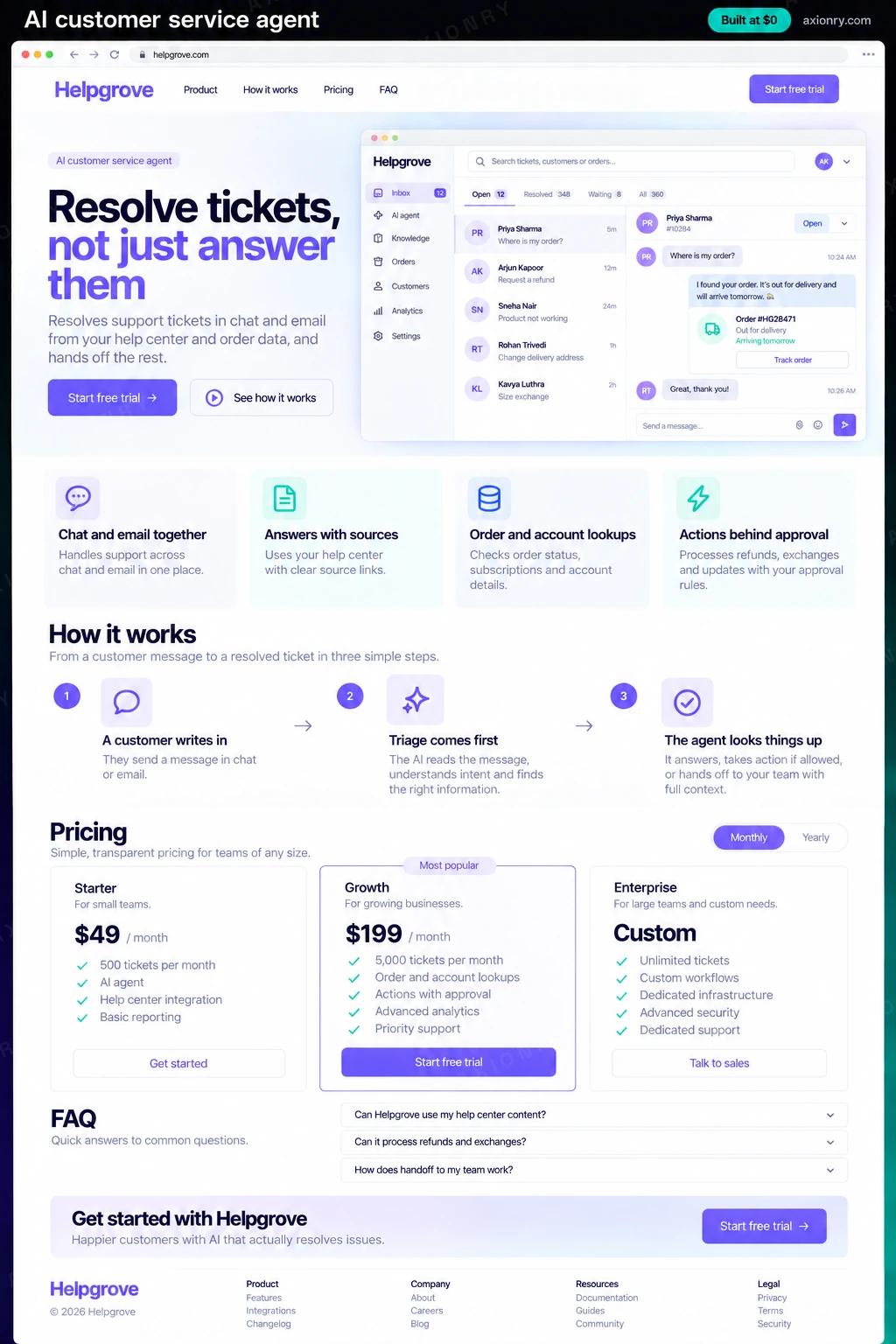
What is an AI customer service agent?
An AI customer service agent answers support conversations for you. It reads the customer's message, finds the answer in your help center or their order, replies with a cited answer or takes a simple action such as resending an invoice, and hands anything uncertain to a person with a written summary of what it checked.
It is built for online stores, SaaS companies and subscription businesses where the same questions arrive every day: where is my order, how do I change my plan, why was I charged twice. The value sits in two places. Tickets it resolves never reach your queue, and tickets it escalates arrive with the order, the account state and what it ruled out, so your team starts at the answer instead of the question.
You can run it for your own support team, or build it as a product and sell it to other companies. This page prices one agent for one business: a chat widget and email handling, connected to Zendesk or Intercom and your order data, with a dashboard for your support lead. Multi-tenant resale is an add-on.
An answer at 2 a.m. with a link to its source, an order status that is actually current, and a person when they ask for one.
Fewer repeat questions, and escalations that arrive with a brief: what the customer wants, what was checked and what was ruled out.
Resolution rate, reopen rate and cost per ticket by topic, plus a weekly list of questions the help center cannot answer yet.
What features does an AI customer service agent need?
An AI customer service agent needs 8 core features: chat and email together, answers with sources, order and account lookups, actions behind approval, knows when not to answer, handoff with a brief, a threshold you control and weekly gaps report.
Chat and email together
The same agent answers the website chat widget and the email tickets that arrive through your helpdesk, with one history per customer.
Answers with sources
Replies draw on your help center, policies and past resolved tickets, and every factual claim links to the article it came from.
Order and account lookups
It checks order status, tracking, subscriptions and invoices through read-only tools scoped to the customer in the conversation.
Actions behind approval
Resending an invoice, a goodwill credit or a refund under your limit is proposed by the agent and approved by a person until it earns trust.
Knows when not to answer
A separate check confirms each reply is supported by what it retrieved; if not, the ticket goes to a person instead of a guess going to the customer.
Handoff with a brief
Escalations land in Zendesk or Intercom with a summary, the facts checked and a suggested next step, so nobody asks the customer to repeat themselves.
A threshold you control
Your support lead sets how sure the agent must be before it replies, trading more automated answers against fewer mistakes, without a deploy.
Weekly gaps report
Questions it could not answer are grouped by topic, so you know which help center articles to write next.
What screens does an AI customer service agent have?
It is built around 3 screens: customer chat, support dashboard and handoff brief.
- 1Customer chatThe store's chat widget: a customer asks where their order is and the agent replies with the delivery date and the source it used.
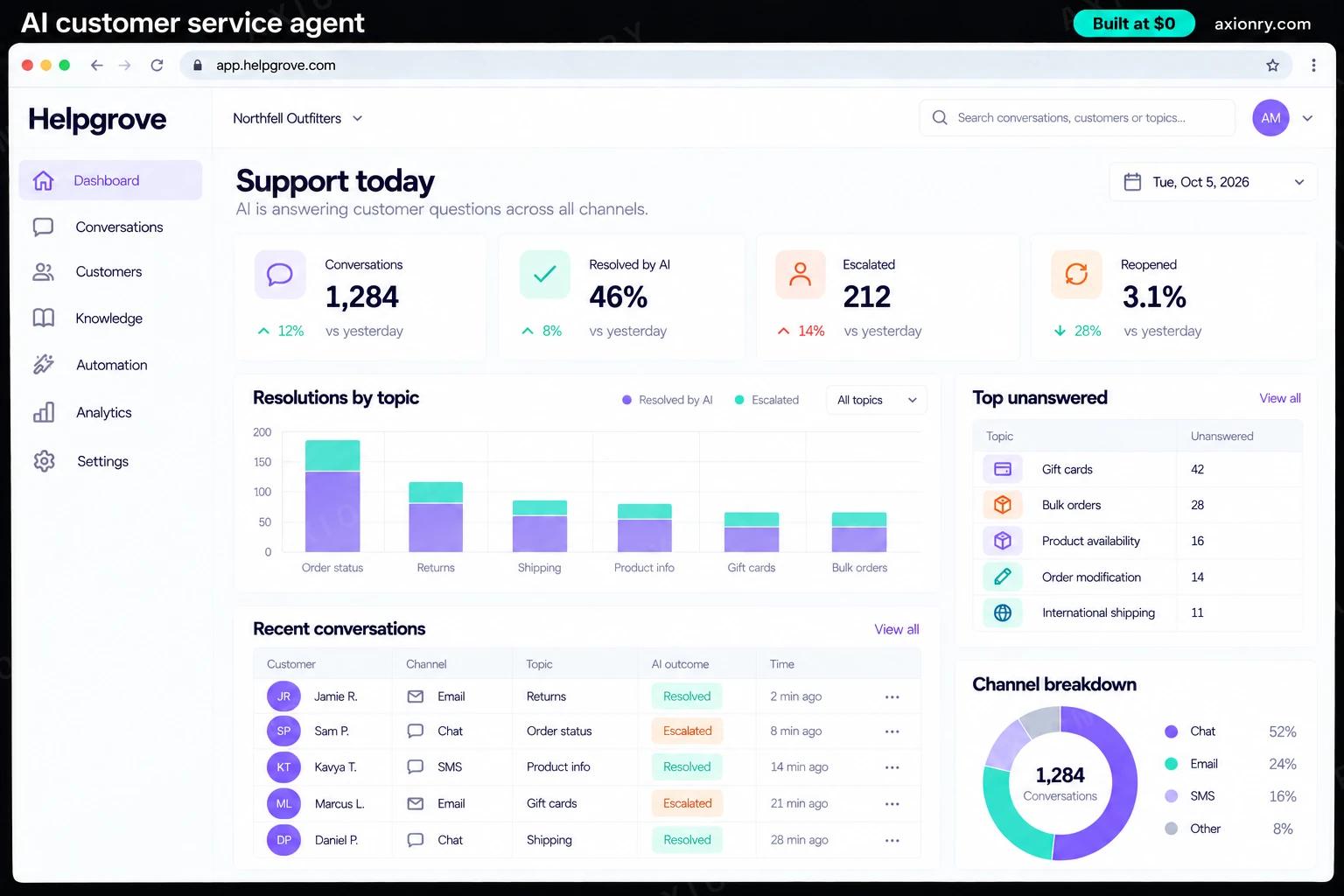
- 2Support dashboardToday's conversations, the share resolved by the agent, escalations, reopen rate and the top unanswered topics.
- 3Handoff briefAn escalated refund request with what the customer wants, what the agent checked and a suggested credit, ready to open in the helpdesk.
How does an AI customer service agent work?
End to end, in 5 steps: a customer writes in, triage comes first, the agent looks things up, a gate decides and people take over cleanly.
- 1
A customer writes in
A chat message or an email ticket arrives through your helpdesk and is matched to the customer and their open conversations, so the agent never answers one person twice in two threads.
- 2
Triage comes first
A small model tags the intent and urgency. Order status and plan questions go to the agent; disputes, legal threats and angry refund demands go straight to a person.
- 3
The agent looks things up
It searches your help center and past resolved tickets, and calls read-only tools for the order, tracking or subscription, scoped to this customer only.
- 4
A gate decides
Every claim in the draft must match a retrieved source, and a second model must agree the reply is grounded. Pass, and it is sent with links. Fail, and it becomes a handoff.
- 5
People take over cleanly
Escalations arrive in Zendesk or Intercom with a brief, and credits wait for approval. Reopened tickets and thumbs-down replies feed the next week's fixes.
What is the architecture and tech stack of an AI customer service agent?
It has 8 layers: helpdesk (Zendesk or Intercom), chat widget (Next.js widget with streamed replies), models (Claude Haiku 4.5 for triage and checks, Claude Sonnet 5 or GPT-5.6 Terra for answers), retrieval (Postgres with pgvector and keyword search), tools (MCP servers over Shopify, Stripe Billing and your admin API), answer gate (Citation span check plus a Claude Haiku 4.5 verifier), evals and monitoring (Langfuse traces, a golden set of past tickets, reopen-rate alerts) and hosting (Vercel and Supabase, or your AWS account). The diagram shows how a request moves through them.
| Layer | What we use | Why |
|---|---|---|
| Helpdesk | Zendesk or Intercom | Tickets, email and your human agents stay where they are; the AI works through the helpdesk API and hands off inside it. |
| Chat widget | Next.js widget with streamed replies | Your brand on your domain, with a status line shown at once so a ten-second lookup never looks broken. |
| Models | Claude Haiku 4.5 for triage and checks, Claude Sonnet 5 or GPT-5.6 Terra for answers | A cheap model sorts every ticket, and the stronger one runs only on tickets worth answering. |
| Retrieval | Postgres with pgvector and keyword search | Hybrid search finds exact product names and plan terms that vector search alone misses, in the database you already run. |
| Tools | MCP servers over Shopify, Stripe Billing and your admin API | Read-only by default and scoped to the customer in the conversation, with writes behind approval. |
| Answer gate | Citation span check plus a Claude Haiku 4.5 verifier | A second model reads the reply cold, because a model grading its own answer in the same call is too easily convinced. |
| Evals and monitoring | Langfuse traces, a golden set of past tickets, reopen-rate alerts | A ticket reopened within days is the cheapest sign an answer was wrong, and it needs no labeling. |
| Hosting | Vercel and Supabase, or your AWS account | Managed services at launch, your own cloud when a security review asks for it. |
How much does it cost to build an AI customer service agent?
A launch-ready AI customer service agent costs $27,500 to $57,500 to build and takes 7 to 12 weeks. A clickable demo costs $3,300 to $7,000 (2 to 5 weeks), and running it costs $1,000 to $2,700 a month at the usage below. You start at $0 and pay per checkpoint you accept.
Priced with the same model as our AI product cost estimator, from the features above. Your price is fixed in writing after a 20-minute call, before any work starts.
| Version | Build cost | Timeline | What it is |
|---|---|---|---|
| Clickable demo | $3,300 to $7,000 | 2 to 5 weeks | Clickable and real where it matters, on test data. Built to show users and investors, not to carry production traffic, so compliance work starts at launch. |
| Launch-ready | $27,500 to $57,500 | 7 to 12 weeks | Production architecture, tests on the risky paths, monitoring, and a handover your team can run. |
| Enterprise-grade | $36,000 to $74,500 | 8 to 15 weeks | Load tested, highly available, audited and documented for a larger team. |
What it costs to run
About 2,500 customers a month, each in one or two conversations with the agent, answered by Claude Sonnet 5 with retrieval, plus hosting.
| Line | Per month | Assumes |
|---|---|---|
| Hosting and database | $80 to $210 | Vercel + managed services, sized for 2,500 monthly users |
| Model usage | $900 to $2,250 | Claude Sonnet 5, 15 requests per user a month |
| Email, monitoring, analytics | $20 to $260 | Free tiers cover most products at launch |
| Total | $1,000 to $2,700 | List prices, before any volume discount |
Build at $0: how you pay
$0 is when you pay, not what you pay. The launch-ready build is split into checkpoints with acceptance criteria agreed before work starts, and each one is invoiced only after you have seen it and accepted it.
- 1Scope and acceptance criteriaBefore work startsA call, then a written plan: every checkpoint with acceptance criteria you agree to before work starts.$0
- 2Architecture and first flowBy week 2Data model, service boundaries and one real flow working end to end.$5,500 to $11,500
- 3Core productBy week 6The main flows on production architecture, with a demo at the end of every week.$8,500 to $17,500
- 4AI on your real dataBy week 10Models, agents or voice working on real inputs, with evals and guardrails in place.$8,500 to $17,500
- 5Launch and handoverBy week 12Deployed on your accounts and documented, with 30 days of defect correction included.$5,500 to $11,500
What can you add to an AI customer service agent after launch?
The additions most teams make next: voice on your support line, more languages, automatic low-risk actions and sell it to other businesses.
Voice on your support line
Callers get the same answers and lookups by phone, on a custom LiveKit voice stack that costs about 2.5 cents per minute in production.
More languages
Answers in the customer's language, with retrieval and the answer gate tested per language before each one goes live.
Automatic low-risk actions
Once a ticket type has been approved unchanged for weeks, actions like resending invoices or small credits can run without a person.
Sell it to other businesses
Each client gets its own help center, separated data and a monthly plan, and the agent becomes a support product you resell.
What are the risks when building an AI customer service agent?
Three things decide whether it works in production: a fluent wrong answer, money needs hard limits and privacy and disclosure.
A fluent wrong answer
The costly failure is a confident, cited reply that is false, such as an outdated refund window. Filter superseded articles at search time, check every claim against its source, and watch tickets reopened within 72 hours.
Money needs hard limits
Refunds and credits need a maximum the model cannot change, an approval step at first, and an idempotency key so a retry never pays twice. The customer's identity comes from the verified session, never from the model.
Privacy and disclosure
Strip personal data from past tickets before indexing them, use model vendors under data processing terms that meet GDPR and CCPA, and tell customers they are talking to an AI, as the EU AI Act requires.
Where can you read more before you build?
- Build an AI Customer Support Agent: Full System Design, Cost Per Ticket and Failure Modes (2026)
- Build an AI Agent That Does Real Work: Orchestrator, Specialist Agents and One MCP Harness
- RAG Over Private Documents: The Full Architecture, Failure Modes, and Cost Per Answer
- AI Product Development: the service behind this build