What is an AI search engine?
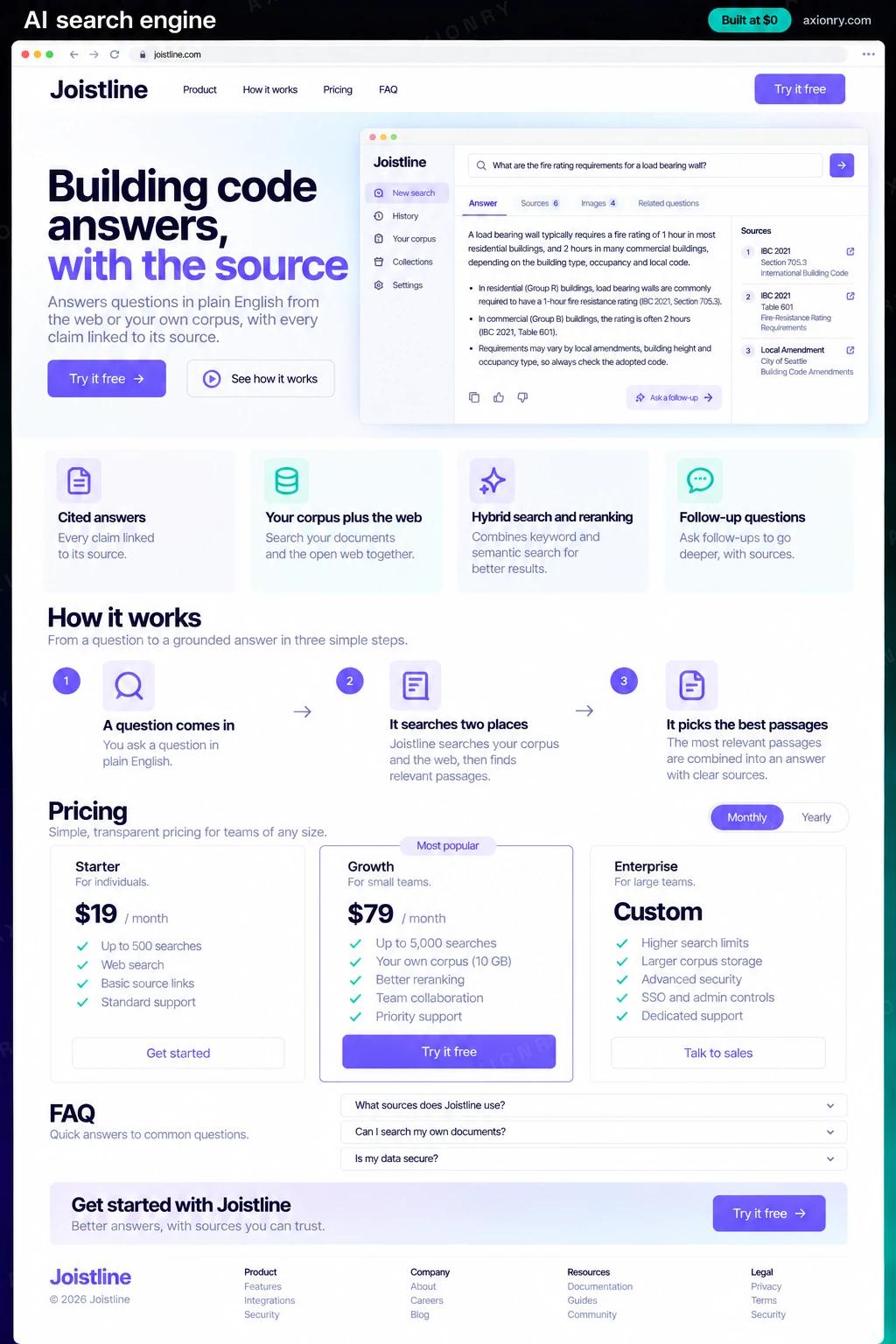
An AI search engine answers a question instead of returning ten links. It searches the web or your own index, reads the best pages, writes a short answer in which every claim cites a source, and suggests follow-up questions. The citations are the product: they let readers check the answer in one click.
General answer engines already exist, so the opportunity is vertical: search over a body of knowledge the big engines index poorly or cannot reach, with sources your users trust. Think building codes for contractors, regulations for compliance teams, clinical guidelines for clinicians, parts catalogs for engineers, or your own publication's archive. Professionals pay for answers they can cite in their own work.
You can build it as a subscription product, as search inside your own site or app, or as an internal tool. This page prices a public answer engine for one vertical: your own index of chosen sources plus live web results for freshness, cited answers, follow-ups, caching, accounts and a paid plan.
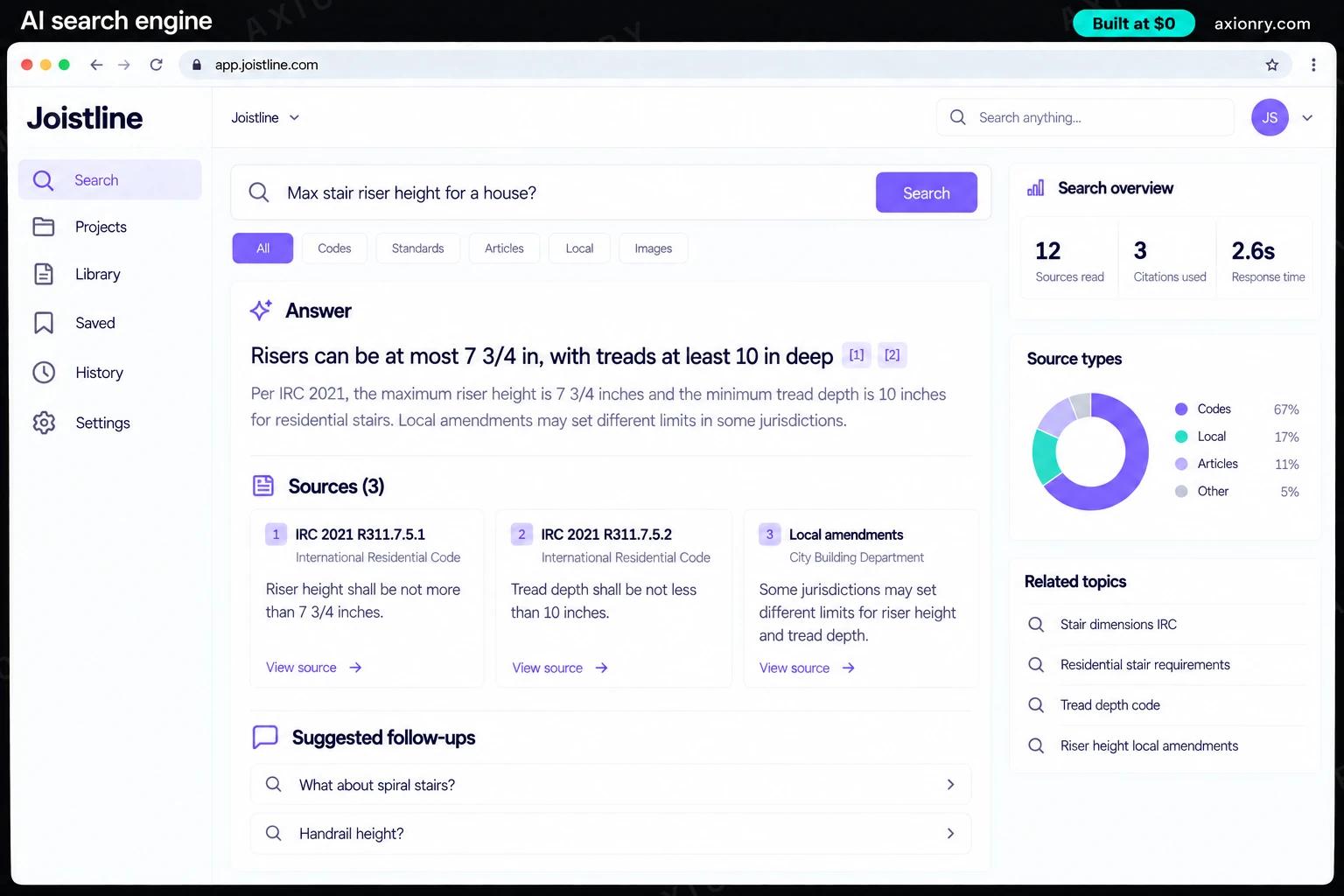
A direct answer with numbered sources in seconds, follow-up questions that keep the context, and the full source one click away.
Control over which sources are indexed and trusted, and a weekly list of questions the engine answered poorly or could not answer.
Subscriptions, cost per answer by model, cache hit rate, and the questions your audience keeps asking.
What features does an AI search engine need?
An AI search engine needs 8 core features: cited answers, your corpus plus the web, hybrid search and reranking, follow-up questions, source controls, answers from cache, accounts and a paid plan and answer quality tracking.
Cited answers
Every sentence that states a fact links to the passage it came from, and the answer says so when sources disagree or nothing reliable was found.
Your corpus plus the web
A crawl of the sources you choose, refreshed on a schedule, combined with live results from a web search API when a question needs today's information.
Hybrid search and reranking
Keyword and vector search find candidates, then a reranker picks the handful of passages the answer is written from.
Follow-up questions
Users ask 'what about spiral stairs?' and the engine rewrites it into a full query using the conversation so far.
Source controls
Allow, block or boost domains and publications, so a blog post never outranks the regulation it summarizes.
Answers from cache
Popular questions are served from a cache keyed to the version of the sources, which cuts cost and waiting without serving stale answers.
Accounts and a paid plan
Free searches to start and a subscription for heavy users, with saved threads and answers they can export.
Answer quality tracking
A test set of real questions with checked answers runs on every change, and thumbs-down answers are reviewed weekly.
What screens does an AI search engine have?
It is built around 3 screens: answer page, source view and weekly numbers.
- 1Answer pageA question, a short answer with numbered citations, the source cards it drew on, and suggested follow-ups.
- 2Source viewThe cited passage highlighted in the original document, with its section number and last update.
- 3Weekly numbersAnswers served, cache hit rate, cost per answer and the share of answers rated down.
How does an AI search engine work?
End to end, in 5 steps: a question comes in, it searches two places, it picks the best passages, it writes and checks the answer and it keeps the thread.
- 1
A question comes in
The engine checks the cache first, keyed to the question and the current version of the sources. A hit comes back at once.
- 2
It searches two places
A rewritten query runs against your own index with keyword and vector search and, when the question needs fresh information, against a web search API such as Brave, Exa or Tavily.
- 3
It picks the best passages
Dozens of candidates are reranked, filtered by your source rules and dates, and cut down to the few passages the answer will be written from.
- 4
It writes and checks the answer
A fast model writes a short answer that cites a passage for every claim. Citations are checked against the passages in code, and unsupported sentences are removed or flagged.
- 5
It keeps the thread
The answer streams to the user with source cards and suggested follow-ups. A follow-up is rewritten into a full question using the conversation, and the loop starts again.
What is the architecture and tech stack of an AI search engine?
It has 8 layers: web results (Brave Search API, Exa or Tavily), your index (OpenSearch or Elasticsearch with BM25 and vectors, or Postgres with pgvector for a smaller corpus), crawling (Scrapy or Firecrawl on a schedule), reranking (Cohere Rerank), answer model (Gemini 3.7 Flash, with Claude Sonnet 5 for hard questions), cache (Redis), app and billing (Next.js on Vercel, Stripe Billing) and quality (Golden question set, Langfuse traces, thumbs up and down). The diagram shows how a request moves through them.
| Layer | What we use | Why |
|---|---|---|
| Web results | Brave Search API, Exa or Tavily | Search results by API under the provider's terms instead of scraping a search engine; choose by coverage, freshness and price per query. |
| Your index | OpenSearch or Elasticsearch with BM25 and vectors, or Postgres with pgvector for a smaller corpus | Exact terms like section numbers need keyword search, and paraphrased questions need vectors, so you want both. |
| Crawling | Scrapy or Firecrawl on a schedule | Your sources refreshed on their own cadence, with robots.txt respected and every page versioned. |
| Reranking | Cohere Rerank | Choosing the best few passages from dozens costs less and reads better than stuffing twenty into the prompt. |
| Answer model | Gemini 3.7 Flash, with Claude Sonnet 5 for hard questions | Fast and cheap on most questions, with a stronger model only when the router sees a complex one. |
| Cache | Redis | Repeat questions come back quickly and cost nothing, as long as the key includes the version of the sources used. |
| App and billing | Next.js on Vercel, Stripe Billing | Streamed answers, accounts, saved threads and a subscription plan. |
| Quality | Golden question set, Langfuse traces, thumbs up and down | Answer quality is measured on every change, not guessed from a demo. |
How much does it cost to build an AI search engine?
A launch-ready AI search engine costs $22,500 to $45,500 to build and takes 6 to 10 weeks. A clickable demo costs $2,700 to $5,500 (2 to 4 weeks), and running it costs $430 to $1,400 a month at the usage below. You start at $0 and pay per checkpoint you accept.
Priced with the same model as our AI product cost estimator, from the features above. Your price is fixed in writing after a 20-minute call, before any work starts.
| Version | Build cost | Timeline | What it is |
|---|---|---|---|
| Clickable demo | $2,700 to $5,500 | 2 to 4 weeks | Clickable and real where it matters, on test data. Built to show users and investors, not to carry production traffic, so compliance work starts at launch. |
| Launch-ready | $22,500 to $45,500 | 6 to 10 weeks | Production architecture, tests on the risky paths, monitoring, and a handover your team can run. |
| Enterprise-grade | $29,000 to $59,000 | 7 to 12 weeks | Load tested, highly available, audited and documented for a larger team. |
What it costs to run
About 5,000 monthly users asking around 15 questions each, answered by Gemini 3.7 Flash, plus hosting; web search API fees are billed per query on top.
| Line | Per month | Assumes |
|---|---|---|
| Hosting and database | $120 to $320 | Vercel + managed services, sized for 5,000 monthly users |
| Model usage | $270 to $680 | Gemini 3.7 Flash, 15 requests per user a month |
| Email, monitoring, analytics | $40 to $390 | Free tiers cover most products at launch |
| Total | $430 to $1,400 | List prices, before any volume discount |
Build at $0: how you pay
$0 is when you pay, not what you pay. The launch-ready build is split into checkpoints with acceptance criteria agreed before work starts, and each one is invoiced only after you have seen it and accepted it.
- 1Scope and acceptance criteriaBefore work startsA call, then a written plan: every checkpoint with acceptance criteria you agree to before work starts.$0
- 2Architecture and first flowBy week 2Data model, service boundaries and one real flow working end to end.$4,500 to $9,000
- 3Core productBy week 5The main flows on production architecture, with a demo at the end of every week.$7,000 to $13,500
- 4AI on your real dataBy week 8Models, agents or voice working on real inputs, with evals and guardrails in place.$7,000 to $13,500
- 5Launch and handoverBy week 10Deployed on your accounts and documented, with 30 days of defect correction included.$4,500 to $9,000
What can you add to an AI search engine after launch?
The additions most teams make next: an API for your answers, private documents for teams, deep research mode and alerts on new sources.
An API for your answers
Sell cited answers to other products through an API with keys, rate limits and usage billing.
Private documents for teams
Paying teams upload their own files and search them alongside the public corpus, with permissions kept separate.
Deep research mode
For hard questions, an agent runs several searches in sequence and writes a longer, fully cited report.
Alerts on new sources
Users follow a topic and get a summary when a new regulation, filing or document appears.
What are the risks when building an AI search engine?
Three things decide whether it works in production: rights to what you index, confident answers from weak sources and advice in regulated fields.
Rights to what you index
Respect robots.txt and each publisher's terms, prefer licensed feeds and search APIs over scraping, and show short quoted passages with links rather than republishing whole articles.
Confident answers from weak sources
Rank official and primary sources above commentary, show a date on every citation, check each claim against its passage, and let the engine say it found no reliable answer.
Advice in regulated fields
In legal, medical or financial verticals, answers can read as professional advice. Label the product as information, keep sources prominent, and have a qualified person review the test set before launch.