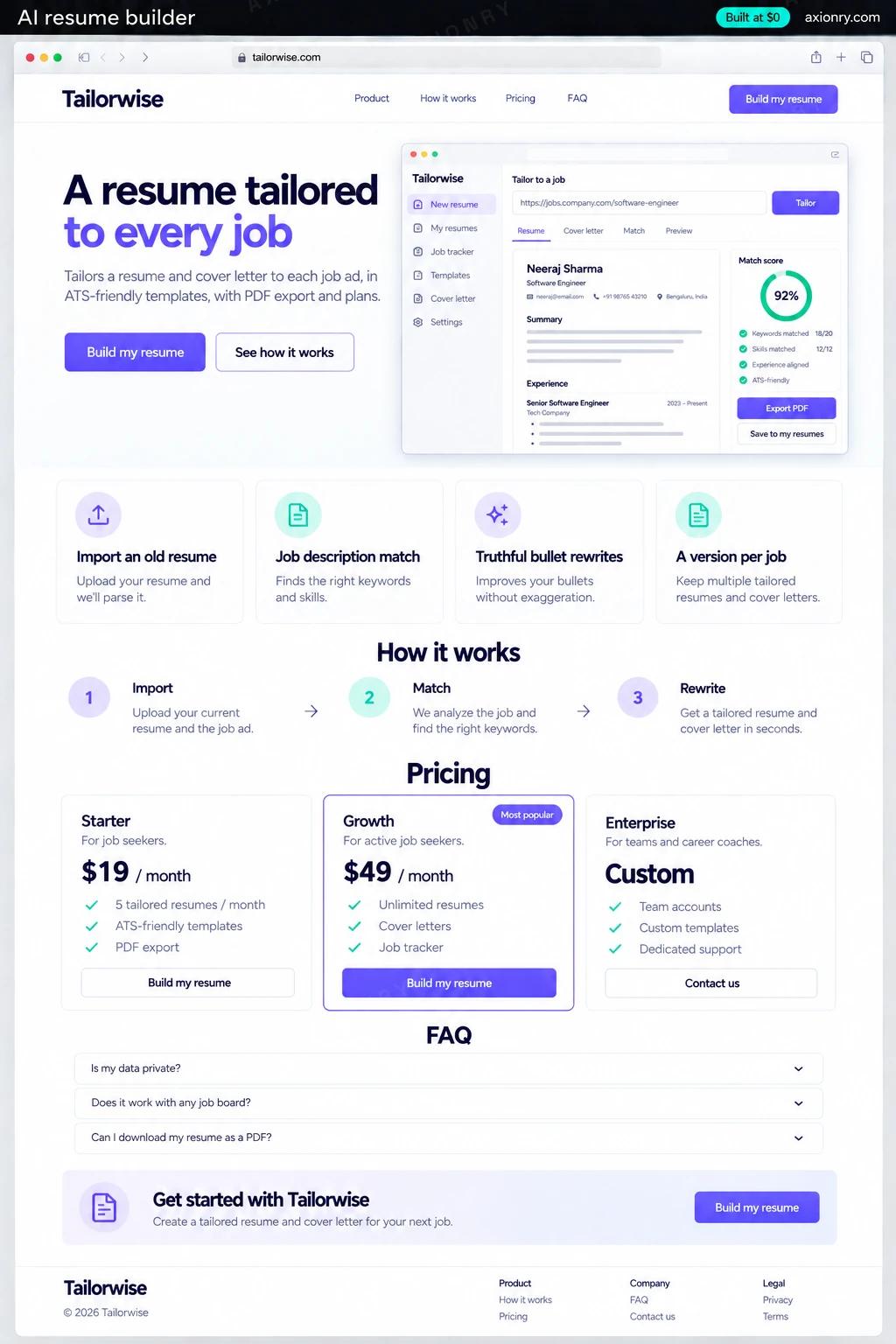
What is an AI resume builder?
An AI resume builder helps a job seeker write a resume and cover letter, then tailor both to each job they apply for. It imports an old resume, compares it with the job description, suggests truthful rewrites and missing keywords, and exports a layout that applicant tracking systems can read.
Job seekers pay for it at the moment they care most, and career coaches, bootcamps, universities and outplacement firms buy it for the people they support. Its value rests on trust: a builder that invents experience or buries its renewal terms earns refunds and chargebacks instead of referrals.
You can sell it directly to job seekers or license it to schools and coaches under their brand. This page prices the direct-to-consumer version: a web app with import, job matching, templates, cover letters, PDF and Word export, and Stripe subscriptions. The white-label version adds organizations, seats and a coach view.
A resume and cover letter tailored to each application in one sitting, with every change shown and nothing claimed they did not do.
Accounts, plans, refunds and exports in one admin view, so billing questions are answered without touching the database.
Conversion from free to paid at each step, the model cost of each tailored resume, and churn once people find a job.
What features does an AI resume builder need?
An AI resume builder needs 8 core features: import an old resume, job description match, truthful bullet rewrites, a version per job, ATS-friendly templates, cover letters that fit, PDF and Word export and clear subscriptions.
Import an old resume
PDF and Word uploads, or a LinkedIn profile saved as PDF, are parsed into sections, dates and bullets the user can edit.
Job description match
Paste a job ad to see the skills and keywords it asks for, which ones the resume already shows, and which are missing.
Truthful bullet rewrites
Vague bullets become specific ones, and the assistant asks for real numbers instead of inventing them.
A version per job
Each application gets its own copy with reordered sections and matched wording, saved with the job it was made for.
ATS-friendly templates
Single-column layouts with real text, standard headings and common fonts, tested by parsing every exported PDF back to text.
Cover letters that fit
A one-page letter built from the resume and the job ad, naming the company and the role, in the user's own tone.
PDF and Word export
Print-accurate PDFs and editable Word files, with a free plan that exports with a small footer.
Clear subscriptions
Weekly and monthly plans on Stripe, the renewal price shown before payment and a cancel button in account settings.
What screens does an AI resume builder have?
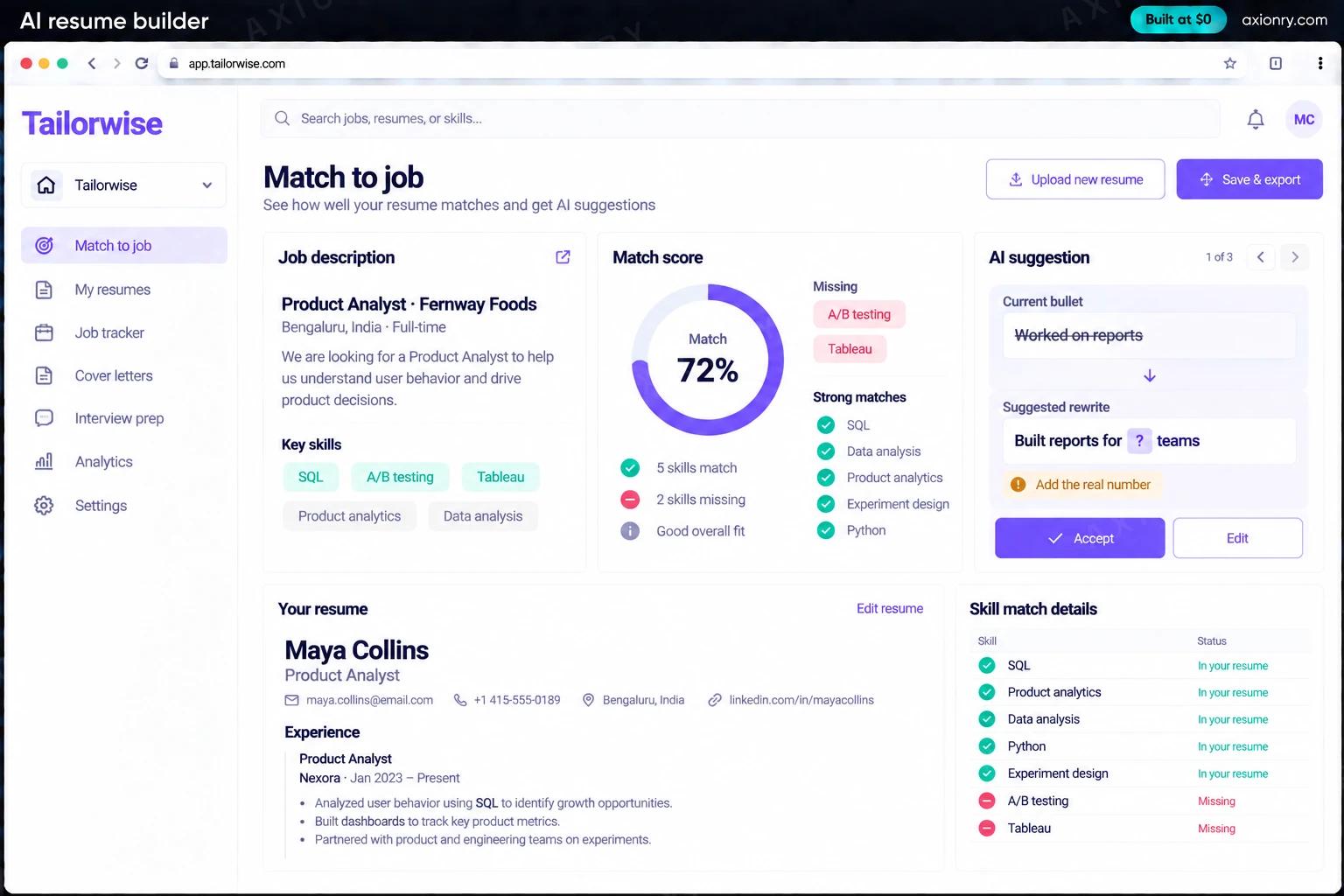
It is built around 3 screens: match to job, resume preview and founder dashboard.
- 1Match to jobThe job ad beside the resume, with a match score, the missing skills and a suggested rewrite of one bullet.
- 2Resume previewThe tailored resume in an ATS-friendly template on a phone, ready to export as PDF or Word.
- 3Founder dashboardSign-ups, new paid plans, refunds and model cost per resume for the day.
How does an AI resume builder work?
End to end, in 5 steps: import, match, rewrite, export and upgrade and return.
- 1
Import
The user uploads an old resume or a LinkedIn PDF. It is parsed into sections and dates, and anything the parser is unsure of is shown for a quick check.
- 2
Match
They paste a job ad. The model extracts the skills, tools and seniority it asks for and marks which ones the resume already shows.
- 3
Rewrite
Suggested rewrites and keyword placements appear one at a time. Where a bullet needs a number, the assistant asks for it instead of guessing.
- 4
Export
The tailored copy renders in an ATS-friendly template to PDF and Word, and the PDF is parsed back to text to confirm nothing was lost.
- 5
Upgrade and return
Free users hit a limit and upgrade through Stripe with the renewal terms shown first, and each application stays saved with its job.
What is the architecture and tech stack of an AI resume builder?
It has 8 layers: language model (Claude Haiku 4.5 for suggestions, Claude Sonnet 5 for full tailoring), parsing (pdf.js and mammoth for text, a model pass into the JSON Resume schema), templates and export (React templates, Playwright for PDF, the docx library for Word), ATS check (A pdftotext round trip on every template), billing (Stripe Checkout, Stripe Billing and the customer portal), data and privacy (Postgres, uploads encrypted in S3, deletion jobs), product analytics (PostHog) and hosting (Vercel with Supabase or Neon Postgres). The diagram shows how a request moves through them.
| Layer | What we use | Why |
|---|---|---|
| Language model | Claude Haiku 4.5 for suggestions, Claude Sonnet 5 for full tailoring | Most requests are short edits a fast model handles well; rewriting a whole resume for a job gets the stronger model. |
| Parsing | pdf.js and mammoth for text, a model pass into the JSON Resume schema | Resume layouts vary wildly, so plain text plus a model filling fixed fields holds up better than a rules-based parser. |
| Templates and export | React templates, Playwright for PDF, the docx library for Word | One template source renders both formats, and headless Chromium prints pixel-accurate PDFs. |
| ATS check | A pdftotext round trip on every template | If the text that comes back is out of order or missing, an applicant tracking system will read the same mess. |
| Billing | Stripe Checkout, Stripe Billing and the customer portal | Weekly and monthly plans, trials and self-serve cancellation without custom code. |
| Data and privacy | Postgres, uploads encrypted in S3, deletion jobs | Resumes are personal data, so access is logged and a deletion request removes every copy. |
| Product analytics | PostHog | Where free users stall and which templates convert, without sending resume text to analytics. |
| Hosting | Vercel with Supabase or Neon Postgres | A low fixed cost while traffic is small and spiky. |
How much does it cost to build an AI resume builder?
A launch-ready AI resume builder costs $20,000 to $39,500 to build and takes 6 to 9 weeks. A clickable demo costs $2,400 to $4,700 (7 to 15 working days), and running it costs $550 to $1,600 a month at the usage below. You start at $0 and pay per checkpoint you accept.
Priced with the same model as our AI product cost estimator, from the features above. Your price is fixed in writing after a 20-minute call, before any work starts.
| Version | Build cost | Timeline | What it is |
|---|---|---|---|
| Clickable demo | $2,400 to $4,700 | 7 to 15 working days | Clickable and real where it matters, on test data. Built to show users and investors, not to carry production traffic, so compliance work starts at launch. |
| Launch-ready | $20,000 to $39,500 | 6 to 9 weeks | Production architecture, tests on the risky paths, monitoring, and a handover your team can run. |
| Enterprise-grade | $25,500 to $51,000 | 7 to 11 weeks | Load tested, highly available, audited and documented for a larger team. |
What it costs to run
About 2,500 job seekers a month making around 60 AI requests each on Claude Haiku 4.5, plus hosting; full tailoring on Claude Sonnet 5 costs a little more.
| Line | Per month | Assumes |
|---|---|---|
| Hosting and database | $80 to $210 | Vercel + managed services, sized for 2,500 monthly users |
| Model usage | $450 to $1,150 | Claude Haiku 4.5, 60 requests per user a month |
| Email, monitoring, analytics | $20 to $260 | Free tiers cover most products at launch |
| Total | $550 to $1,600 | List prices, before any volume discount |
Build at $0: how you pay
$0 is when you pay, not what you pay. The launch-ready build is split into checkpoints with acceptance criteria agreed before work starts, and each one is invoiced only after you have seen it and accepted it.
- 1Scope and acceptance criteriaBefore work startsA call, then a written plan: every checkpoint with acceptance criteria you agree to before work starts.$0
- 2Architecture and first flowBy week 2Data model, service boundaries and one real flow working end to end.$4,000 to $8,000
- 3Core productBy week 5The main flows on production architecture, with a demo at the end of every week.$6,000 to $12,000
- 4AI on your real dataBy week 7Models, agents or voice working on real inputs, with evals and guardrails in place.$6,000 to $12,000
- 5Launch and handoverBy week 9Deployed on your accounts and documented, with 30 days of defect correction included.$4,000 to $8,000
What can you add to an AI resume builder after launch?
The additions most teams make next: mock interviews, application tracker, white-label for schools and coaches and LinkedIn profile suggestions.
Mock interviews
Practice questions generated from the job ad, answered by voice and scored against what the role asks for.
Application tracker
A board of every job applied to, with the tailored resume, deadlines and follow-up reminders.
White-label for schools and coaches
Organizations, seats, a coach view with comments on drafts, and the school's brand on every export.
LinkedIn profile suggestions
A headline and About section written to match the resume, for the user to paste into their profile.
What are the risks when building an AI resume builder?
Three things decide whether it works in production: renewal terms in plain sight, never invent experience and personal data in every file.
Renewal terms in plain sight
A cheap trial that quietly renews at a higher price is the quickest way to earn chargebacks and complaints. ROSCA requires clear terms and express consent before billing, and California's Automatic Renewal Law requires online cancellation, so show the renewal price at checkout and keep the cancel button working.
Never invent experience
A rewrite that adds a skill, a title or a number the user did not give is a false statement on their application. The model may only rephrase what the user provided, asks when a number is needed, and every change is shown before it is accepted.
Personal data in every file
Resumes hold names, phone numbers, addresses and work histories. Encrypt uploads, keep resume text out of analytics and model training, honor deletion requests completely, and add GDPR consent and export before selling in the EU.