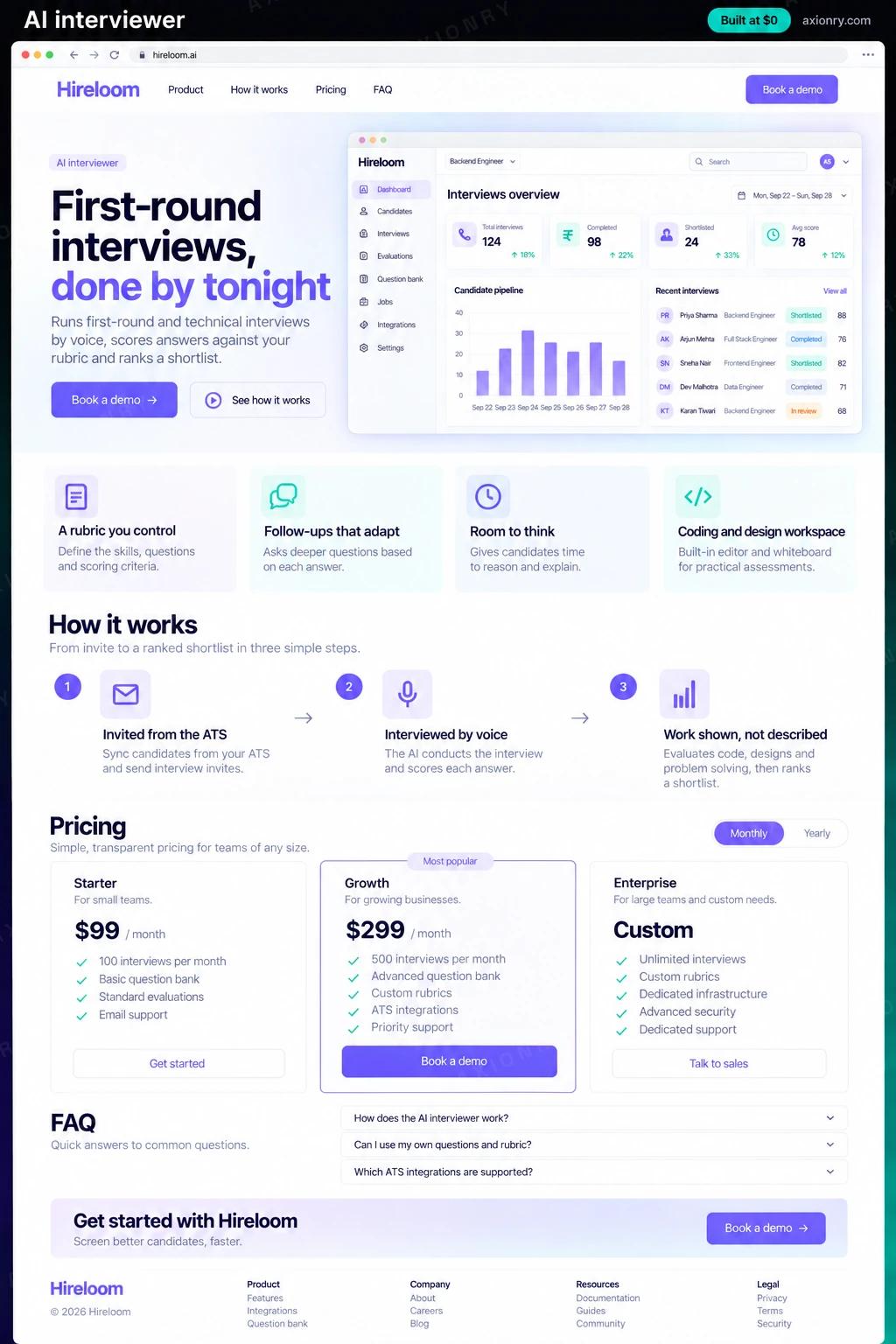
What is an AI interviewer?
An AI interviewer is a voice agent that runs structured job interviews. It asks every candidate the same core questions, follows up on each person's own answers, runs coding or design exercises for technical roles, and scores each answer against your rubric with a quote as evidence. Recruiters review a ranked shortlist, and a person makes every decision.
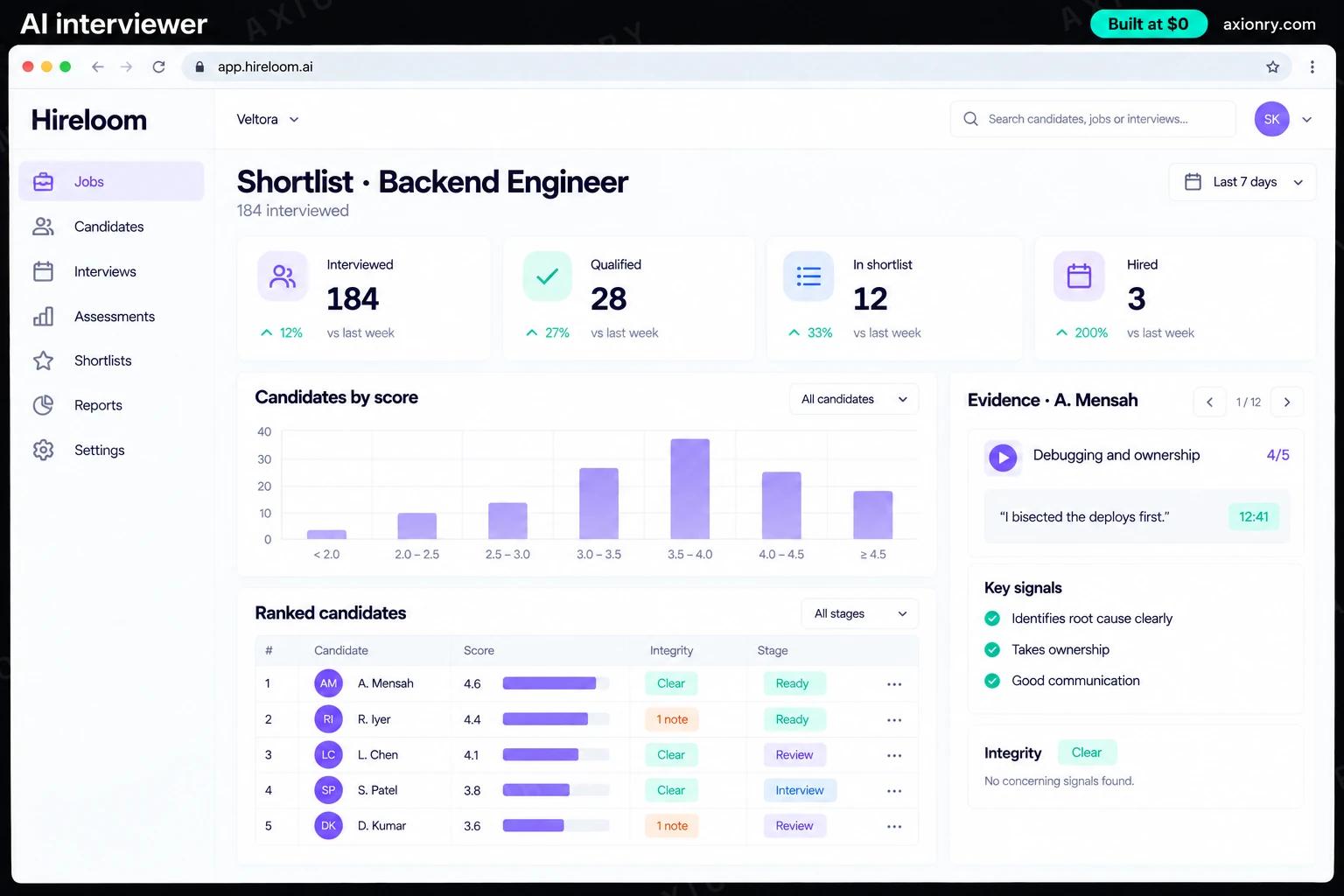
It is for companies and staffing firms screening hundreds of applicants a month, and for HR tech founders whose product is the interview. The value is recruiter time and consistency: a first screen at any hour, the same questions for everyone, and evidence a hiring manager can check. Neeraj built AccioMatrix, an AI assessment and interview platform, on his own; it now serves 20+ enterprise clients.
Employers build it for their own hiring when volume is high or the rubric is a competitive asset; founders build it as a product to sell to employers. The version priced here is a production interviewer for one hiring organization: browser interviews, a coding workspace, rubric scoring, integrity notes, a recruiter dashboard and write-back to your ATS. Selling it to many employers adds a workspace per client and per-interview billing.
An interview slot at any hour, a clear notice that an AI is asking the questions, accommodations on request, and follow-ups about their own work.
A ranked shortlist where every score opens to the sentence that earned it, plus integrity notes to weigh rather than verdicts to obey.
Writes and owns the rubric, sees how the machine's scores compare with human ones, and makes the advance or reject decision in the ATS.
What features does an AI interviewer need?
An AI interviewer needs 8 core features: a rubric you control, follow-ups that adapt, room to think, coding and design workspace, scores with quotes, integrity as evidence, ATS in and out and rules by candidate location.
A rubric you control
Competencies, core questions, allowed follow-ups and anchored scores for 1, 3 and 5, versioned so every interview records what it ran on.
Follow-ups that adapt
A planner chooses between probing deeper, the next question or moving on while the candidate is still speaking, so replies stay quick.
Room to think
Longer pauses are allowed inside answers so nobody is cut off mid-thought, and 'give me a second' is treated as a hold.
Coding and design workspace
A code editor whose runs execute in an isolated sandbox, or a whiteboard, recorded on the same timeline as the conversation.
Scores with quotes
Two independent scoring passes after the interview; every score cites a quote that must appear in the transcript, and disagreements go to a person.
Integrity as evidence
Headphone checks, tab focus and answer patterns are noted with timestamps for the reviewer and never reject anyone on their own.
ATS in and out
Invites go out when a candidate reaches the stage, and scores, evidence and the recording link return to Greenhouse, Lever or Ashby.
Rules by candidate location
AI disclosure, recording consent, accommodations, deletion on request and bias-audit data, configured by where the candidate is.
What screens does an AI interviewer have?
It is built around 3 screens: interview room, ranked shortlist and evidence view.
- 1Interview roomThe candidate's browser: the interviewer's current question with a caption, the code editor with a passing test run and the time left.
- 2Ranked shortlistCandidates for the role ranked by weighted score, with integrity notes and each candidate's stage in the ATS.
- 3Evidence viewOne rubric item opened: the score, the anchor it matched and the candidate's own words with a timestamp to replay.
How does an AI interviewer work?
End to end, in 5 steps: invited from the ATS, interviewed by voice, work shown, not described, scored after the call and decided by a person.
- 1
Invited from the ATS
When a candidate reaches the screening stage, the ATS triggers an invite; they pick a time, read the AI notice, consent to recording and ask for accommodations if needed.
- 2
Interviewed by voice
The interviewer asks core questions from the rubric and follows up on the candidate's own words, keeping each block inside its time box.
- 3
Work shown, not described
Technical candidates code or sketch while they talk; runs execute in a sandbox and join the same timeline as speech and integrity signals.
- 4
Scored after the call
Two models score each rubric item independently from the full transcript, quotes are checked word for word, and gaps of more than one point go to a person.
- 5
Decided by a person
Recruiters review the ranked shortlist with its evidence and make the call, and the decision goes back to the ATS with the recording link.
What is the architecture and tech stack of an AI interviewer?
It has 8 layers: interview room (Next.js in the browser over LiveKit WebRTC), voice pipeline (LiveKit Agents, Deepgram Nova-3, Claude Haiku 4.5, Cartesia), planner (Claude Sonnet 5 inside a deterministic state machine), workspace (Monaco editor, E2B sandboxes, Excalidraw for design rounds), scoring (Claude Sonnet 5 and GPT-5.6 Terra as independent passes), records (Postgres event timeline, recordings in S3), ATS (Greenhouse API v3, Lever or Ashby) and integrity (Headphone echo test, focus events, verification probes). The diagram shows how a request moves through them.
| Layer | What we use | Why |
|---|---|---|
| Interview room | Next.js in the browser over LiveKit WebRTC | Wideband audio and a screen for code, with no phone line on the bill; phone interviews only for hourly roles. |
| Voice pipeline | LiveKit Agents, Deepgram Nova-3, Claude Haiku 4.5, Cartesia | Targets replies within about 800 milliseconds, with end-of-turn settings tuned for people who pause to think. |
| Planner | Claude Sonnet 5 inside a deterministic state machine | It decides while the candidate is still talking, so the stronger model adds no delay, and if it is late the next core question is always safe. |
| Workspace | Monaco editor, E2B sandboxes, Excalidraw for design rounds | Each run is isolated, and the whiteboard exports its scene as JSON the planner can read. |
| Scoring | Claude Sonnet 5 and GPT-5.6 Terra as independent passes | Two model families are less likely to make the same mistake, and a string check confirms that every quoted sentence exists. |
| Records | Postgres event timeline, recordings in S3 | Rubric, question and model versions are stored with every interview, and California's rules call for four years of records. |
| ATS | Greenhouse API v3, Lever or Ashby | Invites fire at the stage you choose and results land on the candidate's profile; Greenhouse's Harvest v1 and v2 stopped working after 31 August 2026. |
| Integrity | Headphone echo test, focus events, verification probes | Signals become timestamped notes for a reviewer, and visual signals are switched off for candidates with accommodations. |
How much does it cost to build an AI interviewer?
A launch-ready AI interviewer costs $27,500 to $56,500 to build and takes 7 to 12 weeks. A clickable demo costs $3,100 to $6,500 (2 to 4 weeks), and running it costs $640 to $1,000 a month at the usage below. You start at $0 and pay per checkpoint you accept.
Priced with the same model as our AI product cost estimator, from the features above. Your price is fixed in writing after a 20-minute call, before any work starts.
| Version | Build cost | Timeline | What it is |
|---|---|---|---|
| Clickable demo | $3,100 to $6,500 | 2 to 4 weeks | Clickable and real where it matters, on test data. Built to show users and investors, not to carry production traffic, so compliance work starts at launch. |
| Launch-ready | $27,500 to $56,500 | 7 to 12 weeks | Production architecture, tests on the risky paths, monitoring, and a handover your team can run. |
| Enterprise-grade | $35,000 to $72,500 | 8 to 15 weeks | Load tested, highly available, audited and documented for a larger team. |
What it costs to run
About 1,000 interviews a month at 20 minutes each, with candidates and recruiters counted as 1,000 monthly users and scoring run after every interview.
| Line | Per month | Assumes |
|---|---|---|
| Hosting and database | $45 to $120 | Vercel + managed services, sized for 1,000 monthly users |
| Model usage | $90 to $230 | Claude Sonnet 5, 15 requests per user a month |
| Voice minutes | $500 | 20,000 minutes on Custom LiveKit stack |
| Email, monitoring, analytics | $0 to $150 | Free tiers cover most products at launch |
| Total | $640 to $1,000 | List prices, before any volume discount |
Build at $0: how you pay
$0 is when you pay, not what you pay. The launch-ready build is split into checkpoints with acceptance criteria agreed before work starts, and each one is invoiced only after you have seen it and accepted it.
- 1Scope and acceptance criteriaBefore work startsA call, then a written plan: every checkpoint with acceptance criteria you agree to before work starts.$0
- 2Architecture and first flowBy week 2Data model, service boundaries and one real flow working end to end.$5,500 to $11,500
- 3Core productBy week 6The main flows on production architecture, with a demo at the end of every week.$8,500 to $17,000
- 4AI on your real dataBy week 10Models, agents or voice working on real inputs, with evals and guardrails in place.$8,500 to $17,000
- 5Launch and handoverBy week 12Deployed on your accounts and documented, with 30 days of defect correction included.$5,500 to $11,500
What can you add to an AI interviewer after launch?
The additions most teams make next: workspaces for other employers, identity check at offer stage, practice interviews and scoring for human rounds.
Workspaces for other employers
Separate workspaces, rubric libraries by role family and billing per interview, for founders selling the interviewer to other companies.
Identity check at offer stage
A document and selfie match before an offer, the right control for stand-ins and deepfakes, kept separate from the interview itself.
Practice interviews
An unscored practice round candidates can take first, which settles nerves and tests their microphone and connection.
Scoring for human rounds
The same transcription and rubric scoring applied to later interviews your team runs, so every round is compared on the same terms.
What are the risks when building an AI interviewer?
Three things decide whether it works in production: hiring laws differ by place, score answers, not people and flags that punish honest candidates.
Hiring laws differ by place
NYC Local Law 144 requires an independent bias audit within a year before use and candidate notice 10 business days ahead. Illinois's AI Video Interview Act requires notice, an explanation and consent before AI analyzes a video interview. The EU AI Act treats hiring AI as high-risk, with those duties applying from 2 December 2027.
Score answers, not people
The EU has banned emotion recognition in hiring since February 2025, and accent, eye contact or speaking speed correlate with disability, age and national origin. Score the content of answers and the work on screen, strip names before scoring, and keep a person on every advance or reject decision.
Flags that punish honest candidates
Looking away while thinking is not cheating. Treat proctoring signals as notes for a reviewer, test doubts with follow-up questions on the candidate's own work, and switch off visual signals for candidates with accommodations. Every false flag risks losing a good hire.
Where can you read more before you build?
- How to Build an AI Interviewer: Voice Screening, Rubric Scoring and Cost Per Interview (2026)
- AI Interview Proctoring in 2026: How It Actually Works (and When It Is Overkill)
- How Candidates Cheat AI Interviews in 2026, and How to Detect Each Method
- AI Voice Agent Development: the service behind this build