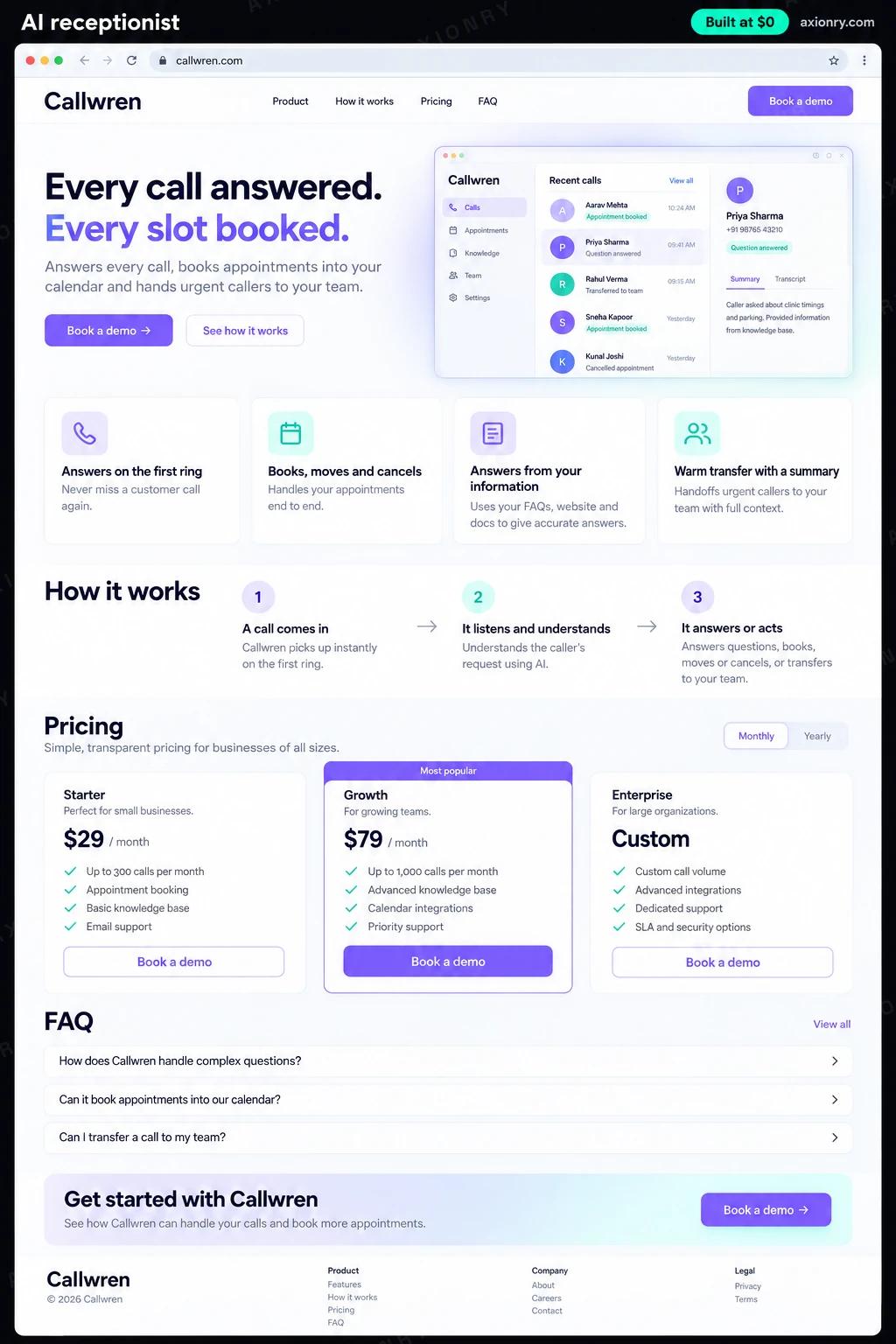
What is an AI receptionist?
An AI receptionist is a voice agent on your phone number. It answers on the first ring, day or night, works out what the caller wants, answers questions from your own policies and price list, books or moves appointments in your calendar, and transfers the calls that need a person with a short summary of what was said.
It is built for businesses where a missed call is a lost customer: clinics, dental and vet practices, law firms, salons, home services and property managers. These are the businesses that miss calls at lunch, after hours and during the morning rush, and the AI covers exactly those gaps without a night shift.
You can build it for your own business or as a product you sell to other businesses. The version priced on this page is a production agent for one business with its own dashboard. Turning it into a multi-tenant product with self-serve sign-up and billing is one of the add-ons further down.
Answered on the first ring at any hour, booked or rescheduled in one call, and put through to a person when it matters.
No more answering the same ten questions. Warm transfers arrive with a summary, and callbacks that need a human arrive as a list.
Every call, booking and missed opportunity in one dashboard, with recordings and the cost of each call.
What features does an AI receptionist need?
An AI receptionist needs 8 core features: answers on the first ring, books, moves and cancels, answers from your information, warm transfer with a summary, messages you can act on, recordings and transcripts, weekly quality review and rules your staff can change.
Answers on the first ring
Picks up on your existing number 24 hours a day, with your business name, your greeting and a voice chosen for your brand.
Books, moves and cancels
Reads live availability from Google Calendar or Microsoft 365, writes the appointment back and texts the caller a confirmation.
Answers from your information
Hours, prices, insurance, directions and policies come from documents you control, so it answers from a source instead of guessing.
Warm transfer with a summary
Emergencies, complaints and anything outside its rules go to a person, who hears a one-line summary before the caller is connected.
Messages you can act on
When nobody is free it captures the name, number, reason and urgency, and sends them to the right person by SMS or email.
Recordings and transcripts
Every call is recorded and transcribed with its outcome: booked, answered, transferred or message taken.
Weekly quality review
Calls it handled badly are flagged with the reason, so the answers and rules improve every week instead of drifting.
Rules your staff can change
Opening hours, holiday closures, transfer numbers and answers are edited in the dashboard, not in code.
What screens does an AI receptionist have?
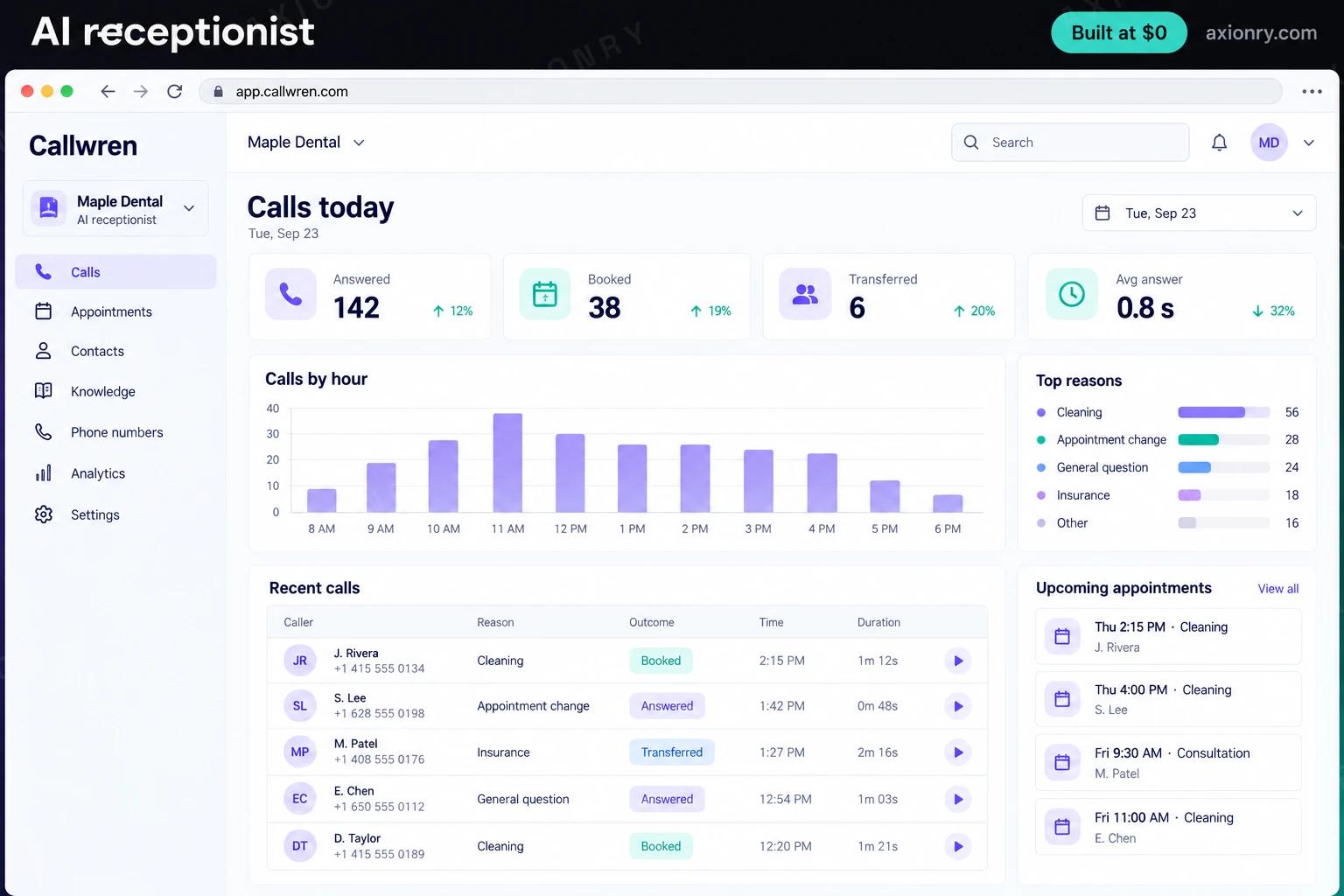
It is built around 3 screens: live call, calls dashboard and booking and confirmation.
- 1Live callThe caller's side: the call answered in the practice's name, with the live transcript and the slot being booked.
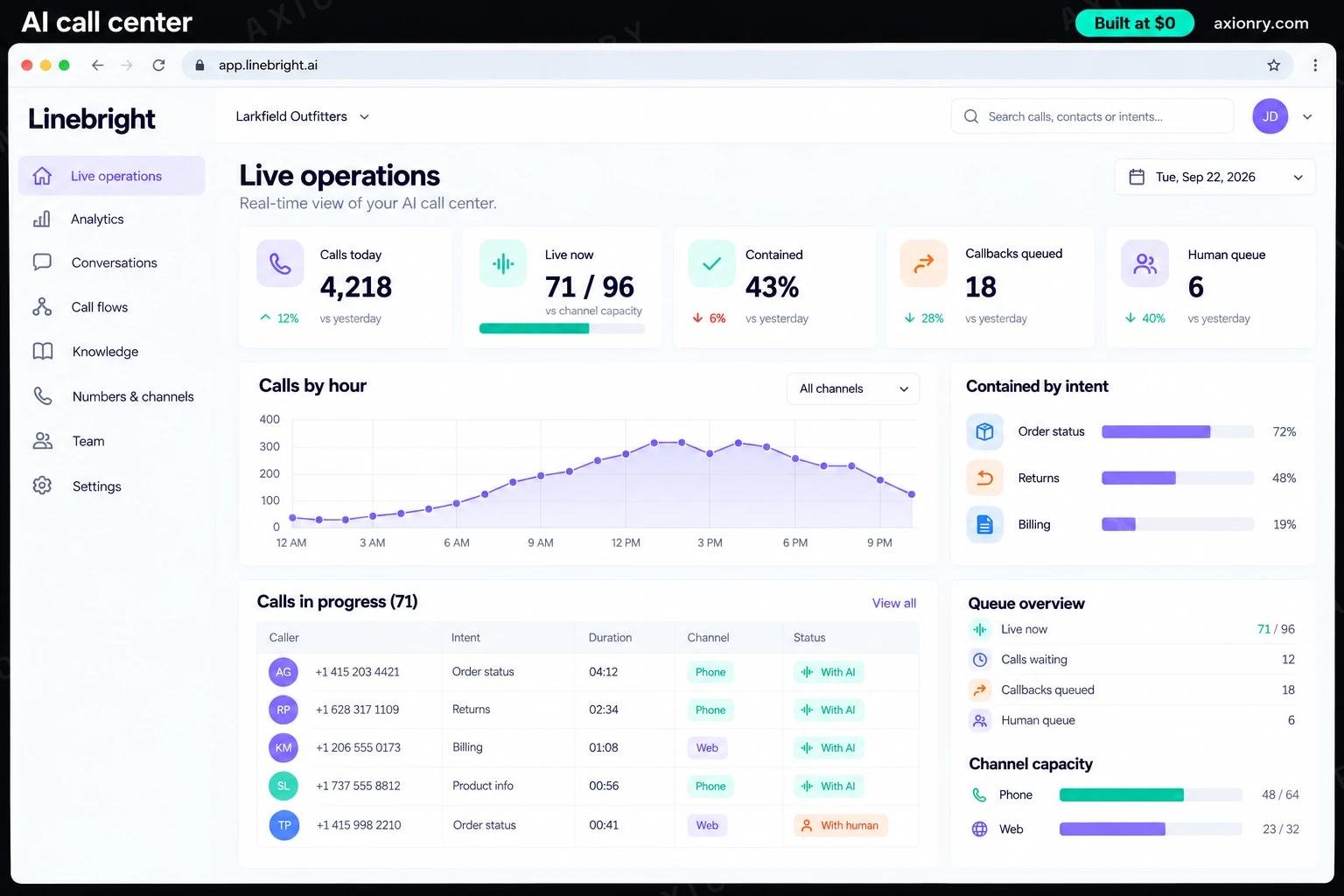
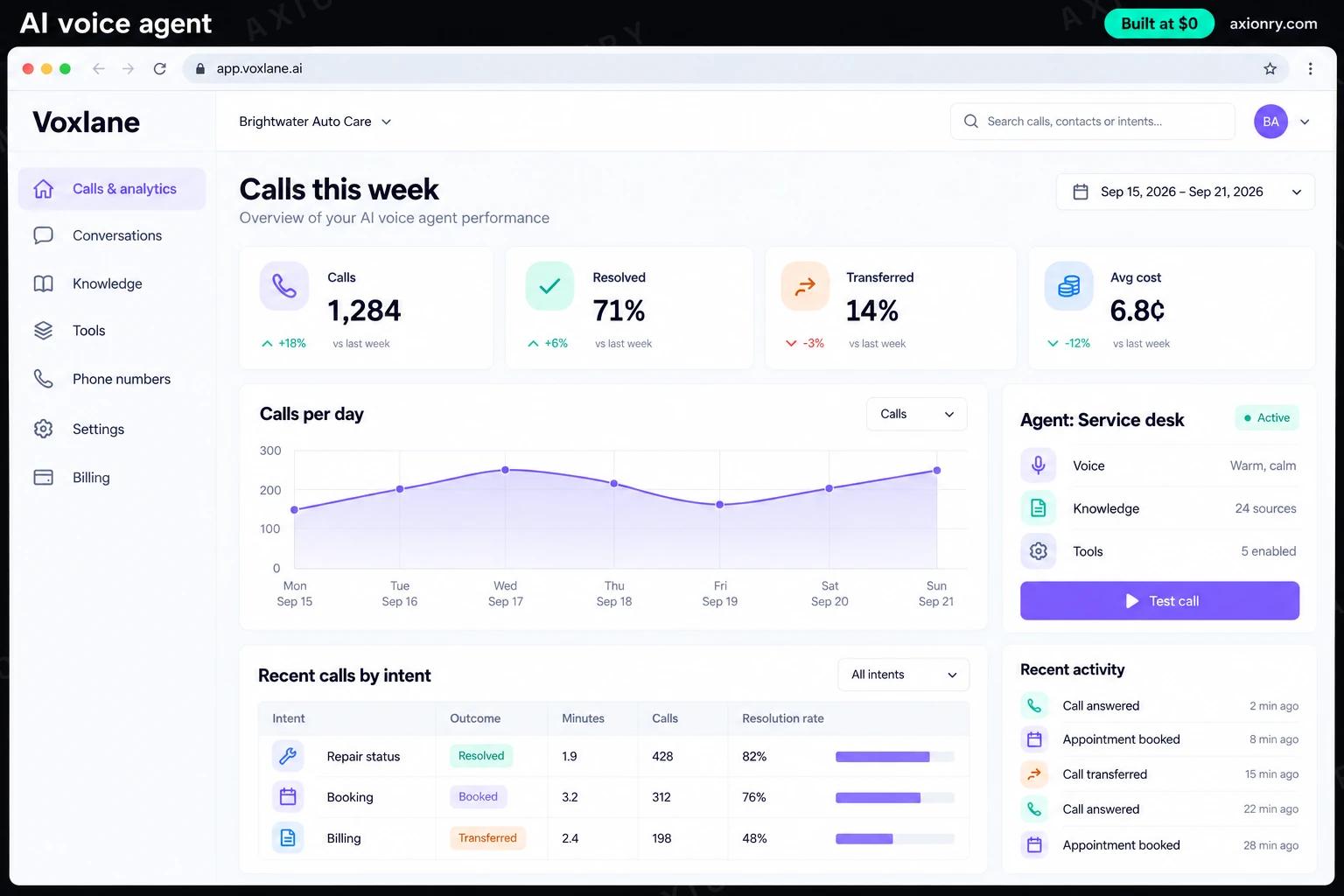
- 2Calls dashboardToday's calls answered, booked and transferred, calls by hour, and a list of recent calls with outcomes.
- 3Booking and confirmationThe appointment written to the calendar and the SMS confirmation the caller receives.
How does an AI receptionist work?
End to end, in 5 steps: a call comes in, it listens and understands, it answers or acts, it hands over when it should and everything is logged.
- 1
A call comes in
Your number forwards to a SIP trunk. The call joins a LiveKit room and an agent worker picks it up at once.
- 2
It listens and understands
Speech is transcribed as the caller talks. The agent decides when they have finished and what they want: a question, a booking, or a person.
- 3
It answers or acts
Questions are answered from your approved documents. Booking requests check live availability and write the appointment back, then a confirmation goes out by SMS.
- 4
It hands over when it should
Emergencies and anything outside its rules are transferred to a person with a summary, or turned into a message when nobody is free.
- 5
Everything is logged
The recording, transcript, outcome and cost land in the dashboard, and the weekly review flags the calls worth fixing.
What is the architecture and tech stack of an AI receptionist?
It has 8 layers: telephony (Twilio or Telnyx SIP trunk), real-time voice (LiveKit server and LiveKit Agents), speech to text (Deepgram streaming), language model (Claude Haiku 4.5, a larger model for hard turns), text to speech (Cartesia or ElevenLabs), knowledge (Postgres with pgvector), calendar and messages (Google Calendar or Microsoft 365, Twilio SMS) and dashboard and hosting (Next.js on Vercel, agent workers on AWS). The diagram shows how a request moves through them.
| Layer | What we use | Why |
|---|---|---|
| Telephony | Twilio or Telnyx SIP trunk | You keep your number and forward it. Pick the carrier by price and coverage in your country. |
| Real-time voice | LiveKit server and LiveKit Agents | Open source, runs in your cloud, handles turn-taking and interruptions. It is the stack behind our 2.5 cents a minute in production. |
| Speech to text | Deepgram streaming | Accurate on phone audio and fast enough to keep the conversation natural. |
| Language model | Claude Haiku 4.5, a larger model for hard turns | A fast model keeps replies quick. The larger model is used only when a turn needs more reasoning. |
| Text to speech | Cartesia or ElevenLabs | Natural voices with a short delay before the first word. |
| Knowledge | Postgres with pgvector | Your policies and prices, versioned, so every answer can be traced to a document. |
| Calendar and messages | Google Calendar or Microsoft 365, Twilio SMS | Books where your staff already look and confirms by text. |
| Dashboard and hosting | Next.js on Vercel, agent workers on AWS | Recordings, transcripts, rules and reviews in one place, on accounts you own. |
How much does it cost to build an AI receptionist?
A launch-ready AI receptionist costs $19,000 to $39,000 to build and takes 5 to 9 weeks. A clickable demo costs $2,300 to $4,700 (7 to 15 working days), and running it costs $180 to $430 a month at the usage below. You start at $0 and pay per checkpoint you accept.
Priced with the same model as our AI product cost estimator, from the features above. Your price is fixed in writing after a 20-minute call, before any work starts.
| Version | Build cost | Timeline | What it is |
|---|---|---|---|
| Clickable demo | $2,300 to $4,700 | 7 to 15 working days | Clickable and real where it matters, on test data. Built to show users and investors, not to carry production traffic, so compliance work starts at launch. |
| Launch-ready | $19,000 to $39,000 | 5 to 9 weeks | Production architecture, tests on the risky paths, monitoring, and a handover your team can run. |
| Enterprise-grade | $24,500 to $50,500 | 7 to 11 weeks | Load tested, highly available, audited and documented for a larger team. |
What it costs to run
About 5,000 call minutes a month, roughly 50 calls a day at 3 minutes each, plus your staff using the dashboard.
| Line | Per month | Assumes |
|---|---|---|
| Hosting and database | $45 to $120 | Vercel + managed services, sized for 100 monthly users |
| Model usage | $15 to $35 | Claude Sonnet 5, 15 requests per user a month |
| Voice minutes | $130 | 5,000 minutes on Custom LiveKit stack |
| Email, monitoring, analytics | $0 to $150 | Free tiers cover most products at launch |
| Total | $180 to $430 | List prices, before any volume discount |
Build at $0: how you pay
$0 is when you pay, not what you pay. The launch-ready build is split into checkpoints with acceptance criteria agreed before work starts, and each one is invoiced only after you have seen it and accepted it.
- 1Scope and acceptance criteriaBefore work startsA call, then a written plan: every checkpoint with acceptance criteria you agree to before work starts.$0
- 2Architecture and first flowBy week 2Data model, service boundaries and one real flow working end to end.$3,800 to $8,000
- 3Core productBy week 5The main flows on production architecture, with a demo at the end of every week.$5,500 to $11,500
- 4AI on your real dataBy week 7Models, agents or voice working on real inputs, with evals and guardrails in place.$5,500 to $11,500
- 5Launch and handoverBy week 9Deployed on your accounts and documented, with 30 days of defect correction included.$3,800 to $8,000
What can you add to an AI receptionist after launch?
The additions most teams make next: sell it to other businesses, outbound callbacks and reminders, more languages and your own voice and your practice or booking software.
Sell it to other businesses
Multi-tenant accounts, self-serve onboarding and subscriptions turn your receptionist into a product you charge for.
Outbound callbacks and reminders
The same agent calls back missed callers and confirms tomorrow's appointments, inside legal calling hours and with consent.
More languages and your own voice
Conversations in the caller's language, and a custom or cloned voice for your brand.
Your practice or booking software
A direct integration with the booking or practice management system you already use, in place of a shared calendar.
What are the risks when building an AI receptionist?
Three things decide whether it works in production: say that it is an AI, only approved answers and long pauses lose callers.
Say that it is an AI
Put it in the greeting. The EU AI Act requires people to be told they are talking to an AI, and some US states require every party's consent before a call is recorded.
Only approved answers
It should answer only from approved documents and decline everything else, medical or legal advice included. Test it on real calls before launch and review failures every week.
Long pauses lose callers
People hang up on silence. Keep the reply loop short with a fast model, streamed speech and servers close to your callers, and measure it on every call.
Where can you read more before you build?
- Voice AI Agent Use Cases Worth Building in 2026: 13 Products With Cost Per Call
- AI Voice Agent Cost Per Minute (2026): Every Line Item, Managed vs Custom, 20K to 1M Minutes
- Voice AI Build vs Buy: The Break-Even Math at 20K, 100K and 1M Minutes a Month
- AI Voice Agent Development: the service behind this build