Voice AI Agent Use Cases Worth Building in 2026: 13 Products With Cost Per Call
- At the 2.5 cents a minute I run in production, most phone use cases here cost 3 to 15 cents a call; on a managed platform at 12.5 cents a minute, roughly 13 to 75 cents. The minute is rarely the business case; the integration and the human handoff are.
- Build first where a call ends in one write to one system and the outcome is countable: appointment booking, order status, transactional confirmations. Leave collections negotiation and emergency dispatch until the compliance design exists.
- Outbound is where the law bites: in the US an AI voice counts as an artificial voice under the TCPA (FCC 24-17, February 2024), debt collectors are presumed to harass above seven calls in seven days, and India's RBI bars recovery calls before 8 am and after 7 pm.
A phone number or browser link, the AI and recording disclosure in the first seconds, and for outbound calls the consent record that allowed the call.
fails: calling without consentA SIP trunk, or a browser session, into a media server such as LiveKit.
$0.0032 to $0.005/min carrierStreaming speech to text, a language model, text to speech, turn detection and barge-in.
~2.5¢/min all-in, self-hostedThe states, the allowed actions and the things the agent may not improvise, written per use case.
fails: promises it cannot keepScoped reads and writes into the calendar, CRM, order, payment or ticketing system.
where the build time goesWarm transfer with a summary, a booked callback or an SMS follow-up when the call leaves policy.
often the biggest cost lineTranscript, outcome code, cost and consent record for every call, rolled up per use case.
fails: no proof of consentWhich voice AI agent use cases are worth building in 2026?
Thirteen that share a shape: short, structured conversations that end in a read or write to one system. Inbound: receptionist, booking and rescheduling, order status, field-service dispatch, patient intake, IT helpdesk. Outbound: pre-sales qualification, payment reminders and collections, renewals, surveys and NPS, transactional confirmations. Browser sessions: the AI interviewer and the AI tutor.
The prize is the gap between live and automated contact. Gartner put live channels at an average of $8.01 per contact against about $0.10 for self-service, and in March 2025 predicted that agentic AI will autonomously resolve 80% of common customer service issues by 2029. The first is a 2019 measurement and the second a forecast; neither is your number. Your number is what one resolved call is worth to you, and the table below is built so you can put it next to the cost.
How to read the table. Call lengths are my planning estimates for a well-scoped agent, not measurements; replace them with your own call logs. Cost is minutes times an all-in rate: 2.5 cents a minute is what I run in production on a custom LiveKit stack, down from about 10 cents, and 12.5 cents is Retell's published default of $0.11 a minute plus its $0.015 telephony. Outbound calls use 2.7 cents on the self-hosted side, because Telnyx lists outbound local at $0.005 a minute against $0.0032 inbound.
One disclosure. The 2.5-cent figure comes from voice AI I run in production. The use cases below are reference designs with the arithmetic shown, not deployments I am claiming for anyone.
| Use case | What it does | Call length (estimate) | Volume driver | Cost per call: self-hosted · managed | Must integrate with | Main risk |
|---|---|---|---|---|---|---|
| AI receptionist | Answers every call, handles routine questions, takes messages, books, transfers | 2.5 min inbound | Every inbound call | 2.5 × 2.5¢ = 6¢ · 2.5 × 12.5¢ = 31¢ | Calendar, CRM, call transfer, SMS | Answering what it should not: prices, advice |
| Appointment booking and rescheduling | Finds a slot, holds it, confirms, reschedules or cancels | 3 min inbound | About one per appointment, plus reschedules | 3 × 2.5¢ = 7.5¢ · 3 × 12.5¢ = 37.5¢ | Scheduling system with slot holds | Double-booking across channels |
| Order status and support | Verifies the caller, reads order and shipment status, opens a ticket | 2 min inbound | A share of shipped orders | 2 × 2.5¢ = 5¢ · 2 × 12.5¢ = 25¢ | Order management, carrier tracking, helpdesk | Wrong delivery dates; weak caller verification |
| Field-service dispatch | Books a technician, captures the fault, gives an arrival window | 3 min inbound | One per service request | 3 × 2.5¢ = 7.5¢ · 3 × 12.5¢ = 37.5¢ | Field-service scheduling, technician calendars | Missing an emergency that needed a person now |
| Patient intake and reminders | Collects pre-visit details; reminds, confirms or reschedules | 6 min intake, 1 min reminder | One intake per new patient, one reminder per appointment | 6 × 2.5¢ = 15¢ · 6 × 12.5¢ = 75¢ (reminder 2.5¢ · 12.5¢) | Practice management or EHR | Health data without a BAA; drift into clinical advice |
| Internal IT helpdesk | Triages issues, guides self-service fixes, opens tickets | 4 min inbound | Tickets per employee per month | 4 × 2.5¢ = 10¢ · 4 × 12.5¢ = 50¢ | Identity provider, ITSM | Social engineering into password or MFA resets |
| Pre-sales qualification | Calls new leads within a minute, qualifies, books a meeting | 4 min outbound | One per inbound lead | 4 × 2.7¢ = 11¢ · 4 × 12.5¢ = 50¢ | CRM, calendar | Calling without written consent; invented discounts |
| Payment reminders and collections | Reminds before due dates, takes promises to pay, sends a payment link | 3 min outbound | One to three per due account per cycle, within legal caps | 3 × 2.7¢ = 8¢ · 3 × 12.5¢ = 37.5¢ | Loan or billing system, payment links | Call-frequency and calling-hour rules |
| Renewals | Reminds, reads renewal terms from the system, books a person for changes | 5 min outbound | One per expiring policy or plan | 5 × 2.7¢ = 13.5¢ · 5 × 12.5¢ = 62.5¢ | Policy or subscription system, quote engine | Misstating terms or price |
| Surveys and NPS | Asks three questions after an interaction and records the answers | 2 min outbound | One per consenting customer after an interaction | 2 × 2.7¢ = 5.4¢ · 2 × 12.5¢ = 25¢ | CRM or survey tool | Low answer rates; consent |
| Transactional confirmations | Confirms a cash-on-delivery order, an address or a delivery slot | 1 min outbound | One per COD order or delivery slot | 1 × 2.7¢ = 2.7¢ · 1 × 12.5¢ = 12.5¢ | Order system, courier | Language coverage; telecom rules |
| AI interviewer | Runs a structured first-round interview and scores it with evidence | 20 min in a browser | One per screened applicant | 20 × 2.5¢ = 50¢ · 20 × 11¢ = $2.20 | ATS | Bias audits; emotion inference |
| AI tutor and doubt support | Explains, hints and answers doubts from course material | 10 min in a browser or app | One per study or doubt session | 10 × 2.5¢ = 25¢ · 10 × 11¢ = $1.10 | Course content, LMS, learner model | Handing out answers; children's data |
What does every voice AI agent need under the hood?
The same seven layers: an entry point with consent and disclosure, telephony or a browser session, a streaming voice pipeline, a conversation policy that limits what the agent may do, a tool gateway into your systems, a human handoff, and a call log with outcome and cost. Use cases differ in policy, tools and handoff; the pipeline is shared.
Follow a call through the diagram. It arrives by phone over a SIP trunk or by browser over WebRTC, and the first seconds carry the disclosure: the FCC requires artificial-voice calls to identify the business responsible at the start, and the EU AI Act's Article 50 requires telling people they are talking to an AI from 2 August 2026. The voice pipeline turns speech into turns; the conversation policy decides which actions are allowed in the current state; the tool gateway performs them with scoped credentials; anything outside policy goes to a human with a summary. Every call writes one log row: transcript, outcome, cost and consent record.
The cost sits where my per-minute breakdown says it does: text to speech and transport, not the language model. That changes if a use case needs a large model on every turn. Assume a minute of conversation sends about 3,000 input tokens, 2,000 of them cached, and returns 175: on Claude Sonnet 5 list prices that adds about 0.4 cents a minute, or about 0.8 cents uncached. Collections and renewals may need that; confirmations and order status do not.
Recording needs its own consent. California, for one, makes it an offence to record a confidential communication without the consent of all parties, so the opening line should cover recording as well as the AI. Put both in the first sentence the agent speaks, log that it was played, and you have a consent record for every call rather than a policy document nobody can match to a call.
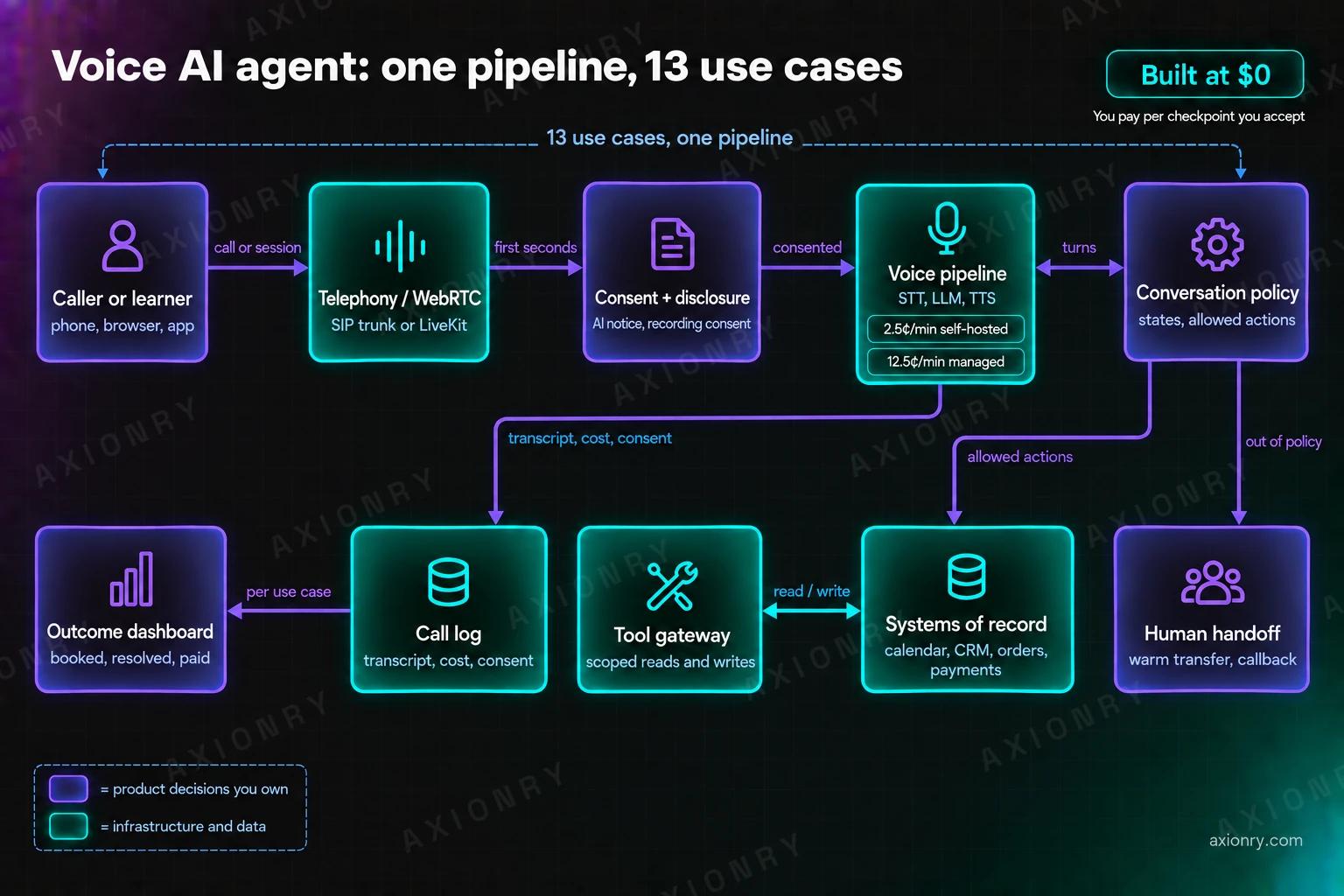
- Numbers, SIP trunk and a browser entry point
- An opening line that discloses the AI and the recording, logged as playedyour consent record
- A tuned voice pipeline with turn detection and barge-in
- A tool gateway with scoped credentials per use case
- Warm transfer with a written summary
- One call log row per call: outcome, cost, consent
- An evaluation set of recorded calls per use caseeasy to skip, and needed the first time a change breaks a call
Which inbound voice AI use cases pay back fastest?
Booking and order status, because each call ends in one read or one write and the caller wants speed, not rapport. An AI receptionist is the widest version of the same idea. Field-service dispatch pays back as well, but only once emergencies reliably reach a person within seconds.
An AI receptionist answers every call, handles the questions the business already answers the same way every time, takes messages, books and transfers. The value is the calls nobody answers: across 16.7 million missed business calls on Quo's platform in 2026, only 31% got a callback at all. At an estimated 2.5 minutes a call it costs about 6 cents self-hosted or 31 cents managed, and it integrates with a calendar, the CRM, call transfer and SMS. The risk is scope: it must not quote prices it cannot see or give advice the business would not stand behind, so its answers come from a curated list, not the website.
Booking and rescheduling is the receptionist's core write. The agent finds a slot, places a hold, confirms, and releases the hold if the caller hangs up, which is where double-booking races between phone, web and front desk get fixed or created. A 2010 randomized trial found no-show rates of 23.1% with no reminder, 17.3% with automated reminders and 13.6% with staff calls; a conversational agent that can reschedule on the spot aims at the staff-call number, which is a hypothesis to measure, not a promise. At 3 minutes a call is about 7.5 or 37.5 cents. Order status is simpler still: verify the caller with an order number and phone, read status and tracking, open a ticket if something is wrong. At 2 minutes it is 5 or 25 cents, against Gartner's $8.01 for a live contact.
Field-service dispatch books a technician, captures the fault and gives an arrival window from the scheduling system rather than from the model. At 3 minutes it costs 7.5 or 37.5 cents. The risk that matters is the rare emergency (a gas smell, a flood, no heat for an elderly customer), which must reach a person or an emergency line immediately and is the first thing to test. Running any of these at thousands of calls a day adds queueing, concurrency and QA problems of its own, covered in running an AI call center agent at thousands of calls.
| Scheduling | Customer record | Order or job system | Warm transfer | SMS follow-up | |
|---|---|---|---|---|---|
| AI receptionist | ✓ | ✓ | ✕ | ✓ | ✓ |
| Booking and rescheduling | ✓ | Read only | ✕ | ✓ | ✓ |
| Order status and support | ✕ | ✓ | ✓ | ✓ | Tracking link |
| Field-service dispatch | ✓ | ✓ | ✓ | Emergencies first | ✓ |
| Patient intake and reminders | Practice system | EHR, under a BAA | ✕ | Nurse line | ✓ |
| Internal IT helpdesk | ✕ | Identity provider | ITSM tickets | ✓ | ✕ |
Which outbound voice AI calls work, and what consent do they need?
Outbound works when the person expects the call: a lead who filled in a form minutes ago, a customer with a payment due, an order awaiting confirmation. Cold AI calling is a legal problem first. In the US an AI voice counts as an artificial voice under the TCPA, which requires prior express consent, and written consent for telemarketing.
Pre-sales qualification is speed to lead. The Lead Response Management study found the odds of qualifying a lead drop 21 times between calling within 5 minutes and calling at 30, and an agent can call within a minute of the form arriving, any day, inside legal calling hours. It asks the qualification questions, books a meeting on a rep's calendar and writes the answers to the CRM. At an estimated 4 minutes it is about 11 cents self-hosted or 50 cents managed. The risks are consent (after the FCC's February 2024 ruling, a marketing call in an AI voice needs prior express written consent) and an agent that improvises discounts. The full design is in the AI voice agent for pre-sales calls.
Payment reminders and collections run on a loan or billing system: remind before the due date, take a promise to pay, send a payment link by SMS, and hand disputes and hardship to a person. At 3 minutes it is about 8 or 37.5 cents a connected call. The rules are specific and should be code, not training: US debt collectors are presumed to harass if they call more than seven times in seven days, or within seven days of a conversation; India's RBI told lenders that borrowers must not receive recovery calls before 8 am or after 7 pm; and TRAI now requires RBI-regulated lenders to make service calls from the 1600 number series. More in AI voice agents for payment reminders and loan collections. Renewals have the same shape and run longer, about 5 minutes (13.5 or 62.5 cents); the agent reads terms from the system verbatim and books a person for any change, because a paraphrased price is a misstatement.
Surveys and NPS calls are cheap, about 5.4 or 25 cents for two minutes, and fight the medium: Pew's telephone survey response rate fell to 6% in 2018. Call only customers who just finished an interaction and agreed to be contacted, and keep it to three questions. Transactional confirmations are the opposite, short and wanted: confirming a cash-on-delivery order before dispatch in India targets the gap Shipway measured between nearly 26% returns on non-prepaid orders and under 2% on prepaid. A one-minute call is about 2.7 or 12.5 cents. The risk is language: Hindi and regional-language speech costs more, with Sarvam listing ₹30 an hour for speech to text and ₹3 per 1,000 characters for speech synthesis.
- Consent record checked before every dialprior express consent for AI voice calls; written for telemarketing (FCC 24-17)
- The business identified in the first sentence, with an opt-outrequired for artificial-voice calls
- A seven-in-seven frequency cap per debt, per person (US)12 CFR 1006.14(b)(2)
- Recovery calls only between 8 am and 7 pm (India)RBI, August 2022
- Service calls from 1600-series numbers for RBI-regulated lenders (India)
- Do-not-call and opt-out lists synced before every campaign
- Every attempt logged with its consent basiswithout it you cannot show consent for a specific call
Why do patient intake and IT helpdesk voice agents need extra care?
Because one handles protected health information and the other handles identity. Every vendor in a patient-intake voice path needs a HIPAA business associate agreement, including the speech and model providers. An IT helpdesk agent that resets passwords on a caller's say-so is the social-engineering path attackers already use against human help desks.
Patient intake collects demographics, insurance, reason for visit and pre-visit questions, and the reminder side confirms, reschedules or cancels. An intake call runs about 6 minutes (15 cents self-hosted, 75 cents managed) and a reminder about a minute (2.5 or 12.5 cents). HHS guidance is plain that a provider storing or transmitting ePHI is a business associate even if it cannot view the data, so the carrier, the speech to text, the model, the text to speech and your hosting each need a BAA. The other risk is drift into clinical advice: the agent collects and schedules, and any symptom on a red-flag list goes to a nurse line on the spot.
The internal IT helpdesk is the high-volume internal use case: figures attributed to Gartner put password resets at 20% to 50% of help desk calls, and Forrester at about $70 of labour per reset. A voice agent triages, walks people through self-service fixes and opens tickets in the ITSM tool, at about 4 minutes (10 or 50 cents). It must not reset credentials on voice alone. CISA's advisory on Scattered Spider describes attackers who posed as employees and IT staff to get help desks to reset passwords and MFA, and cloned voices make that attack easier to run at scale.
The rule for both: verify with something the caller has, not something the caller says. Push a verification to the enrolled device or the patient portal, let the agent act only after it succeeds, and keep irreversible or sensitive actions (credential resets, clinical questions, payments above a threshold) with a person.
An order number and the phone number on file are enough for most reads.
Every write carries the call id, so a mistake can be traced and undone.
The voice agent guides; the device proves identity. A voice alone never does.
The agent collects and schedules. It does not assess.
These are the calls where tone and judgement decide the outcome.
How do the AI interviewer and AI tutor work as voice products?
They are the longest sessions on the list and among the most valuable per minute. A 10 to 20 minute interview replaces a recruiter's screening call, and a tutoring session costs cents instead of a tutor's hour. Both run in a browser or app rather than on the phone, which removes the telephony line and adds a screen.
An AI interviewer runs a structured first-round interview, adapts follow-ups to the candidate's answers and scores against a rubric with quoted evidence. The strongest evidence I found is a randomized field experiment with 70,000 applicants in which those interviewed by an AI voice agent were 12% more likely to receive offers. A 20-minute browser session is 50 cents self-hosted or $2.20 at Retell's $0.11 a minute. It integrates with the ATS, and the risks are legal: annual bias audits in New York City and a ban on emotion recognition in hiring in the EU. I built AccioMatrix, an AI assessment and interview platform, on my own, and it now serves 20+ enterprise clients; the full design is in how to build an AI interviewer.
An AI tutor explains from your course material, asks Socratic questions instead of handing out answers, tracks mastery and answers doubts, by voice when reading gets in the way. A Harvard trial found learning gains more than double those of in-class active learning with a carefully designed tutor, while unguarded GPT-4 left students scoring 17% lower on exams in a Turkish study. A 10-minute voice doubt session costs about 25 cents self-hosted or $1.10 managed. It integrates with your content, your LMS and a learner model; the risks are answer leakage and children's data. The design is in how to build an AI tutor.
The browser changes the economics and the risk. A WebRTC session has wideband audio and a screen for code or equations, carries no carrier charge, and, because the user opens it, involves no outbound call at all. It also needs a device and a link, so interviews for hourly roles and learners with poor bandwidth may still need a phone path.
How do you estimate the cost of a voice AI call before you build?
Multiply the connected minutes you expect by an all-in rate per minute, then add what the minutes hide: failed outbound attempts, the person who finishes escalated calls, and a larger model if the use case needs one. The minute is rarely the biggest number. The human handoff often is.
Start with the rate cards. Self-hosted, I use 2.5 cents a minute inbound and 2.7 outbound. Managed platforms publish theirs: Retell's default is $0.11 a minute plus $0.015 for its telephony; Vapi charges $0.05 a minute for its platform and passes speech, model and telephony through at cost, which lands between about 8 and 14 cents on its own listed provider ranges; Bland lists $0.12 to $0.14 a minute, telephony extra. The voice AI cost calculator does the multiplication for your own mix.
Then the hidden lines. Outbound campaigns pay for attempts that never connect: at an assumed 35% connect rate, each connected call carries about two failed attempts, and if each costs 20 seconds of line and agent time, that adds about 1.7 cents at 2.7 cents a minute. Handoffs cost far more: if 20% of calls transfer to a person who spends 4 minutes at an assumed $20 an hour, that is $1.33 per transfer and 27 cents averaged across all calls, more than three times the machine cost of a 3-minute self-hosted call. Reduce transfers before you optimise the minute.
Finally, volume decides the stack. A dental group taking, say, 2,000 calls a month at 3 minutes uses 6,000 minutes, and a managed platform is the right answer, because a custom stack only pays for itself at around 20,000 minutes a month once engineering time is counted. A company selling the same agent to 50 groups like it would run 300,000 minutes a month, and it passes that line with its fourth customer.
Which voice AI use case should you build first?
The one where a call already ends in a single system write and the outcome is countable: booking, order status or a transactional confirmation. They are the quickest to build, the easiest to measure and the least harmful when wrong. Collections, dispatch and patient intake can be worth more, but each needs its compliance design finished before the first call.
The matrix below scores each use case on two axes. Value is volume times what a resolved call is worth: a recovered missed call, a kept appointment, a qualified lead, a collected payment. Build difficulty is integrations plus policy risk plus conversational range: an order-status agent needs one read-only integration and a narrow script, while a collections agent needs a payment system, a frequency counter, calling-hour rules, dispute handling and a tone that stays calm with a stressed caller.
Two I would not build first, even though they are valuable. Collections negotiation, because the value sits in the hard calls (hardship, disputes, anger) that the agent should hand off anyway, so start with reminders before the due date and let people negotiate. And emergency-capable dispatch, because the cost of missing one emergency outweighs a year of saved minutes; start with routine visits and route anything urgent to a person.
Pick the platform with the Retell, Vapi, Bland and LiveKit comparison, ship the first use case there, and measure resolution and transfer rates for a month before choosing the second. The second use case reuses the pipeline, the consent line and the call log, so it needs far less engineering than the first.
| Value | Build difficulty | Main integration | Build first? | |
|---|---|---|---|---|
| Appointment booking and rescheduling | High | Low | Scheduling system | ✓ |
| Order status and support | High | Low | Order management | ✓ |
| Transactional confirmations | Medium | Low | Order system | ✓ |
| AI receptionist | High | Medium | Calendar, CRM, transfer | ✓ |
| Pre-sales qualification | High | Medium | CRM, calendar | After a consent audit |
| Payment reminders | High | Medium | Billing, payment links | Reminders only |
| Collections negotiation | High | High | Loan system, disputes | ✕ |
| Renewals | Medium | Medium | Policy system, quotes | Second wave |
| Surveys and NPS | Low | Low | CRM or survey tool | If cheap to test |
| Field-service dispatch | High | High | Field-service scheduling | Routine visits only |
| Patient intake and reminders | High | High | Practice system, BAAs | Reminders first |
| Internal IT helpdesk | Medium | Medium | Identity provider, ITSM | Triage, no resets |
| AI interviewer | High | High | ATS | If hiring is your product |
| AI tutor and doubt support | High | High | Course content, LMS | If content is your product |
Should you build a voice agent on Retell or Vapi, or on your own stack?
On a platform until your combined minutes pass roughly 20,000 a month, then on your own stack. A single business rarely gets there with one use case. A company selling one use case to many businesses gets there quickly, and owning the pipeline is what makes its per-call margin work at 2.5 cents a minute rather than 12.5.
The arithmetic is plain at the extremes. At 20,000 minutes a month, 12.5 cents against 2.5 cents is a $2,000 monthly difference, which roughly pays for the maintenance of a custom stack and not much more. At 300,000 minutes it is $30,000 a month. I moved a production voice stack from about 10 cents a minute to about 2.5 on a custom LiveKit build, and the saving only mattered because the volume was there. Platforms also give you things you would rebuild on leaving: post-call analysis, campaign dialling, PII redaction and someone else's compliance paperwork.
Whichever you choose, keep the parts that carry your use-case knowledge portable: the conversation policies, the tool gateway, the consent records and the call logs. They move between platforms, and the pipeline underneath can be swapped. Then price your version in the AI product cost estimator; a voice agent build starts from $12,000.
If you want one built, Axionry builds it at $0: the work is split into checkpoints with acceptance criteria agreed before work starts, and each checkpoint is invoiced only after you have seen and accepted it. The details are on voice AI development.
Prove the use case before you optimise the minute.
Retell, Vapi or Bland at roughly 8 to 15 cents a minute all-in, shipped in weeks.
At about 2.5 cents a minute the saving covers maintenance and grows with every minute.
Per-call margin is the business model, and volume arrives with every new customer.
A BAA or data processing terms are a requirement, not a feature.
Voice AI agent use cases: common questions
→What are the best use cases for voice AI agents in 2026?
The ones with short, structured conversations that end in one system write and a countable outcome: appointment booking and rescheduling, order status, transactional confirmations and AI receptionists first, then pre-sales qualification and payment reminders once consent is designed in. Longer browser sessions such as AI interviews and AI tutoring are valuable products of their own. Collections negotiation and emergency dispatch should come later.
→How much does a voice AI agent call cost?
Minutes times an all-in rate. At the 2.5 cents a minute I run in production on a self-hosted LiveKit stack, a 3-minute call is 7.5 cents; at Retell's published $0.11 a minute plus $0.015 telephony it is 37.5 cents. Human handoffs often cost more than the machine: 20% of calls transferred for 4 minutes at $20 an hour adds 27 cents a call on average.
→Is it legal to make outbound calls with an AI voice?
In the US, yes with prior express consent, and prior express written consent for telemarketing, because the FCC ruled in February 2024 that AI-generated voices are artificial voices under the TCPA. The call must identify the business at the start and offer an opt-out where required. Debt collection adds call-frequency limits, and India adds calling hours and number-series rules.
→Which voice AI use case should I build first?
One where the call ends in a single read or write to one system and the outcome is easy to count: appointment booking, order status or a transactional confirmation. They are the fastest to build and the least harmful when wrong. Measure resolution and transfer rates for a month on that one before adding a second use case with more integrations or regulation.
→Should I use Retell or Vapi, or build my own voice stack?
Use a managed platform below roughly 20,000 minutes a month, where published rates land around 8 to 15 cents a minute all-in. Above that, a self-hosted stack at about 2.5 cents a minute pays for its maintenance. If you sell one use case to many businesses you will cross that threshold quickly, and the per-call margin becomes your business model.
→Can a voice agent reset passwords or give medical advice?
It should not do either on voice alone. Help desk social engineering is a documented attack path, so credential and MFA resets need verification on an enrolled device or a person. In healthcare the agent collects information and schedules, symptoms on a red-flag list go straight to a nurse line, and every vendor in the voice path needs a HIPAA business associate agreement.
Open the article in your assistant with one click and ask it how this applies to your product.