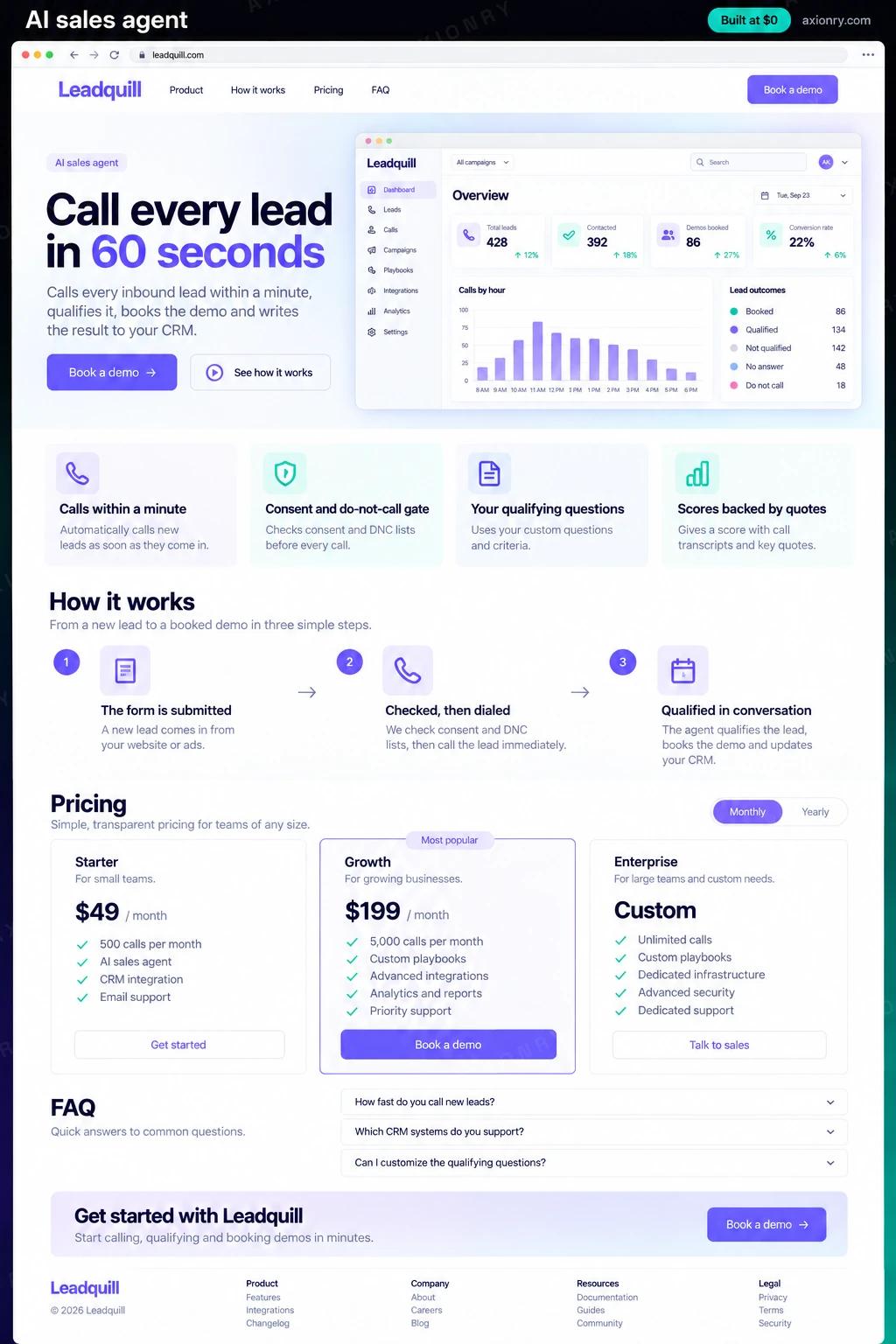
What is an AI sales agent?
An AI sales agent is a voice agent that makes your first sales call. It phones each inbound lead seconds after they submit a form, asks your qualifying questions, answers product questions from approved material, and books a demo with the right salesperson or puts a hot lead straight through to one.
It is built for B2B software, insurance, lending, education and home-services companies whose leads arrive in bursts and out of hours. The value is speed and sales time: a lead called within a minute is far easier to reach than one called the next day, and your salespeople spend their hours on buyers who qualified instead of on dialing lists.
Companies build it for their own funnel, with their own questions, calendar rules and CRM fields. This page prices that build: inbound lead calling with consent checks, qualification scoring, demo booking, warm transfer and CRM write-back. Cold calls to people who never asked to hear from you are a different product under stricter consent rules, and are not what this page prices.
A call within a minute of asking, a few relevant questions rather than a script, and a demo time that suits them before the call ends.
A calendar of qualified demos, each with a brief: need, timeline, decision maker, budget and the lead's own words behind each.
Edits questions, scoring and routing rules without a developer, and tracks speed to lead, connect rate, qualification rate and show rate.
What features does an AI sales agent need?
An AI sales agent needs 8 core features: calls within a minute, consent and do-not-call gate, your qualifying questions, scores backed by quotes, approved product answers, books the right calendar, hot leads put through and written back to the CRM.
Calls within a minute
A CRM or form webhook starts the call seconds after submission, inside permitted hours for the lead's time zone.
Consent and do-not-call gate
Written consent, do-not-call lists, local time and state rules are checked before every dial, in code the model cannot bypass.
Your qualifying questions
Need, timing, authority and budget, or your own criteria, as editable slots asked in a natural order with at most two attempts each.
Scores backed by quotes
Each answer is stored with the lead's own words, and code rather than the model computes the score and the next step.
Approved product answers
Pricing, integrations and security answers come from a reviewed answer sheet; anything else is deferred to the specialist on the demo.
Books the right calendar
Reads live availability across your account executives, books by round robin or territory, and sends the invite by email and SMS.
Hot leads put through
A decision maker with a near deadline is transferred to a free salesperson after a private briefing, or booked if nobody picks up.
Written back to the CRM
Answers, score, summary, objections and the recording link reach HubSpot or Salesforce within a minute of hang-up.
What screens does an AI sales agent have?
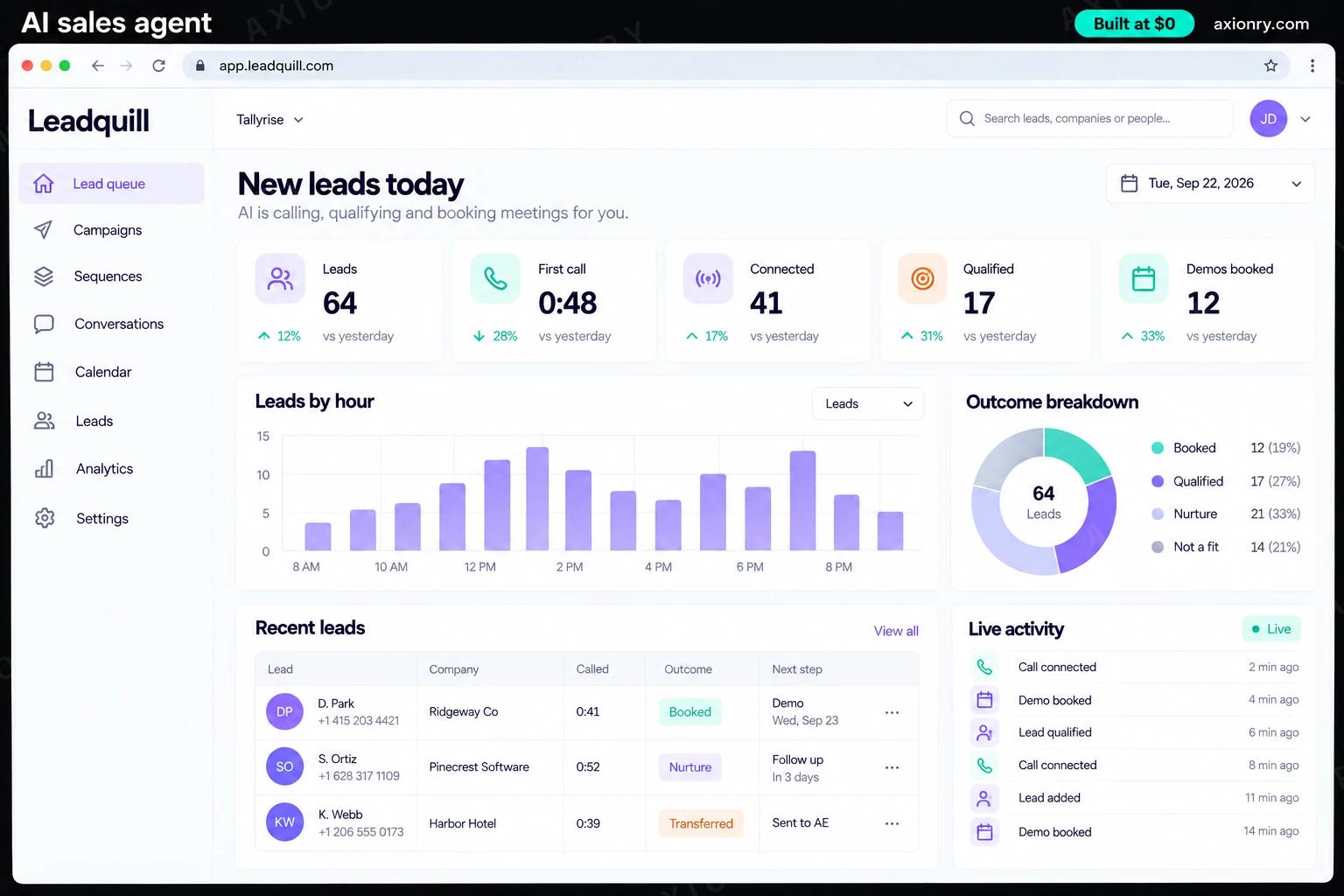
It is built around 3 screens: lead queue, the lead's phone and CRM record.
- 1Lead queueToday's new leads with time to first call, connected, qualified and booked counts, and each lead's outcome.
- 2The lead's phoneThe call arriving seconds after the form fill, with the agent's opening line and the start of qualification.
- 3CRM recordNeed, timing, authority and budget with the lead's quotes, the score, a short summary and the booked demo.
How does an AI sales agent work?
End to end, in 5 steps: the form is submitted, checked, then dialed, qualified in conversation, booked, transferred or closed and written back with a brief.
- 1
The form is submitted
The lead ticks a consent box that names your company and covers AI calls, and your CRM fires a webhook within seconds.
- 2
Checked, then dialed
Consent, do-not-call status, the lead's local time and any active call are checked, then the dialer rings through your SIP trunk with voicemail detection.
- 3
Qualified in conversation
The agent says it is an AI assistant on a recorded line, works through your questions and answers product questions from the approved sheet.
- 4
Booked, transferred or closed
Qualified leads get a demo slot and hot ones a warm transfer; early ones go to nurture and unclear ones to a human callback.
- 5
Written back with a brief
Answers with quotes, the score, a summary and the recording link land in the CRM, and the salesperson gets a brief before the meeting.
What is the architecture and tech stack of an AI sales agent?
It has 8 layers: lead trigger (HubSpot or Salesforce webhooks, or your form tool's), compliance gate (A small Node.js service with consent records and a do-not-call list in Postgres), telephony (LiveKit outbound SIP over Telnyx or Twilio, answering machine detection), voice pipeline (LiveKit Agents, Deepgram, Claude Haiku 4.5, Cartesia), product knowledge (An approved answer sheet loaded into a cached prompt), booking (Calendly or Cal.com API, or Google and Microsoft 365 calendars), CRM write-back (HubSpot or Salesforce API through a queue with retries) and QA and dashboard (Claude Sonnet 5 transcript checks, Next.js admin). The diagram shows how a request moves through them.
| Layer | What we use | Why |
|---|---|---|
| Lead trigger | HubSpot or Salesforce webhooks, or your form tool's | The call starts when the lead is created; polling every few minutes throws away the minutes the product exists to save. |
| Compliance gate | A small Node.js service with consent records and a do-not-call list in Postgres | Consent wording, timestamp and page are stored with each lead, and no dial happens without a pass from this service. |
| Telephony | LiveKit outbound SIP over Telnyx or Twilio, answering machine detection | Voicemail also picks up the line, so detection decides between a conversation and a short message. |
| Voice pipeline | LiveKit Agents, Deepgram, Claude Haiku 4.5, Cartesia | Turn detection is tuned for patience, because on a sales call a pause is often an objection forming. |
| Product knowledge | An approved answer sheet loaded into a cached prompt | Small enough to load whole, so there is no search step in the turn and every claim sits in one reviewable file. |
| Booking | Calendly or Cal.com API, or Google and Microsoft 365 calendars | Slots are read when offered and booked with an idempotency key, so a retry never double-books a salesperson. |
| CRM write-back | HubSpot or Salesforce API through a queue with retries | One structured record per call, written from the qualification state rather than parsed from the transcript afterwards. |
| QA and dashboard | Claude Sonnet 5 transcript checks, Next.js admin | Every call is checked for the AI disclosure, invented claims and opt-outs, and the dashboard shows speed to lead and show rate. |
How much does it cost to build an AI sales agent?
A launch-ready AI sales agent costs $22,000 to $46,000 to build and takes 6 to 10 weeks. A clickable demo costs $2,600 to $5,500 (2 to 4 weeks), and running it costs $180 to $420 a month at the usage below. You start at $0 and pay per checkpoint you accept.
Priced with the same model as our AI product cost estimator, from the features above. Your price is fixed in writing after a 20-minute call, before any work starts.
| Version | Build cost | Timeline | What it is |
|---|---|---|---|
| Clickable demo | $2,600 to $5,500 | 2 to 4 weeks | Clickable and real where it matters, on test data. Built to show users and investors, not to carry production traffic, so compliance work starts at launch. |
| Launch-ready | $22,000 to $46,000 | 6 to 10 weeks | Production architecture, tests on the risky paths, monitoring, and a handover your team can run. |
| Enterprise-grade | $28,500 to $60,000 | 7 to 13 weeks | Load tested, highly available, audited and documented for a larger team. |
What it costs to run
Roughly 1,500 new leads a month, each getting one qualification call or a voicemail, which comes to about 5,000 minutes, plus the sales team on the dashboard.
| Line | Per month | Assumes |
|---|---|---|
| Hosting and database | $45 to $120 | Vercel + managed services, sized for 100 monthly users |
| Model usage | $10 to $25 | Claude Sonnet 5, 15 requests per user a month |
| Voice minutes | $130 | 5,000 minutes on Custom LiveKit stack |
| Email, monitoring, analytics | $0 to $150 | Free tiers cover most products at launch |
| Total | $180 to $420 | List prices, before any volume discount |
Build at $0: how you pay
$0 is when you pay, not what you pay. The launch-ready build is split into checkpoints with acceptance criteria agreed before work starts, and each one is invoiced only after you have seen it and accepted it.
- 1Scope and acceptance criteriaBefore work startsA call, then a written plan: every checkpoint with acceptance criteria you agree to before work starts.$0
- 2Architecture and first flowBy week 2Data model, service boundaries and one real flow working end to end.$4,400 to $9,000
- 3Core productBy week 5The main flows on production architecture, with a demo at the end of every week.$6,500 to $14,000
- 4AI on your real dataBy week 8Models, agents or voice working on real inputs, with evals and guardrails in place.$6,500 to $14,000
- 5Launch and handoverBy week 10Deployed on your accounts and documented, with 30 days of defect correction included.$4,400 to $9,000
What can you add to an AI sales agent after launch?
The additions most teams make next: research brief before the dial, an AI line for inbound sales calls, rules for other countries and re-engagement on a new signal.
Research brief before the dial
Pulls the lead's company size, industry and CRM history before calling, so the first question fits the account.
An AI line for inbound sales calls
Answers calls to your sales number with the same questions, scoring and booking, so phone leads are handled like form leads.
Rules for other countries
Consent wording, calling hours, voices and do-not-call lists per country for leads in the UK, Canada or Australia.
Re-engagement on a new signal
Calls a quiet lead once more only when they act again, such as registering for a webinar or requesting pricing, with consent on file.
What are the risks when building an AI sales agent?
Three things decide whether it works in production: consent before code, invented claims on a recorded line and booked is not qualified.
Consent before code
Under the TCPA, the FCC's February 2024 ruling treats AI voices as artificial voices, so sales calls to mobiles need prior express written consent naming your company. Put a consent checkbox in the form and store its wording, timestamp and page with every lead before the agent makes a single call.
Invented claims on a recorded line
A prospect who hears a wrong security or pricing answer will hold your team to it. Answer only from the approved sheet, defer the rest to the specialist, and check every transcript for claims the sheet does not support; the target is zero.
Booked is not qualified
An agent that fills calendars with meetings nobody attends wastes more sales time than it saves. Keep scoring in code, send thin evidence to a human callback, and judge the agent on show rate and pipeline, not on bookings.
Where can you read more before you build?
- AI Voice Agent for Pre-Sales Calls: Call Every Lead in 60 Seconds, Qualify It, Book the Demo
- AI Voice Agent Development: the service behind this build