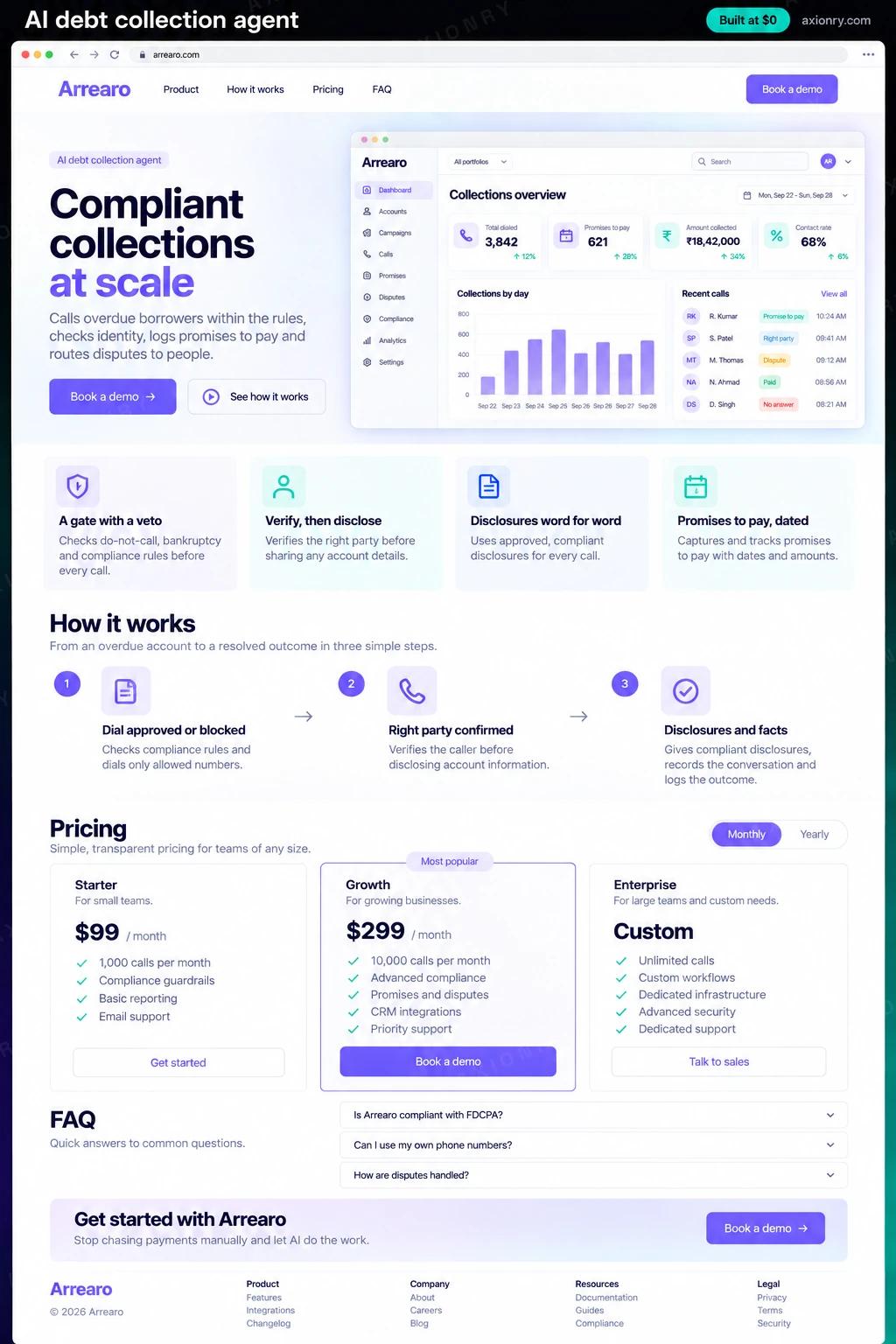
What is an AI debt collection agent?
An AI debt collection agent phones borrowers about overdue payments and follows the same rules as human collectors. It verifies identity before discussing the account, reads the amount from your loan system, offers payment by link, a promise to pay or an approved plan, and hands disputes, hardship and requests for a person to specialists.
It is built for lenders, NBFCs, credit unions, buy-now-pay-later providers, card issuers and collection agencies working early-stage delinquency, where most accounts need a reminder and an easy way to pay rather than negotiation. The value is coverage and consistency: every account called, and only inside the permitted window, every disclosure given word for word, and every call provable afterwards.
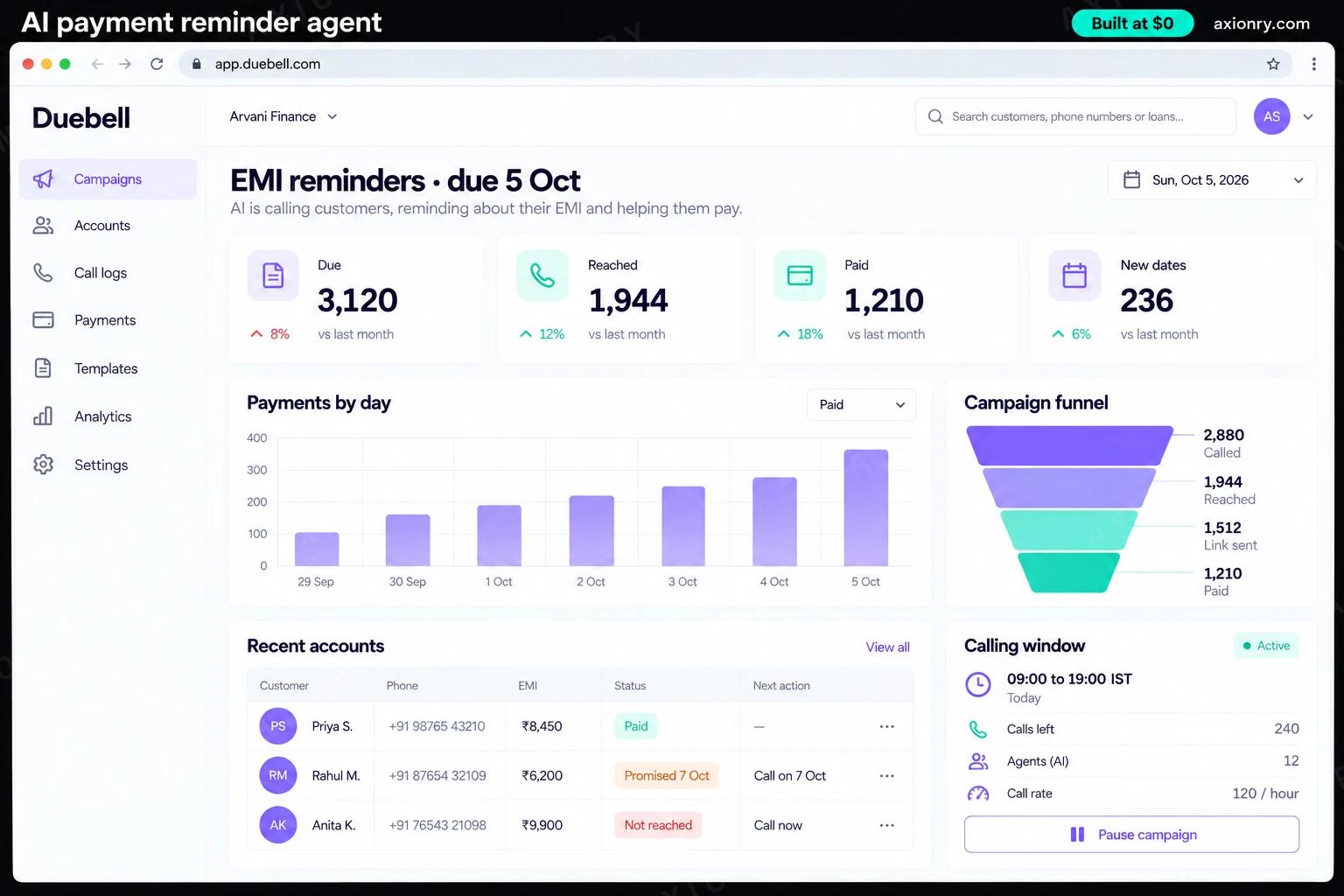
Lenders build it for their own book; agencies build it to work portfolios for several creditors, which adds per-client rules and reporting. The estimate below is for the lender's version: one portfolio, US and Indian calling rules held as data, identity checks, payment links, a specialist queue and a full audit trail. Pre-due reminders are simpler and are priced on the AI payment reminder agent page.
A calm call at a permitted time, nothing shared with anyone else, clear ways to pay, and a person whenever they dispute the debt or describe hardship.
A queue of disputes, hardship cases and plan requests outside policy, each with the recording, the borrower's own words and the reason it was routed.
Calling rules they can read as a table, a log proving each dial was allowed and each disclosure given, and flagged calls to review every week.
What features does an AI debt collection agent need?
An AI debt collection agent needs 8 core features: a gate with a veto, verify, then disclose, disclosures word for word, promises to pay, dated, plans only from policy, handover triggers, payment by link and an audit row per call.
A gate with a veto
Before every dial it checks local time, attempts on that debt, cease, dispute, attorney and bankruptcy flags, and consent; no pass, no call.
Verify, then disclose
Asks for the borrower by name and checks two facts against the loan record before saying anything about the account.
Disclosures word for word
The debt collector notice (the mini-Miranda) and the recording notice play as fixed text at fixed points, never paraphrased by the model.
Promises to pay, dated
Accepts a date inside your policy window, reads the amount back and stores the promise with the borrower's words quoted.
Plans only from policy
Offers only the installment plans your matrix allows for that product and days past due; anything else goes to a person.
Handover triggers
A dispute, hardship, a bereavement, a lawyer, bankruptcy or a request for a person pauses automated calls and routes the account to a specialist.
Payment by link
Sends a link to your gateway's own page by SMS or WhatsApp, and the gateway webhook, not the conversation, marks the account paid.
An audit row per call
Gate decision, verification result, disclosures played, outcome and recording in one record you can retrieve with one query.
What screens does an AI debt collection agent have?
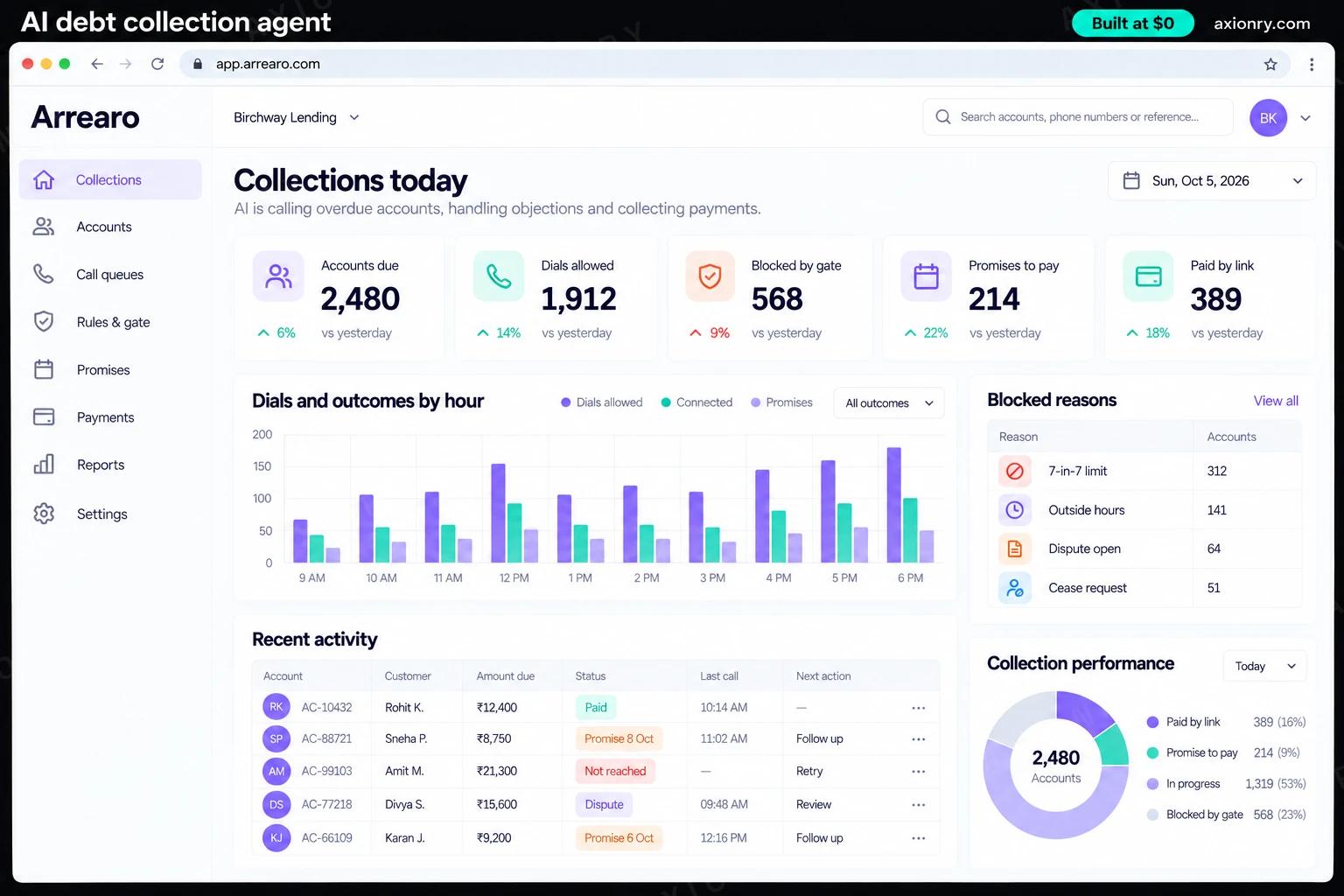
It is built around 3 screens: live call, collections workspace and specialist queue.
- 1Live callThe borrower's phone: the agent confirms it has the right person, asking for her date of birth before any account detail.
- 2Collections workspaceToday's accounts, dials allowed and blocked by the gate with reason codes, promises to pay and payments received.
- 3Specialist queueDisputes, hardship cases and plan requests handed over by the agent, each with the reason and the recording.
How does an AI debt collection agent work?
End to end, in 5 steps: dial approved or blocked, right party confirmed, disclosures and facts, resolved or routed and proved and reconciled.
- 1
Dial approved or blocked
The scheduler picks accounts by days past due and local time, and the compliance gate approves or blocks each dial with a logged reason code.
- 2
Right party confirmed
The agent asks for the borrower by name, says it is an automated assistant and checks two facts before any account detail. With the wrong person it ends politely and discloses nothing.
- 3
Disclosures and facts
Required notices play word for word, then the amount and due date are read exactly as the loan system returned them.
- 4
Resolved or routed
Pay now by link, a promise to pay inside the policy window or an approved plan; disputes, hardship and requests for a person go to a specialist.
- 5
Proved and reconciled
The gateway webhook marks payments, promises feed tomorrow's schedule, and every call is written to the audit record and scored for compliance.
What is the architecture and tech stack of an AI debt collection agent?
It has 8 layers: rules as data (Versioned rule tables in Postgres, per US state and for India), compliance gate (A small Node.js or Python service with a veto over the dialer), sequences (Temporal or Inngest durable workflows), telephony (LiveKit outbound SIP over Telnyx or Twilio, answering machine detection), voice and model (LiveKit Agents, Deepgram, Claude Haiku 4.5, Cartesia), payments (Razorpay or Stripe payment links, driven by webhooks), audit and QA (Postgres, S3 recordings, Claude Sonnet 5 transcript scoring) and workspace (Next.js with team roles and an audit log). The diagram shows how a request moves through them.
| Layer | What we use | Why |
|---|---|---|
| Rules as data | Versioned rule tables in Postgres, per US state and for India | Calling hours, attempt limits and disclosure text live in tables your compliance team can read and your lawyer can review. |
| Compliance gate | A small Node.js or Python service with a veto over the dialer | Every dial needs a gate token with a reason code, and the voice agent has no path around it. |
| Sequences | Temporal or Inngest durable workflows | Message first, call later, pause seven days after a conversation: multi-day sequences that survive restarts without double-calling. |
| Telephony | LiveKit outbound SIP over Telnyx or Twilio, answering machine detection | Every attempt counts toward the limit whether answered or not, so the counter is fed from the dialer, not the conversation. |
| Voice and model | LiveKit Agents, Deepgram, Claude Haiku 4.5, Cartesia | The model chooses words only; amounts come from tool results, terms from the policy file, and a filter checks each sentence before it is spoken. |
| Payments | Razorpay or Stripe payment links, driven by webhooks | Payment happens on the gateway's page, and its webhook is the only thing that marks an account paid. |
| Audit and QA | Postgres, S3 recordings, Claude Sonnet 5 transcript scoring | Each call is scored after hang-up for disclosures, threats, third-party mentions and missed handovers, and flagged calls go to a person. |
| Workspace | Next.js with team roles and an audit log | Specialists work their queue and compliance edits the rules, and every change to a rule is logged with who made it. |
How much does it cost to build an AI debt collection agent?
A launch-ready AI debt collection agent costs $32,500 to $67,500 to build and takes 8 to 14 weeks. A clickable demo costs $3,800 to $8,000 (2 to 5 weeks), and running it costs $800 to $1,050 a month at the usage below. You start at $0 and pay per checkpoint you accept.
Priced with the same model as our AI product cost estimator, from the features above. Your price is fixed in writing after a 20-minute call, before any work starts.
| Version | Build cost | Timeline | What it is |
|---|---|---|---|
| Clickable demo | $3,800 to $8,000 | 2 to 5 weeks | Clickable and real where it matters, on test data. Built to show users and investors, not to carry production traffic, so compliance work starts at launch. |
| Launch-ready | $32,500 to $67,500 | 8 to 14 weeks | Production architecture, tests on the risky paths, monitoring, and a handover your team can run. |
| Enterprise-grade | $42,000 to $87,000 | 9 to 17 weeks | Load tested, highly available, audited and documented for a larger team. |
What it costs to run
About 30,000 call minutes a month across attempts, voicemails and conversations on overdue accounts, plus specialists and compliance staff in the workspace.
| Line | Per month | Assumes |
|---|---|---|
| Hosting and database | $45 to $120 | Vercel + managed services, sized for 100 monthly users |
| Model usage | $10 to $25 | Claude Sonnet 5, 15 requests per user a month |
| Voice minutes | $750 | 30,000 minutes on Custom LiveKit stack |
| Email, monitoring, analytics | $0 to $150 | Free tiers cover most products at launch |
| Total | $800 to $1,050 | List prices, before any volume discount |
Build at $0: how you pay
$0 is when you pay, not what you pay. The launch-ready build is split into checkpoints with acceptance criteria agreed before work starts, and each one is invoiced only after you have seen it and accepted it.
- 1Scope and acceptance criteriaBefore work startsA call, then a written plan: every checkpoint with acceptance criteria you agree to before work starts.$0
- 2Architecture and first flowBy week 3Data model, service boundaries and one real flow working end to end.$6,500 to $13,500
- 3Core productBy week 7The main flows on production architecture, with a demo at the end of every week.$10,000 to $20,500
- 4AI on your real dataBy week 11Models, agents or voice working on real inputs, with evals and guardrails in place.$10,000 to $20,500
- 5Launch and handoverBy week 14Deployed on your accounts and documented, with 30 days of defect correction included.$6,500 to $13,500
What can you add to an AI debt collection agent after launch?
The additions most teams make next: agency mode, self-serve hardship portal, settlements with sign-off and more languages.
Agency mode
Separate rule sets, scripts, reports and data per creditor, for collection agencies working several portfolios.
Self-serve hardship portal
A secure page where borrowers explain their situation, upload documents and choose from approved plans without a call.
Settlements with sign-off
Settlement offers inside limits your credit team sets, each approved by a person before the agent presents it.
More languages
Calls in the borrower's preferred language, with every disclosure translated, approved and stored as fixed text.
What are the risks when building an AI debt collection agent?
Three things decide whether it works in production: FDCPA and Regulation F, RBI rules in India and what it must never do.
FDCPA and Regulation F
Regulation F presumes compliance at no more than seven call attempts in seven days per debt and none for seven days after a conversation; unanswered calls count, and calls before 8am or after 9pm local time are presumed inconvenient. It binds third-party collectors, who also owe the mini-Miranda disclosure; lenders collecting in their own name are largely outside it, but the same limits are the safer default. Enforce them in the gate, not the prompt.
RBI rules in India
Recovery calls are barred before 8:00 a.m. and after 7:00 p.m., along with threats, harassment of family or referees and misleading statements, and microfinance is stricter at 9:00 a.m. to 6:00 p.m. From 1 January 2027 lenders must also document and record recovery calls and tell the borrower.
What it must never do
Never threaten arrest, seizure or legal action that is not lawful and intended, never discuss the debt with anyone but the verified borrower, never invent an amount or offer, never ask for card numbers or OTPs, and never carry on after a dispute or hardship signal. Each rule needs a place in code.
Where can you read more before you build?
- AI Voice Agent for Payment Reminders and Loan Collections: Architecture, FDCPA and RBI Rules
- AI Voice Agent Development: the service behind this build