AI Agents Worth Building in 2026: 11 Types by Job, Buyer, Build Cost and Risk
- Eleven agent types are worth building in 2026, and each has frequent work, an API to act through and an outcome someone can check. Support resolution, voice reception, document processing and payment reminders are the places to start; browser agents come last, because any web page can carry instructions.
- Set autonomy by the cost of a wrong action: assistive for hiring decisions and analysis, supervised for anything that moves money, autonomous only inside hard limits. Gartner expects over 40% of agentic AI projects to be cancelled by the end of 2027 over cost, value and risk controls.
- Most of these need a workflow or one tool-using agent, not a multi-agent system, which Anthropic measured at about 15 times the tokens of a chat. Axionry's published starting prices run from $1,000 for a working demo to $22,000 for an AI-first product, against the $50,000 to $150,000 US agencies quote for a production MVP.
Support resolution agent, sales research and outreach agent, voice receptionist and phone agents. They answer, book, qualify and follow up where customers already are.
supervisedAI interviewer and AI tutor. High value, regulated, and never the final decision-maker on a hire or a grade.
assistive to supervisedData analyst agent, document processing agent and research agent. Read-mostly, and checkable against a source before anyone acts.
read-mostlyCoding and QA agent. Opens pull requests and runs tests in a sandbox; a person merges.
supervisedBack-office ops agent for finance, collections and reminders, plus the browser or computer-use agent for systems with no API.
hard limits in codeWhich AI agents are actually worth building in 2026?
Eleven types clear the bar: support resolution, sales research and outreach, voice receptionist and phone agents, AI interviewers, AI tutors, data analysts, document processing, coding and QA, browser or computer use, back-office ops, and research. Each does a frequent job, acts through an API or a controlled interface, and produces an outcome someone can check.
What is missing from the list matters as much: general assistants that do anything for anyone, agents nobody can measure, and agents that need write access to systems with no API. Gartner predicts over 40% of agentic AI projects will be cancelled by the end of 2027 over escalating costs, unclear value or inadequate risk controls, and counts only about 130 real vendors among the thousands claiming agentic products. Every agent in the table exists because its value is countable: tickets closed, calls answered, pages extracted, hours returned.
Read the table as a buyer. Autonomy has three levels: assistive (it drafts, a person acts), supervised (it acts on low-risk steps, a person approves the rest) and autonomous (it acts end to end inside hard limits). Build costs are estimates anchored to Axionry's published starting prices: a working demo from $1,000, an AI feature inside an existing product from $10,000, a voice agent from $12,000, an AI-first product from $22,000, and an AI data analyst at $6,000 to $18,000 for most builds. US agencies quote $50,000 to $150,000 for a production MVP.
My reference point is AccioMatrix, the AI assessment and interview platform I built solo, which now serves 20+ enterprise clients. That is where the scepticism in this post comes from: the agents that survive are the ones with a narrow job, a spending limit and a person who can say no.
| Agent | What it does | Who buys it | Autonomy | Build cost (estimate) | Main risk |
|---|---|---|---|---|---|
| Support resolution | Resolves tickets from docs and account data, briefs a person on the rest | Support leads at SaaS and e-commerce companies | Supervised | From $10,000 in your helpdesk; from $22,000 as the product | A confident wrong answer sent to a customer |
| Sales research and outreach | Researches accounts, writes briefs and first-touch emails, logs to the CRM | Sales and revenue operations teams | Research autonomous, sending supervised | From $10,000 | Stale facts in a brief; spam complaints near Gmail's 0.3% ceiling |
| Voice receptionist and phone agents | Answers calls, books appointments, qualifies leads, transfers to a person | Clinics, home services, property and sales teams | Autonomous inside a script | From $12,000 | Latency, wrong bookings, consent rules on outbound calls |
| AI interviewer | Runs structured screening interviews by voice or video and scores against a rubric | Recruiting teams, assessment platforms, staffing firms | Assistive: a person decides | From $12,000; from $22,000 as a hiring product | Bias and regulation: NYC Local Law 144, EU high-risk rules |
| AI tutor | Guides a learner through problems without giving the answer away | Edtech companies, schools, training teams | Autonomous in session, supervised on grading | From $12,000 as an MVP; from $22,000 as a product | Answer-leaking or wrong help; children's data rules |
| Data analyst | Answers business questions in plain English with the SQL on show | Operators and founders without an analyst on call | Assistive | $6,000 to $18,000 | A plausible wrong number |
| Document processing | Extracts, validates and routes invoices, contracts and forms | Finance, insurance, logistics and legal operations | Supervised: low-confidence pages go to review | From $10,000 | Silent extraction errors that pass downstream |
| Coding and QA | Turns tickets into pull requests, writes and runs tests in a sandbox | Engineering teams and agencies | Supervised: a person merges | From $10,000 as internal tooling | Changes that pass tests and are still wrong |
| Browser or computer use | Operates web apps and desktops that have no API | Operations teams stuck with legacy portals | Supervised: approval before submit or pay | From $10,000 per workflow | Prompt injection from page content |
| Back-office ops | Chases payments, sends reminders, matches invoices, prepares reconciliations | Finance teams, lenders, subscription businesses | Supervised; reminders can run autonomously | From $10,000; from $12,000 with voice | Wrong amounts; calling-hour and consent rules |
| Research agent | Searches, reads and synthesises sources into a cited report | Strategy, diligence, sales and product teams | Autonomous, read-only | From $10,000 | Confident synthesis of weak sources |
How do you tell if an AI agent is worth building?
Ask five questions: is the job frequent, is a correct outcome checkable, is a wrong action cheap or reversible, can the agent act through an API, and does a named person own the result. Four yeses justify a demo. Two or fewer, and a better form, macro or report will beat any agent you could build.
The quadrant places the eleven types on the two axes that decide most of it: how much work there is to take off people, and how costly a wrong action is. Support, document processing, reminders and voice reception sit in the good corner, with lots of volume and mistakes a person can catch or reverse. Interviewing and anything that moves money sit further along the risk axis. That does not rule them out; it sets their autonomy and puts an approval step and an audit trail in the first version.
Checkability is the question teams skip. A support answer can be checked against the document it cites, an extracted invoice against its own line totals, a SQL answer against the query printed beside it. A research memo or a sales email is checked by a person reading it, which caps how much autonomy it can have and how fast you can test a new model. If you cannot write down the correct outcome for 50 real examples, you can build a demo but not an agent you can trust.
Anthropic's guidance says the same from the builder's side: start with simple prompts and add multi-step agentic systems only when simpler solutions fall short. The first version of most agents on this list is a workflow with one or two model calls, and the agent loop arrives only where the path through the task cannot be known in advance.
- Does the job happen hundreds of times a month?Below that the build cost will not come back; a checklist or macro is cheaper.
- Can you define the correct outcome for 50 real examples?If not, you can build a demo but not an eval, and you will not see a model change break it.
- Is a wrong action cheap, reversible or caught before it lands?If not, the agent proposes and a person approves, which fixes its autonomy level.
- Can the agent act through an API or an MCP server?If it has to drive a screen, add a browser agent's risks and costs to the case.
- Does a named person own the outcome and the metrics?Agents without an owner drift, and nobody notices the override rate climbing.
What do support, sales and voice AI agents do for a business?
They work the front of the queue and the front of the funnel. A support agent resolves routine tickets and briefs a person on the rest, a sales agent researches accounts and drafts outreach, and a voice agent answers or places calls. All three are supervised in practice, because customers see their mistakes.
The support resolution agent is the most proven of the eleven. It answers from your documentation and account data, resolves what it can cite, and hands the rest to a person with a written brief. The vendor benchmark is Intercom's Fin from $0.99 per outcome; our AI customer support agent design models an in-house build at about 7 cents in models per resolved ticket and finds buying cheaper below roughly 14,000 tickets a month. Minimum architecture: triage, retrieval, a bounded loop with read tools, and a confidence gate. Main risk: a fluent, cited, wrong answer.
The sales research and outreach agent builds an account brief before a call and drafts a first-touch email a rep can send. Research can run autonomously because it only reads. Sending should stay supervised, because Gmail requires bulk senders to keep reported spam below 0.30% and support one-click unsubscribe, and an agent that sends at volume can cross that line faster than anyone reviews its drafts. Freshness and cost per brief are worked through in the sales research agent design.
Voice receptionist and phone agents answer calls, book appointments, qualify leads and transfer to a person, or place outbound calls. Published pricing runs from $0.07 to $0.31 a minute on Retell; on a custom LiveKit stack I cut production voice cost from about 10 cents to 2.5 cents a minute. In the US an AI voice counts as an artificial voice under the TCPA, so outbound AI calls need the called party's prior express consent unless an exemption applies (FCC 24-17). The detailed builds are an AI voice agent for pre-sales calls and a call center agent for thousands of calls.
Are AI interviewers and AI tutors worth building?
Yes, if you design for the rules first. An AI interviewer runs consistent structured screens at any hour and an AI tutor gives every learner a patient guide, but recruitment and the assessment of learners are high-risk uses under the EU AI Act, and a person should own every hiring decision and every final grade.
The AI interviewer runs a structured screening interview by voice or video, follows up on vague answers and scores against a rubric the hiring team wrote. Buyers are recruiting teams, assessment platforms and staffing firms. This is my home ground: at AccioJob, where I head engineering, an AI voice follow-up after assessments cut false-positive assessments from 50% to 15%, a 70% reduction Retell AI published as a case study. Packaged tools price by credit: Interviewer.AI's entry plan is $199 a month for 50 interviews, about $4 each. The build is in how to build an AI interviewer.
The AI tutor walks a learner through a problem, asks the next question instead of giving the answer, and adapts to what the learner gets wrong. The best-known controlled evidence is a Harvard randomised trial with 194 physics students, where the AI-tutored group's median learning gains were more than double those of an active-learning class, in a median 49 minutes (Scientific Reports, 2025). The price anchor is low: Khanmigo costs learners $4 a month, so a tutor wins on curriculum fit and outcomes, not on being AI. The build is in how to build an AI tutor.
Both share a minimum architecture: a scripted workflow with models inside it, not a free agent. The interviewer is a voice pipeline, a question plan, a rubric scorer and an evidence log a recruiter can audit; the tutor is a lesson state machine, a hint generator and a checker that stops it revealing answers. The rules then set where people sit: New York City's Local Law 144 requires a bias audit and candidate notice, EU high-risk obligations apply from 2 December 2027 after the AI Omnibus entered into force on 27 July 2026, and US tutors for under-13s must meet the amended COPPA rule, whose compliance date was 22 April 2026.
- NYC Local Law 144: bias audit within a year before use, a published summary, candidate noticeCovers automated employment decision tools used on New York City candidates. Enforced since 5 July 2023.
- EU AI Act Annex III: recruitment and learner assessment are high-riskObligations now apply from 2 December 2027 after the AI Omnibus. Plan risk management and logging now.
- EU AI Act Article 50: tell people they are talking to an AIApplies from 2 August 2026 to systems that interact directly with people, including voice interviewers and tutors.
- COPPA for under-13 learners in the USThe amended rule's compliance date was 22 April 2026; parental consent comes before any child's data.
- A person makes the hiring decision and the final gradeThe agent produces evidence and a score with its reasons. It does not reject a candidate or fail a student on its own.
Which internal AI agents pay back fastest?
The read-mostly ones: a data analyst agent that answers questions with the SQL on show, a document processing agent that turns invoices and forms into validated records, and a research agent that writes a cited report. They face no customer directly, their outputs can be checked against a source, and a wrong answer is caught before anyone acts on it.
The data analyst agent answers business questions in plain English against your warehouse and shows the query and filters beside every number. Buyers are operators and founders who wait days for an analyst. It is assistive by design, because the risk is a plausible wrong number: the best published agent on the enterprise-style Spider 2.0-Lite benchmark scores 76.23%, so about one task in four still fails. Axionry prices it at $6,000 to $18,000 for most builds; the rails that stop a wrong number are in the data analyst agent design.
The document processing agent reads invoices, contracts, claims and forms, extracts fields into a schema, checks them with arithmetic, and routes low-confidence pages to a person. Model cost is small: Gemini counts each PDF page as 258 tokens, about $0.0002 of input on Gemini 3.8 Flash at $0.75 per million until the end of 2026, against $0.05 a page for Amazon Textract's forms analysis. The expensive line is the reviewer: a modelled 45 seconds at $22 an hour is about 28 cents a document, so each point of straight-through rate saves about $0.0028 a document, more than ten times a Gemini page read. It needs a workflow, not an agent loop.
The research agent searches, reads and synthesises sources into a cited report for strategy, diligence, sales and product teams. It is the one place a multi-agent design earns its cost: Anthropic's lead-and-subagents research system beat a single agent by 90.2% on its internal eval while using about 15 times the tokens of a chat (Anthropic engineering). Search is billed on top, at $10 per 1,000 searches on Claude's web search tool, so a 40-search report carries 40 cents of search fees before any tokens. It can run autonomously because it only reads; the risk is a confident synthesis of weak sources.
When should you build a coding, QA or computer-use agent?
Build a coding and QA agent when it has a test suite to run and a reviewer who merges. Build a browser or computer-use agent only when the system has no API, and keep a person approving anything it submits or pays. Both operate software on your behalf, so both need a sandbox and a hard boundary.
The coding and QA agent turns well-specified tickets into pull requests, writes and runs tests in a sandbox, and triages failing builds. Engineering teams and agencies buy it, and it is supervised by construction because a person merges. The caution is productivity: in METR's randomised trial with early-2025 tools, experienced open-source developers were 19% slower with AI assistance while believing they were 20% faster. Measure merge rate and review minutes, not lines generated. Hosted sandboxes are cheap: Claude Managed Agents bills $0.08 per session-hour plus tokens.
The browser or computer-use agent operates web apps and desktops with no API: legacy portals, supplier sites, government forms. Its main risk is not accuracy but instructions hidden in the pages it reads. Anthropic reported its browser agent's prompt-injection success rate falling from 23.6% to 11.2% with mitigations in August 2025, then 1% for Claude Opus 4.5 against its adaptive attacker in November, while stating that no browser agent is immune. At 1%, if a thousand pages it reads carry an attack, about ten land, so the agent should hold no credential worth stealing and submit nothing without approval.
It is also the most expensive way to call a system. Claude's browser toolset adds about 6,600 input tokens to every request before the first screenshot, and each screenshot is billed as an image. If the vendor has an API, wrap it as an MCP tool instead; if it does not, ask for one before you build a robot to click through their interface. A well-scoped browser workflow starts from about $10,000 to build (estimate).
Cheaper per call, testable, and no page content can issue instructions.
Read and fill freely; a person approves every submit.
Separate credentials, a sandboxed browser profile, no access to email or other tabs.
A person does it faster than you can maintain the agent.
What can AI agents do in finance and back-office operations?
They chase payments, send reminders, match invoices and prepare reconciliations, and in lending they make collection calls. The work is repetitive and rule-bound, which suits agents, but many of the rules are law: call hours, call frequency, consent and disclosure. So the agent is supervised, and its limits live in code, not in a prompt.
The back-office ops agent is a family: payment reminders by email, SMS or voice before and after a due date; collection calls that confirm identity, state the amount and record a promise to pay; accounts-payable agents that match invoices to purchase orders; month-end helpers that prepare reconciliations for a person to post. Buyers are finance teams, lenders, subscription businesses and marketplaces. Reminders can run autonomously on a schedule. Anything that changes a balance, issues a refund or writes a journal entry goes through approvals and idempotency keys, the orchestrator pattern in the architecture section below.
The rules are specific enough to encode. In the US a debt collector must assume the convenient time to call is after 8 a.m. and before 9 p.m. local time, Regulation F presumes a violation above seven calls in seven days about one debt, and AI voices need prior express consent under the TCPA. In India, RBI's Responsible Business Conduct Directions of 28 November 2025 bar NBFC recovery calls before 8:00 a.m. and after 7:00 p.m., or outside 9:00 a.m. to 6:00 p.m. for microfinance loans. RBI issued revised recovery-conduct rules in August 2026, so re-check the window before launch. A scheduler that knows the borrower's time zone and a counter per debt are the controls; a prompt that says be polite is not.
The economics are a voice-minute problem more than a model problem: a two-minute reminder call at 2.5 cents a minute is 5 cents of voice cost on a custom stack. Build cost starts around $10,000 for email and SMS reminders inside an existing product and from $12,000 with voice (estimates). The full design is in AI voice agents for payment reminders and loan collections.
| United States | India | European Union | |
|---|---|---|---|
| Calling hours | 8 a.m. to 9 p.m. local time (15 U.S.C. 1692c) | 8:00 a.m. to 7:00 p.m.; 9:00 a.m. to 6:00 p.m. for microfinance (RBI directions, November 2025) | Varies by member state |
| Call frequency | Over 7 calls in 7 days per debt presumed a violation (12 CFR 1006.14) | No persistent calling, threats or harassment (same RBI directions) | Varies by member state |
| AI voice and disclosure | AI voice is artificial under the TCPA: prior express consent (FCC 24-17) | No anonymous calls, so the AI caller names the lender; treat it as a recovery agent | Tell people they are talking to an AI (AI Act Article 50, from 2 August 2026) |
| What the agent needs | Time-zone scheduler, per-debt counter, consent record | Hour window by loan type and borrower location, call log | Disclosure in the opening line, call log |
What are the main AI agent architectures, and which does each type need?
Four: a workflow agent (fixed steps with model calls inside), a single tool-using agent (one model choosing among a few tools), orchestrated agents behind an MCP harness (code owns the plan, specialists do steps, every tool call is checked), and multi-agent systems (a lead agent running parallel subagents). Most agents on this list need the first or the third.
Anthropic draws the line cleanly: workflows orchestrate models and tools through predefined code paths, while agents let the model direct its own process. A workflow agent fits document processing, reminders, interviews and tutoring, where the path is known and the model fills in steps. A single tool-using agent fits the data analyst, the coding agent in its sandbox and small research tasks, where the path is open but the blast radius is contained. By Anthropic's measurement, agents use about four times the tokens of a chat.
Orchestrated agents behind an MCP harness are the default for anything that writes to a system of record: support that issues refunds, back-office ops, outreach that sends, voice agents that book or take payments. Code owns the plan and the state, specialist agents handle one step each, and one harness enforces permissions, approvals, idempotency, timeouts, logs and cost caps on every tool call. The full build, with a Shopify refund agent as the worked example, is in how to build an AI agent orchestrator with an MCP harness.
Multi-agent systems earn their cost on broad, parallel work such as research, where Anthropic measured about 15 times the tokens of a chat. On short, sequential tasks they add hand-offs that can only lose information and a debugging surface that behaves like a distributed system. If you are unsure, build the single agent first and split it only when a trace shows two tasks fighting over one context.
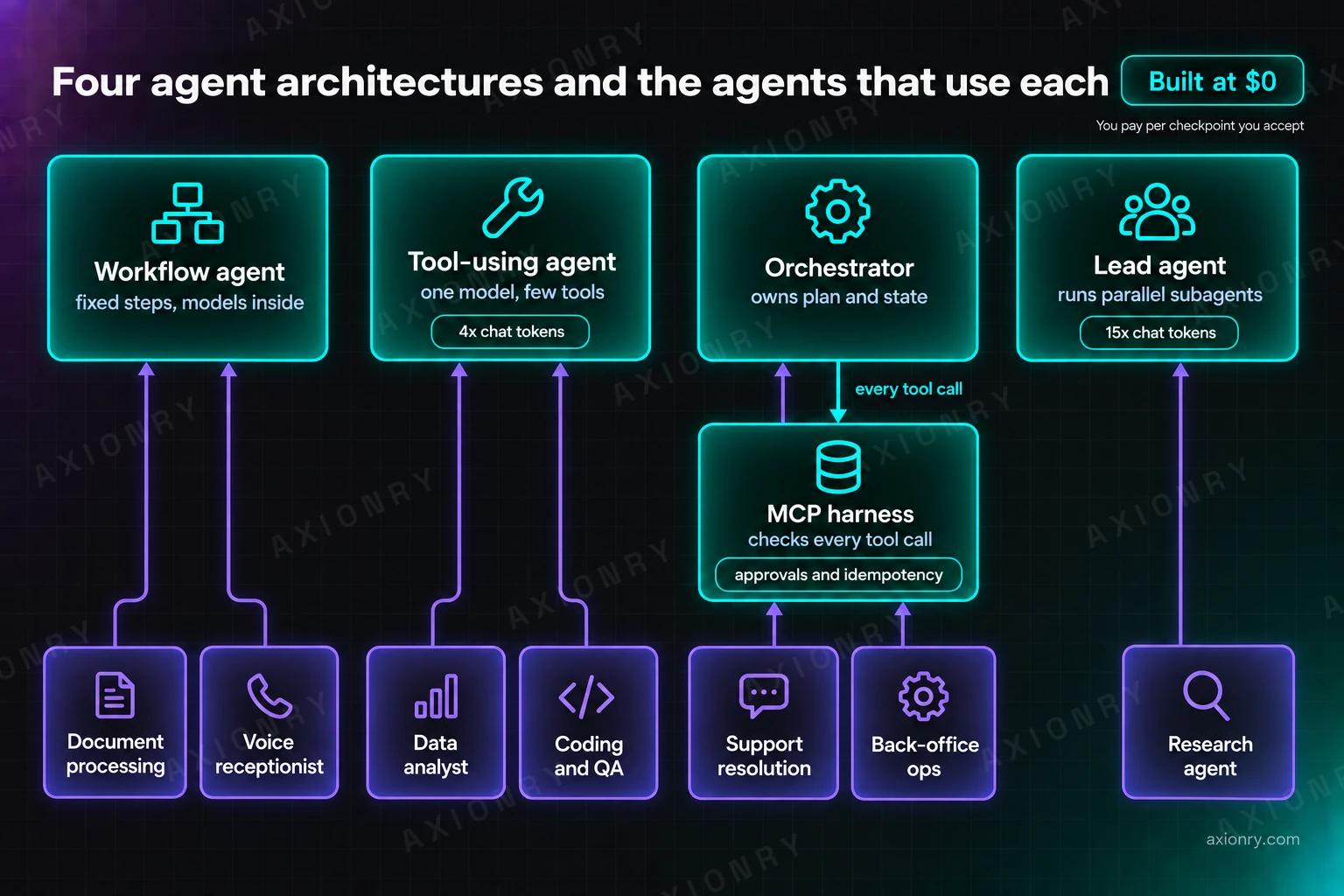
| Workflow agent | Tool-using agent | Orchestrator and MCP harness | Multi-agent | |
|---|---|---|---|---|
| Who picks the next step | Your code | The model | Your code; models fill steps | A lead model |
| Tokens compared with a chat | About 1x to 2x (estimate) | About 4x (Anthropic) | About 1x to 4x per step (estimate) | About 15x (Anthropic) |
| Safe to write to systems of record | Yes, with checks in code | Read-mostly | Yes, the reason it exists | Only with a harness underneath |
| Debugging | Easy: a fixed path | Moderate: read the trace | Easy: one journal row per step | Hard: a distributed conversation |
| Fits | Documents, reminders, interviews, tutoring | Data analyst, coding and QA, small research | Support with actions, back-office ops, outreach, booking voice agents | Broad research |
How much does it cost to build an AI agent in 2026?
A working demo of any agent here starts at $1,000. Production versions start from $6,000 for a data analyst agent, $10,000 for an agent inside an existing product, $12,000 for a voice agent and $22,000 for an AI-first product, on Axionry's published pricing. US agencies quote $50,000 to $150,000 for a production MVP.
Running costs are usually the smaller number, and the unit prices above set them: cents per resolved ticket, 2.5 cents a voice minute on a custom stack up to 31 cents at the top of Retell's range, a fraction of a cent per page read, 40 cents of search fees on a long research report. The bigger recurring cost is people: reviewers, approvers and the owner who watches the override rate. Price your own version, people included, in the AI product cost estimator.
The order I would build in: pick the agent whose outcome you can check and whose volume you can count, build the demo on the happy path, measure it on 50 real cases, and only then add the harness, approvals and evals that make it safe to switch on. For most companies I would start with one of four: support resolution, document processing, voice reception or payment reminders. They have the most volume, the clearest checks and the cheapest mistakes.
If you want one of these built, Axionry builds it at $0: the work is split into checkpoints with acceptance criteria agreed before work starts, and each is invoiced only after you have seen it and accepted it. The service is AI product development.
AI agents worth building: common questions
→What types of AI agents are worth building in 2026?
Eleven types have a clear business case: support resolution, sales research and outreach, voice receptionist and phone agents, AI interviewers, AI tutors, data analyst agents, document processing, coding and QA, browser or computer-use agents, back-office ops agents for finance and collections, and research agents. Each does a frequent job, acts through an API or a controlled interface, and produces an outcome someone can check.
→What is the difference between an AI workflow and an AI agent?
A workflow runs models and tools through code paths you define in advance; an agent lets the model choose its own next step and which tools to use. Workflows are cheaper, easier to test and right for documents, reminders and interviews. Agents fit open-ended work such as data analysis or research, where the path cannot be known beforehand.
→How much does it cost to build an AI agent?
On Axionry's published pricing, a working demo starts at $1,000, an AI data analyst runs $6,000 to $18,000 for most builds, an agent inside an existing product starts at $10,000, a voice agent at $12,000 and an AI-first product at $22,000. US agencies quote $50,000 to $150,000 for a production MVP. Running costs are usually cents per task.
→Should an AI agent be fully autonomous?
Only inside hard limits, and only where a wrong action is cheap or reversible, such as reminders or read-only research. Anything that moves money, changes records or affects a hiring or grading decision should be supervised: the agent proposes, a person approves, and the limits are checked in code. Gartner expects over 40% of agentic AI projects to be cancelled by the end of 2027.
→Do I need a multi-agent system?
Rarely. Most useful agents are a workflow or one tool-using agent, with an orchestrator and an MCP harness when they write to other systems. Multi-agent designs pay off on broad, parallel work like research, where Anthropic's system beat a single agent by 90.2% on its internal eval, but it used about 15 times the tokens of a chat to do it.
→Which AI agent should a company build first?
The one with the most volume, the clearest check and the cheapest mistake. For most companies that is support resolution, document processing, voice reception or payment reminders. Build a demo on real cases, measure how often a person accepts its output unchanged, and add autonomy only where that rate stays high. Leave browser agents until you have asked the vendor for an API.
Open the article in your assistant with one click and ask it how this applies to your product.