AI Development Company in Philadelphia
The best AI Development Company in Philadelphia, at the best available price.
Most of what gets sold here as AI development is a team of five with one person who has shipped, and a bill that reflects the other four. This is the opposite arrangement: the engineer who scopes it is the engineer who builds it, the price is fixed before anything starts, and you pay nothing until a checkpoint is delivered and you accept it.
Philadelphia's economy is anchored by large health systems, a pharmaceutical and cell and gene therapy cluster, insurers and major universities including Penn and Drexel. A lot of the software demand comes from organisations that sit on large volumes of clinical, research or claims data and need to use it carefully.
AI in Philadelphia health care means summarisation, coding support and document extraction with a person reviewing the output. We build it with evaluation and audit trails, not just a model call.
What you get
- One senior engineer end to end: the person on your first call architects it, writes it and hands it over
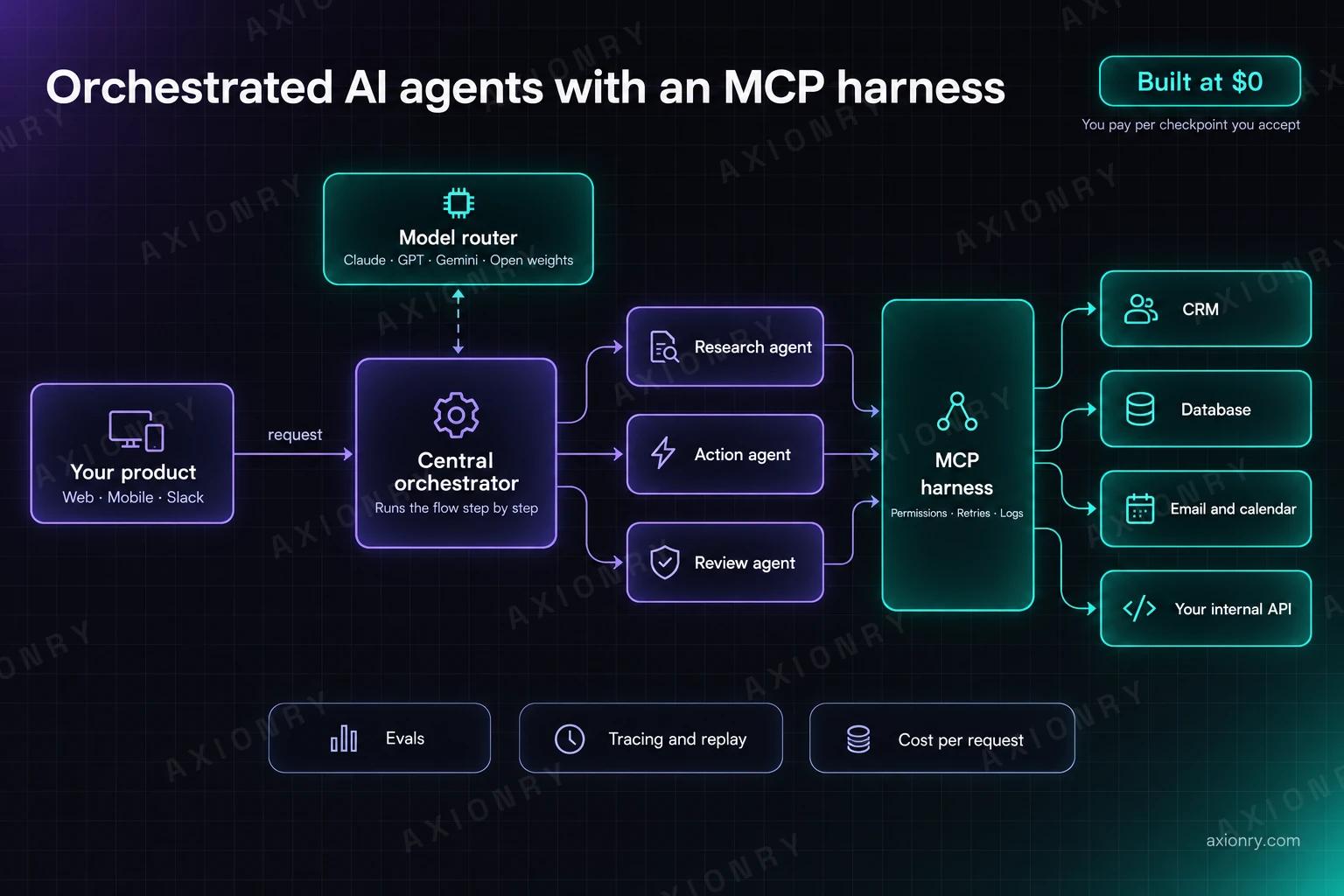
- LLM features, retrieval over your own documents, agents that call real tools, and voice where it earns its place
- Deployed in your own cloud account in a regional data centre, or on your own hardware where residency demands it
- Fixed price and fixed scope agreed in writing before work starts, invoiced per accepted checkpoint
- Code and infrastructure in your repository and your accounts, written to make us replaceable on purpose
Nothing payable upfront. You hold every dollar until a checkpoint is delivered and accepted, and thirty days of defect correction is included. Final scope and price are settled on a call before any work begins.
Invoiced in USD, payable by Wise or bank transfer.
Request a callback
You speak to the engineer who does the work. No sales rep, no deck.
Who builds here
AI Data Analyst
Philadelphia's health systems and insurers run on reporting, and a read-only analyst that answers operational questions with the SQL shown fits their data rules better than most AI tools.
What Philadelphia companies build with us
Get it built at $0.
That is not a discount. It is when you pay. The work is split into checkpoints with acceptance criteria written down before anything starts, and each checkpoint is invoiced only after you have seen it and accepted it. No deposit.
- $0 to start
- You hold every dollar until a checkpoint is delivered and you accept it. No approval, no invoice.
- Fixed cost, unlimited features
- Or hire the team outright: one fixed monthly cost, unlimited feature development, any stack.
- The engineer takes your call
- The person on your first call is the one who architects and writes it. No account managers, no bench time.
A US agency quotes $50,000 to $150,000 for the same build and asks for 40 to 50% of it before a line is written. Account managers, project managers, sales commission and bench time. None of it appears in your product.
Three stages, nothing hidden.
Twenty-minute call
You talk to the engineer who will build it. We scope the problem, and if this is the wrong fit for you, you get told so on that call rather than three weeks into a proposal.
Fixed proposal in 48 hours
Fixed price, fixed timeline, defined deliverables, in writing. No hourly billing, no open-ended scope, and no change-request business model.
Checkpoints until it ships
Working software at each checkpoint, with acceptance criteria agreed before that checkpoint starts and an invoice only after you accept it. Direct access throughout, not a ticket queue.
What actually applies here.
Regulation and data
Health and research work here runs under HIPAA and, for clinical trials, FDA and Good Clinical Practice expectations. Pennsylvania strengthened its data breach notification law in 2024, adding notice to the state attorney general and, in some cases, free credit monitoring for affected residents. Insurers are supervised by the Pennsylvania Insurance Department, which expects them to manage the risk of vendors and of AI used in insurance decisions.
Contracting and payment
You contract with an individual consultant based in India rather than a US entity. Invoices are issued in USD and paid by Wise or bank transfer, with no payroll and no benefits load on your side. Whatever documentation your finance team or counsel needs from an overseas contractor is provided before work starts.
Working hours
Four or more hours of daily overlap with Eastern time, calls in your morning, and same-day replies on working days.
Can the analyst work on health data without exposing it?
Yes. It runs on a read-only replica inside your own environment, with access limited to the tables you approve, and can be restricted to de-identified or aggregated views.
Do you work with insurers?
Yes. Claims and underwriting data suit an analyst that writes SQL, and any AI used in decisions about policyholders is built with documentation and human review your regulator will expect.
Why would we use an overseas engineer rather than a local integrator?
Often you should use both. An integrator holding the prime contract and the local relationship, with a specialist doing the AI and data layer underneath, is a common and sensible structure here. What you should not do is pay integrator rates for engineering that one person is actually doing.
Can the system run entirely inside our own infrastructure?
Yes, and in this region that is frequently the requirement rather than the preference. Model serving on your own hardware or in your own cloud account in a regional data centre, with no outbound calls, up to fully air-gapped.
Who owns the code?
You do, entirely. It ships into your repository on your own cloud accounts, documented so your team or your next hire can carry it without us, and all our access is removed at handover with written confirmation.
AI Product Development
LLM apps, agents, RAG and MCP tooling, architected by the builder of AccioMatrix.