AI Development Company in Houston
The best AI Development Company in Houston, at the best available price.
Most of what gets sold here as AI development is a team of five with one person who has shipped, and a bill that reflects the other four. This is the opposite arrangement: the engineer who scopes it is the engineer who builds it, the price is fixed before anything starts, and you pay nothing until a checkpoint is delivered and you accept it.
Houston is the centre of the US energy industry and home to the Texas Medical Center, one of the largest medical complexes in the world, along with a major port and NASA's Johnson Space Center. The technology demand comes mostly from these industries: energy companies modernising operations, health systems and suppliers working with clinical data, and logistics and aerospace firms.
Document extraction from permits, contracts and inspection reports, and retrieval over decades of engineering files, are the AI projects Houston companies ask about first.
What you get
- One senior engineer end to end: the person on your first call architects it, writes it and hands it over
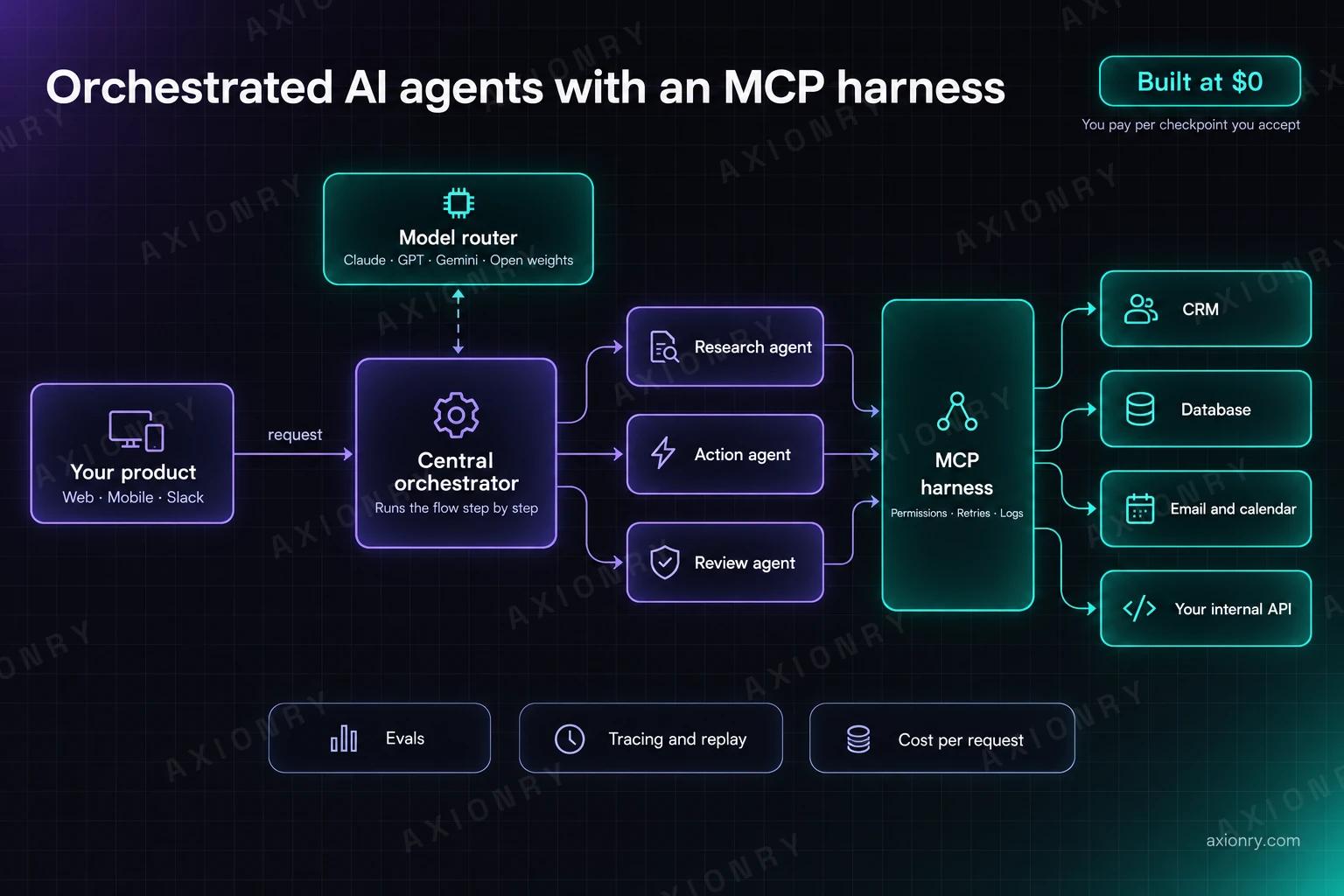
- LLM features, retrieval over your own documents, agents that call real tools, and voice where it earns its place
- Deployed in your own cloud account in a regional data centre, or on your own hardware where residency demands it
- Fixed price and fixed scope agreed in writing before work starts, invoiced per accepted checkpoint
- Code and infrastructure in your repository and your accounts, written to make us replaceable on purpose
Nothing payable upfront. You hold every dollar until a checkpoint is delivered and accepted, and thirty days of defect correction is included. Final scope and price are settled on a call before any work begins.
Invoiced in USD, payable by Wise or bank transfer.
Request a callback
You speak to the engineer who does the work. No sales rep, no deck.
Who builds here
On-Premise LLM Deployment
Houston's energy companies and health systems both hold data that cannot leave their control, so a model running inside their own environment is usually the only AI they can approve.
What Houston companies build with us
Get it built at $0.
That is not a discount. It is when you pay. The work is split into checkpoints with acceptance criteria written down before anything starts, and each checkpoint is invoiced only after you have seen it and accepted it. No deposit.
- $0 to start
- You hold every dollar until a checkpoint is delivered and you accept it. No approval, no invoice.
- Fixed cost, unlimited features
- Or hire the team outright: one fixed monthly cost, unlimited feature development, any stack.
- The engineer takes your call
- The person on your first call is the one who architects and writes it. No account managers, no bench time.
A US agency quotes $50,000 to $150,000 for the same build and asks for 40 to 50% of it before a line is written. Account managers, project managers, sales commission and bench time. None of it appears in your product.
Three stages, nothing hidden.
Twenty-minute call
You talk to the engineer who will build it. We scope the problem, and if this is the wrong fit for you, you get told so on that call rather than three weeks into a proposal.
Fixed proposal in 48 hours
Fixed price, fixed timeline, defined deliverables, in writing. No hourly billing, no open-ended scope, and no change-request business model.
Checkpoints until it ships
Working software at each checkpoint, with acceptance criteria agreed before that checkpoint starts and an invoice only after you accept it. Direct access throughout, not a ticket queue.
What actually applies here.
Regulation and data
Health care work at the Texas Medical Center falls under HIPAA, and Texas adds its own medical records privacy law, which is broader than HIPAA in who it covers. Energy companies protect operational and seismic data under strict contracts, and critical infrastructure operators follow federal cybersecurity guidance for pipelines and grids. Space and defence suppliers add export controls on technical data. The Texas Data Privacy and Security Act covers consumer data across the state.
Contracting and payment
You contract with an individual consultant based in India rather than a US entity. Invoices are issued in USD and paid by Wise or bank transfer, with no payroll and no benefits load on your side. Whatever documentation your finance team or counsel needs from an overseas contractor is provided before work starts.
Working hours
Three or more hours of daily overlap with Central time, calls in your morning, and same-day replies on working days.
Can AI run inside an operational technology environment?
It can run next to it. We keep models on isolated infrastructure with one-way data flows from operational systems, so nothing in the AI environment can reach control networks.
Does the Texas medical records law go beyond HIPAA?
Yes. It applies to a wider set of organisations that handle health information, not only HIPAA covered entities. We build to the stricter of the two, and your counsel confirms scope.
Why would we use an overseas engineer rather than a local integrator?
Often you should use both. An integrator holding the prime contract and the local relationship, with a specialist doing the AI and data layer underneath, is a common and sensible structure here. What you should not do is pay integrator rates for engineering that one person is actually doing.
Can the system run entirely inside our own infrastructure?
Yes, and in this region that is frequently the requirement rather than the preference. Model serving on your own hardware or in your own cloud account in a regional data centre, with no outbound calls, up to fully air-gapped.
Who owns the code?
You do, entirely. It ships into your repository on your own cloud accounts, documented so your team or your next hire can carry it without us, and all our access is removed at handover with written confirmation.
AI Product Development
LLM apps, agents, RAG and MCP tooling, architected by the builder of AccioMatrix.