AI Development Company in Lucknow
The best AI Development Company in Lucknow, at the best available price.
Most of what gets sold here as AI development is a team of five with one person who has shipped, and a bill that reflects the other four. This is the opposite arrangement: the engineer who scopes it is the engineer who builds it, the price is fixed before anything starts, and you pay nothing until a checkpoint is delivered and you accept it.
Lucknow is the capital of Uttar Pradesh, so state departments, public sector bodies and the firms that supply them are a steady source of demand for software. The city is also a medical and research centre, with SGPGIMS, King George's Medical University and four CSIR laboratories, and its traditional economy includes the chikankari embroidery trade centred on Chowk. HCL runs its IT City campus on Sultanpur Road, TCS has a campus in the city, and the state's IT and GCC policies name Lucknow among the hubs it wants to grow.
Useful AI projects in Lucknow tend to involve Hindi and English documents: forms, applications, reports and correspondence. Retrieval with citations, extraction into structured fields and drafting with human review are the patterns that hold up, and each is tested on your own documents before launch.
What you get
- One senior engineer end to end: the person on your first call architects it, writes it and hands it over
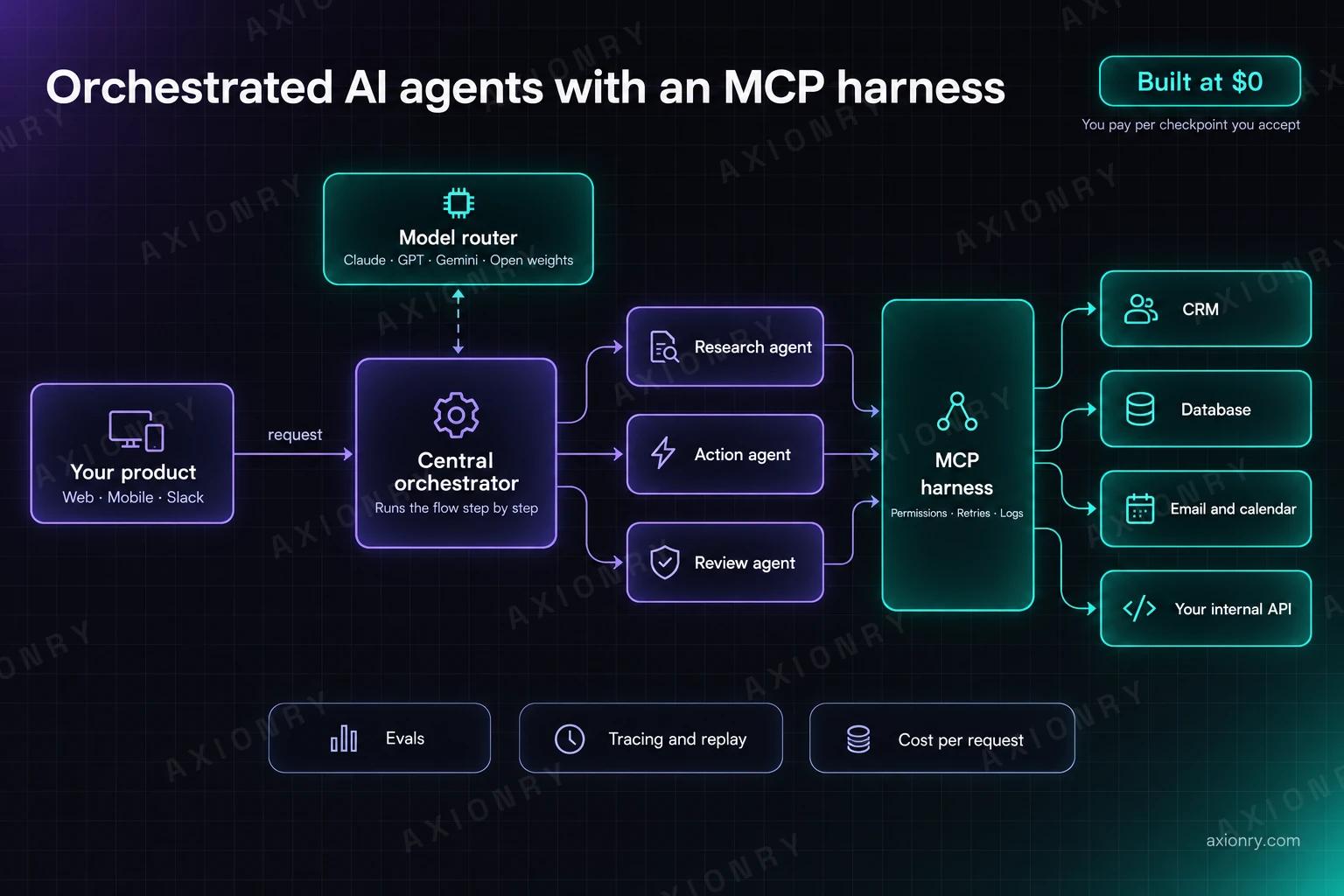
- LLM features, retrieval over your own documents, agents that call real tools, and voice where it earns its place
- Deployed in your own cloud account in a regional data centre, or on your own hardware where residency demands it
- Fixed price and fixed scope agreed in writing before work starts, invoiced per accepted checkpoint
- Code and infrastructure in your repository and your accounts, written to make us replaceable on purpose
Nothing payable upfront. You hold every dollar until a checkpoint is delivered and accepted, and thirty days of defect correction is included. Final scope and price are settled on a call before any work begins.
Invoiced in INR, with GST as applicable.
Request a callback
You speak to the engineer who does the work. No sales rep, no deck.
Who builds here
Fractional CTO Services
Many Lucknow organisations, from private hospitals to family businesses and government suppliers, have reached the point where software decisions carry real risk, yet have no senior technical person to make them. A fractional CTO supplies that judgement part time: what to build or buy, how to check vendors, and how to keep patient or citizen data safe.
What Lucknow companies build with us
Get it built at $0.
That is not a discount. It is when you pay. The work is split into checkpoints with acceptance criteria written down before anything starts, and each checkpoint is invoiced only after you have seen it and accepted it. No deposit.
- $0 to start
- You hold every dollar until a checkpoint is delivered and you accept it. No approval, no invoice.
- Fixed cost, unlimited features
- Or hire the team outright: one fixed monthly cost, unlimited feature development, any stack.
- The engineer takes your call
- The person on your first call is the one who architects and writes it. No account managers, no bench time.
A US agency quotes $50,000 to $150,000 for the same build and asks for 40 to 50% of it before a line is written. Account managers, project managers, sales commission and bench time. None of it appears in your product.
Three stages, nothing hidden.
Twenty-minute call
You talk to the engineer who will build it. We scope the problem, and if this is the wrong fit for you, you get told so on that call rather than three weeks into a proposal.
Fixed proposal in 48 hours
Fixed price, fixed timeline, defined deliverables, in writing. No hourly billing, no open-ended scope, and no change-request business model.
Checkpoints until it ships
Working software at each checkpoint, with acceptance criteria agreed before that checkpoint starts and an invoice only after you accept it. Direct access throughout, not a ticket queue.
What actually applies here.
Regulation and data
The DPDP Act 2023 matters most here for hospitals, diagnostic labs and health startups, because patient records are personal data under the Act, and the Digital Personal Data Protection Rules notified in November 2025 phase in its duties: the provisions establishing the Data Protection Board took effect on notification, and most obligations on data fiduciaries apply from May 2027, a date the government may still bring forward. Uttar Pradesh has adopted the Clinical Establishments (Registration and Regulation) Act, 2010, so hospitals and clinics register under it, and their software has to support its registration and record keeping conditions. The IT and ITeS Policy of Uttar Pradesh 2022 and the state's GCC Policy 2024, with its GCC Rules 2025, offer incentives and carry no compliance duties, and the AI City planned for Lucknow is still at the announcement stage.
Contracting and payment
Simple domestic contracting. Invoices in INR with GST as applicable, under a standard services agreement. No cross-border payment friction, no forex conversion cost, and no time spent on paperwork for an overseas supplier.
Working hours
Same time zone. I work from India on IST, so calls, reviews and replies all happen inside your normal working day.
Can you work with a Lucknow hospital's patient data safely?
Yes, on terms the hospital sets. Work happens on de-identified copies or read-only replicas where possible, inside infrastructure the hospital controls, with named access and logs. Anything that drafts clinical text is introduced as an aid for doctors and staff to review, and the final record remains their responsibility.
Can you support a firm that supplies Uttar Pradesh government departments?
Yes, as the engineering side of your delivery: architecture, code, hosting and documentation that meet the department's requirements. Tendering, registration and the contract with the department stay with your firm, and the source code and accounts are set up so ownership can transfer cleanly at handover.
Can the product work in Hindi?
Yes. Interfaces can be bilingual, and current models read and write Hindi reasonably well for many tasks, though quality varies with the task and the vocabulary. Each Hindi feature is checked against a test set drawn from your own users' text before it ships, and weak spots are reported plainly.
Why would we use an overseas engineer rather than a local integrator?
Often you should use both. An integrator holding the prime contract and the local relationship, with a specialist doing the AI and data layer underneath, is a common and sensible structure here. What you should not do is pay integrator rates for engineering that one person is actually doing.
Can the system run entirely inside our own infrastructure?
Yes, and in this region that is frequently the requirement rather than the preference. Model serving on your own hardware or in your own cloud account in a regional data centre, with no outbound calls, up to fully air-gapped.
Who owns the code?
You do, entirely. It ships into your repository on your own cloud accounts, documented so your team or your next hire can carry it without us, and all our access is removed at handover with written confirmation.
AI Product Development
LLM apps, agents, RAG and MCP tooling, architected by the builder of AccioMatrix.