On-Premise LLM Deployment in San Francisco
The best On-Premise LLM Deployment in San Francisco, at the best available price.
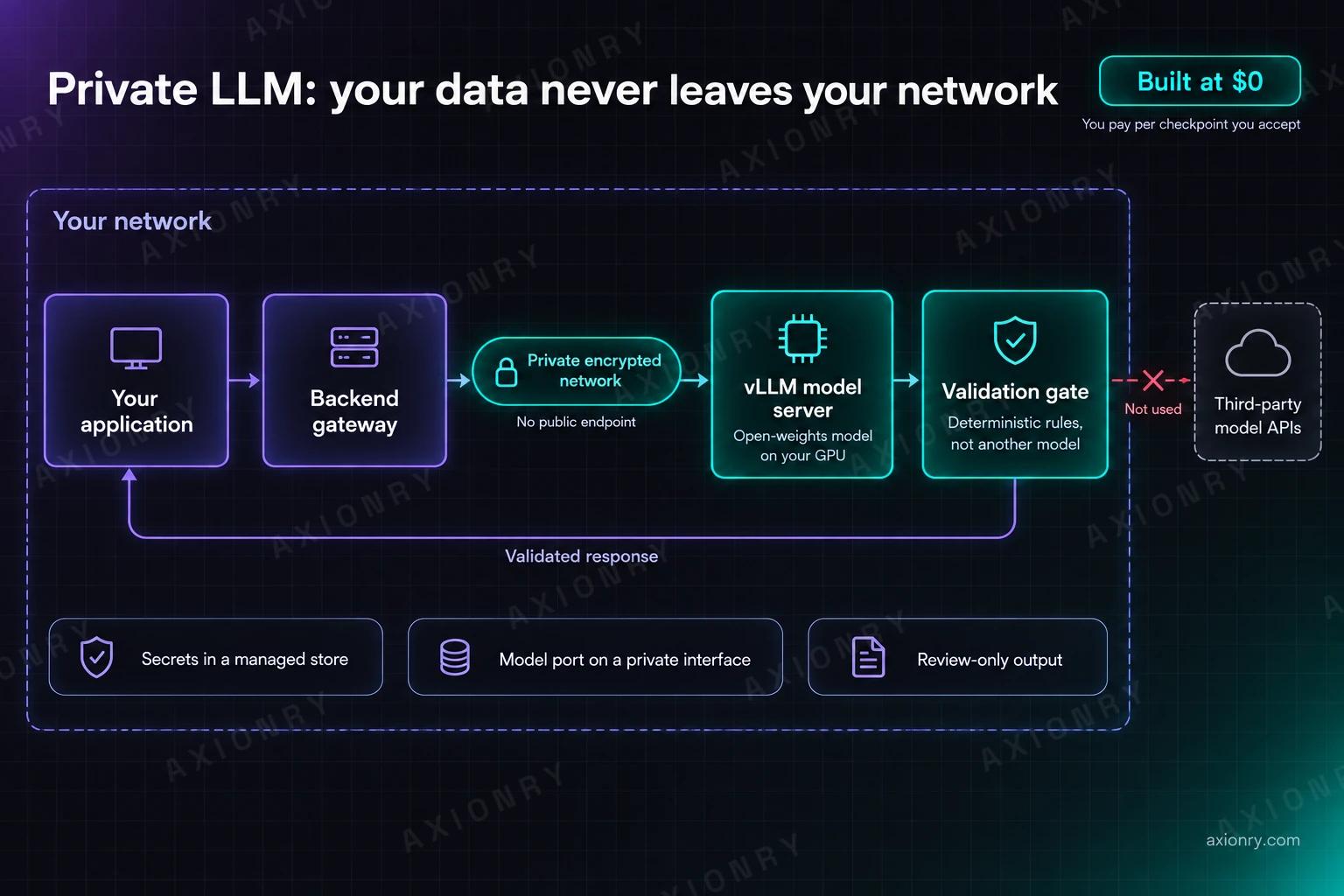
You have the GPU and you have the model. What is missing is the leg in between: the model exposed as a reliable private API, reached securely from your application, returning data you can trust. That is the whole engagement.
San Francisco has the densest concentration of AI companies and venture money anywhere, which cuts both ways: the talent is excellent and almost all of it is already spoken for. Seed-stage teams compete with the largest labs for every senior engineer, so many ship their first product with outside help and hire once the product has shown what kind of engineer it needs.
San Francisco startups selling to enterprises hit the same wall: the customer's security team will not approve prompts going to a shared API. A private deployment of an open-weight model in your own account turns that blocker into one line in the security questionnaire.
What you get
- vLLM serving tuned to your GPU: quantisation on the native kernel path, KV cache sizing, continuous batching, prefix caching
- A private network path with no public exposure, verified as a direct peer connection rather than a relay
- Schema-constrained responses plus a deterministic QA gate, so a wrong answer is rejected rather than rendered
- Documented baseline: tokens per second, time to first token, real concurrent capacity
- Infrastructure as code in your repository, a runbook, and every credential held by you
No upfront payment and no escrow required. You hold every dollar until a checkpoint is delivered and accepted, and thirty days of defect correction is included. Scope and price are set on a call.
Invoiced in USD, payable by Wise or bank transfer.
Request a callback
You speak to the engineer who does the work. No sales rep, no deck.
Who builds here
AI Product & MVP Development
The usual San Francisco situation is a funded founder who needs a working product in front of users before the next raise, and cannot wait four months to hire a team to build it.
What San Francisco companies build with us
Get it built at $0.
That is not a discount. It is when you pay. The work is split into checkpoints with acceptance criteria written down before anything starts, and each checkpoint is invoiced only after you have seen it and accepted it. No deposit.
- $0 to start
- You hold every dollar until a checkpoint is delivered and you accept it. No approval, no invoice.
- Fixed cost, unlimited features
- Or hire the team outright: one fixed monthly cost, unlimited feature development, any stack.
- The engineer takes your call
- The person on your first call is the one who architects and writes it. No account managers, no bench time.
A US agency quotes $50,000 to $150,000 for the same build and asks for 40 to 50% of it before a line is written. Account managers, project managers, sales commission and bench time. None of it appears in your product.
Three stages, nothing hidden.
Fixed-fee assessment
Five business days from the day access is in place. Your stack examined end to end, existing work classified as preserved or replaced with reasons, the connection design, and acceptance criteria written as testable statements.
Implementation in checkpoints
Around three weeks. Each checkpoint has written acceptance criteria agreed before work starts, and is invoiced only after you accept it. Appoint an independent technical reviewer if you want one.
Handover and closeout
One real request through your real application, on synthetic data, passing every QA rule. Runbook, recorded handoff, and all our access removed with written confirmation.
What actually applies here.
Regulation and data
California's privacy law, the CCPA as amended by the CPRA, is enforced by a dedicated agency, the California Privacy Protection Agency, and applies to businesses above its revenue or data thresholds wherever they are based. The agency's rules on risk assessments and automated decision-making technology add obligations that phase in over the next few years. If your product makes significant decisions about people, plan for opt-out and access requests from the start rather than after the first enterprise customer asks.
Contracting and payment
You contract with an individual consultant based in India rather than a US entity. Invoices are issued in USD and paid by Wise or bank transfer, with no payroll and no benefits load on your side. Whatever documentation your finance team or counsel needs from an overseas contractor is provided before work starts.
Working hours
Calls in your morning, Pacific time, and work handed over at the end of your day so the next round of changes is waiting when you start.
Is it a problem that you are not in the Bay Area?
Not for the work itself. You get calls in your morning Pacific time and work handed over at the end of your day, so the next round of changes is waiting when you start. Everything lives in your repository and your accounts.
Can you help us get ready for technical due diligence before a raise?
Yes. That usually means tightening security basics, documenting the architecture and making sure more than one person can deploy. It fits naturally into a fractional CTO or build engagement.
We already have hardware and a model running. Is that a problem?
It is the ideal starting point. Existing work is classified during the assessment as preserved unchanged, preserved with changes, or replaced, with reasons, and nothing is replaced without your written agreement.
Can it be fully air gapped?
Yes, including model and dependency mirroring, offline updates and local evaluation, with no outbound network access at all.
Who holds the accounts?
You do, throughout. Cloud accounts are created and held by you, our access is named and limited-privilege, and it is removed at handover with written confirmation.
Private LLM Infrastructure
Self-hosted LLM deployment on hardware you own. vLLM serving, private networking, validated output.