AI Development Company in Frankfurt
The best AI Development Company in Frankfurt, at the best available price.
Most of what gets sold here as AI development is a team of five with one person who has shipped, and a bill that reflects the other four. This is the opposite arrangement: the engineer who scopes it is the engineer who builds it, the price is fixed before anything starts, and you pay nothing until a checkpoint is delivered and you accept it.
Frankfurt is continental Europe's main financial centre, home to the European Central Bank, the Bundesbank, Deutsche Börse and a dense cluster of banks, asset managers and payment firms. It is also one of Europe's biggest data centre and internet exchange locations. Software is bought through vendor risk management, outsourcing registers and information security reviews, and almost every buyer is either regulated or supplies someone who is.
AI work in Frankfurt centres on documents and controls: extracting terms from contracts and prospectuses, summarising research, supporting KYC and anti-money laundering reviews. Each system keeps a person in the loop and an audit trail a compliance team can follow.
What you get
- One senior engineer end to end: the person on your first call architects it, writes it and hands it over
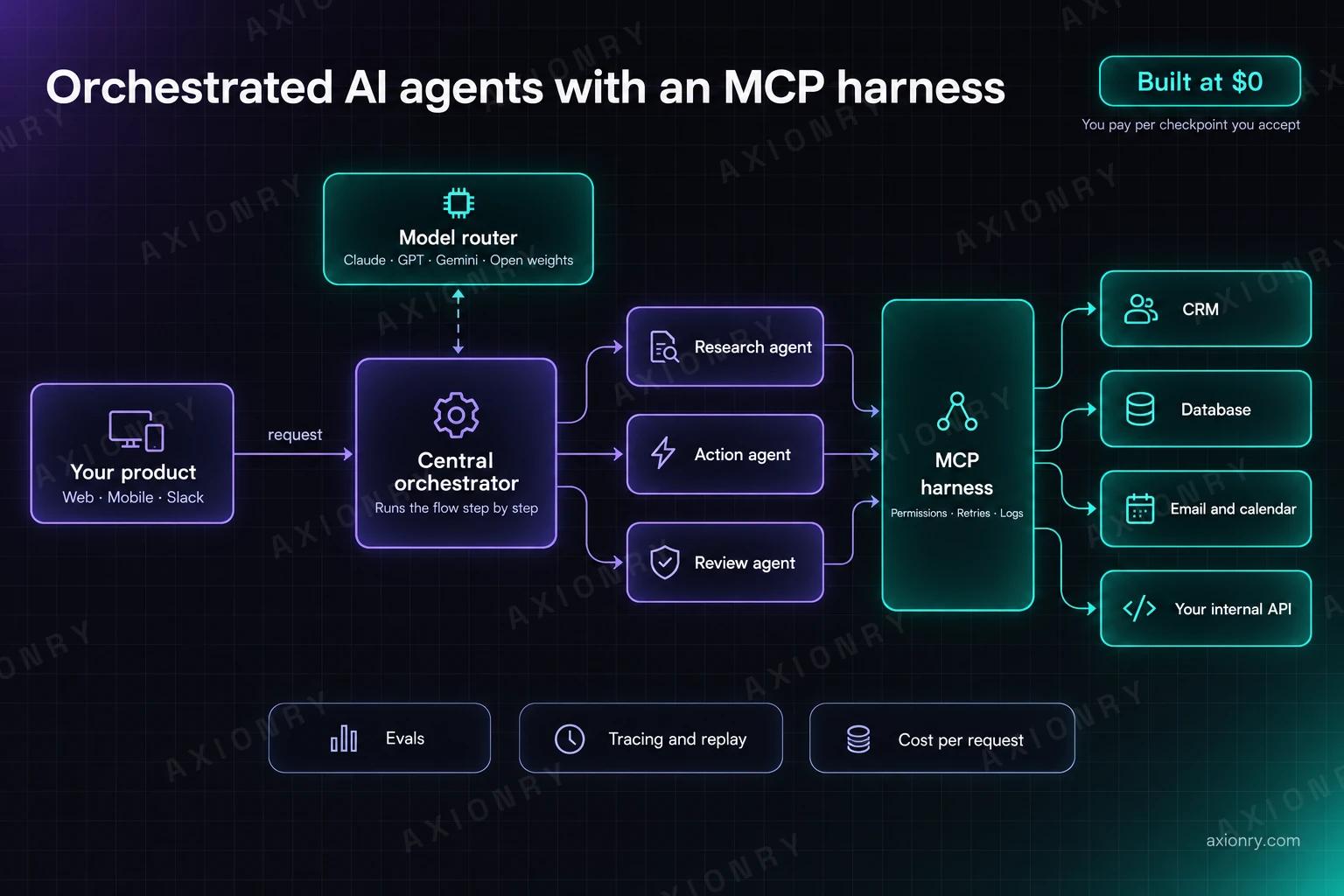
- LLM features, retrieval over your own documents, agents that call real tools, and voice where it earns its place
- Deployed in your own cloud account in a regional data centre, or on your own hardware where residency demands it
- Fixed price and fixed scope agreed in writing before work starts, invoiced per accepted checkpoint
- Code and infrastructure in your repository and your accounts, written to make us replaceable on purpose
Nothing payable upfront. You hold every dollar until a checkpoint is delivered and accepted, and thirty days of defect correction is included. Final scope and price are settled on a call before any work begins.
Invoiced in USD or EUR, payable by Wise or bank transfer.
Request a callback
You speak to the engineer who does the work. No sales rep, no deck.
Who builds here
On-Premise LLM Deployment
Frankfurt's banks and their suppliers work under DORA third-party risk rules, and a model hosted inside their own environment is far easier to put through that review than a new external AI provider.
What Frankfurt companies build with us
Get it built at $0.
That is not a discount. It is when you pay. The work is split into checkpoints with acceptance criteria written down before anything starts, and each checkpoint is invoiced only after you have seen it and accepted it. No deposit.
- $0 to start
- You hold every dollar until a checkpoint is delivered and you accept it. No approval, no invoice.
- Fixed cost, unlimited features
- Or hire the team outright: one fixed monthly cost, unlimited feature development, any stack.
- The engineer takes your call
- The person on your first call is the one who architects and writes it. No account managers, no bench time.
A US agency quotes $50,000 to $150,000 for the same build and asks for 40 to 50% of it before a line is written. Account managers, project managers, sales commission and bench time. None of it appears in your product.
Three stages, nothing hidden.
Twenty-minute call
You talk to the engineer who will build it. We scope the problem, and if this is the wrong fit for you, you get told so on that call rather than three weeks into a proposal.
Fixed proposal in 48 hours
Fixed price, fixed timeline, defined deliverables, in writing. No hourly billing, no open-ended scope, and no change-request business model.
Checkpoints until it ships
Working software at each checkpoint, with acceptance criteria agreed before that checkpoint starts and an invoice only after you accept it. Direct access throughout, not a ticket queue.
What actually applies here.
Regulation and data
Banks, insurers, investment firms and payment institutions have applied the EU's Digital Operational Resilience Act (DORA) since January 2025, covering ICT risk, incident reporting, resilience testing and the register of ICT third-party providers; for firms in its scope it replaced BaFin's BAIT. BaFin also keeps market surveillance powers over AI used in regulated financial activities under Germany's July 2026 AI implementation law. GDPR and the BDSG apply, with the Hessian Commissioner for Data Protection supervising private companies, and works councils have co-determination rights over tools that can monitor staff. Germany's NIS2 act has applied since December 2025. The EU AI Act has been in force since August 2024: general-purpose model rules applied from August 2025 and transparency duties from August 2026, while the 2026 Digital Omnibus moved the main high-risk obligations to December 2027 for stand-alone systems such as hiring or credit scoring, and August 2028 for AI built into regulated products.
Contracting and payment
You contract with an individual consultant based in India. Invoices in EUR or USD, paid by Wise or bank transfer. Your accountant handles an overseas supplier in the usual way, and any documentation they need is provided before access is granted.
Working hours
Four or more hours of daily overlap across your morning, Central European time, with same-day replies on working days.
Can you work within DORA third-party risk requirements?
Yes. Expect to provide information for your register of ICT third-party providers, follow your access and incident procedures, and keep work inside accounts you own. Exit is simple because the code, infrastructure and documentation are yours from the start.
Can everything stay in Frankfurt data centres?
Yes, where your cloud account or hardware is there. Deployments can be pinned to a Frankfurt cloud region or to your own servers, with the model, serving layer and logs all kept inside that boundary.
How does the time difference work with Frankfurt?
Four or more hours of daily overlap across your morning, Central European time, with same-day replies on working days. The work is remote from India, and reviews, incident calls and demos are scheduled inside that window.
Why would we use an overseas engineer rather than a local integrator?
Often you should use both. An integrator holding the prime contract and the local relationship, with a specialist doing the AI and data layer underneath, is a common and sensible structure here. What you should not do is pay integrator rates for engineering that one person is actually doing.
Can the system run entirely inside our own infrastructure?
Yes, and in this region that is frequently the requirement rather than the preference. Model serving on your own hardware or in your own cloud account in a regional data centre, with no outbound calls, up to fully air-gapped.
Who owns the code?
You do, entirely. It ships into your repository on your own cloud accounts, documented so your team or your next hire can carry it without us, and all our access is removed at handover with written confirmation.
AI Product Development
LLM apps, agents, RAG and MCP tooling, architected by the builder of AccioMatrix.