AI Data Analyst in Salt Lake City
The best AI Data Analyst in Salt Lake City, at the best available price.
Your team asks in English. The service finds the tables, writes the SQL, runs it against a read-only replica inside your own cloud, and returns the number with the query attached. It cannot touch a table whose schema it has not just read, and that is enforced in code rather than requested in a prompt. Starts at $0: you pay at checkpoints you accept.
Salt Lake City and the Lehi and Provo corridor, known as Silicon Slopes, have produced a run of large SaaS companies in customer experience, analytics and education software. The talent pool is strong in enterprise software and sales, with lower costs than the coasts.
SaaS businesses here run on product usage, revenue and support data. A plain-English analyst on a read-only replica answers the questions customer success and finance ask every week.
What you get
- Deployed in your own cloud account against a read-only replica you create, so we never hold a credential to your database
- A signed schema check the model cannot skip: no SQL runs against a table it has not just inspected, and the tokens expire in fifteen minutes
- A grant list your data owner approves, naming the exact tables and columns the analyst may read, with everything else refused at the database
- Exposed inside Claude or ChatGPT in your organisation's workspace, behind your existing Google sign in, so nobody learns a new interface
- Every question logged with the SQL it ran, the tables it touched and whether it errored, which is what an auditor actually asks for
- Runs on a private LLM on your own hardware where data security demands it, up to fully air-gapped, so nothing at all crosses your perimeter
No payment before a checkpoint is delivered and accepted. Most builds land between $6,000 and $18,000 depending on how many databases are in scope and how much of the schema the first domain covers. Optional upkeep from $1,200 a month, and only if you want it.
Invoiced in USD, payable by Wise or bank transfer.
Request a callback
You speak to the engineer who does the work. No sales rep, no deck.
Who builds here
Software Development Company
Utah's SaaS companies are past the idea stage and need dependable senior engineering capacity to ship their roadmap, which is what a dedicated engineer provides.
How many free signups from June converted to paid, by week?
customersplan tier is a column here, not a separate status table
subscriptionsone row per plan change, so take the first paid one
AQIAaPr2xQAAAACqL3d1ZwSELECT DATE_TRUNC('week', s."startedAt")
AS "Week",
COUNT(DISTINCT c.id) AS "Converted"
FROM customers c
JOIN subscriptions s
ON s."customerId" = c.id
WHERE c.plan = 'free'
AND s.plan = 'paid'
AND c."createdAt" >= DATE '2026-06-01'
AND c."createdAt" < DATE '2026-07-01'
GROUP BY 1 ORDER BY 1| Week | Converted |
|---|---|
| 2026-06-01 | 214 |
| 2026-06-08 | 188 |
| 2026-06-15 | 243 |
| 2026-06-22 | 201 |
Stage three refuses to run unless it is handed a valid token from stage two for a table in the query. The model cannot skip the schema read, because the check is a signature in code rather than an instruction in a prompt.
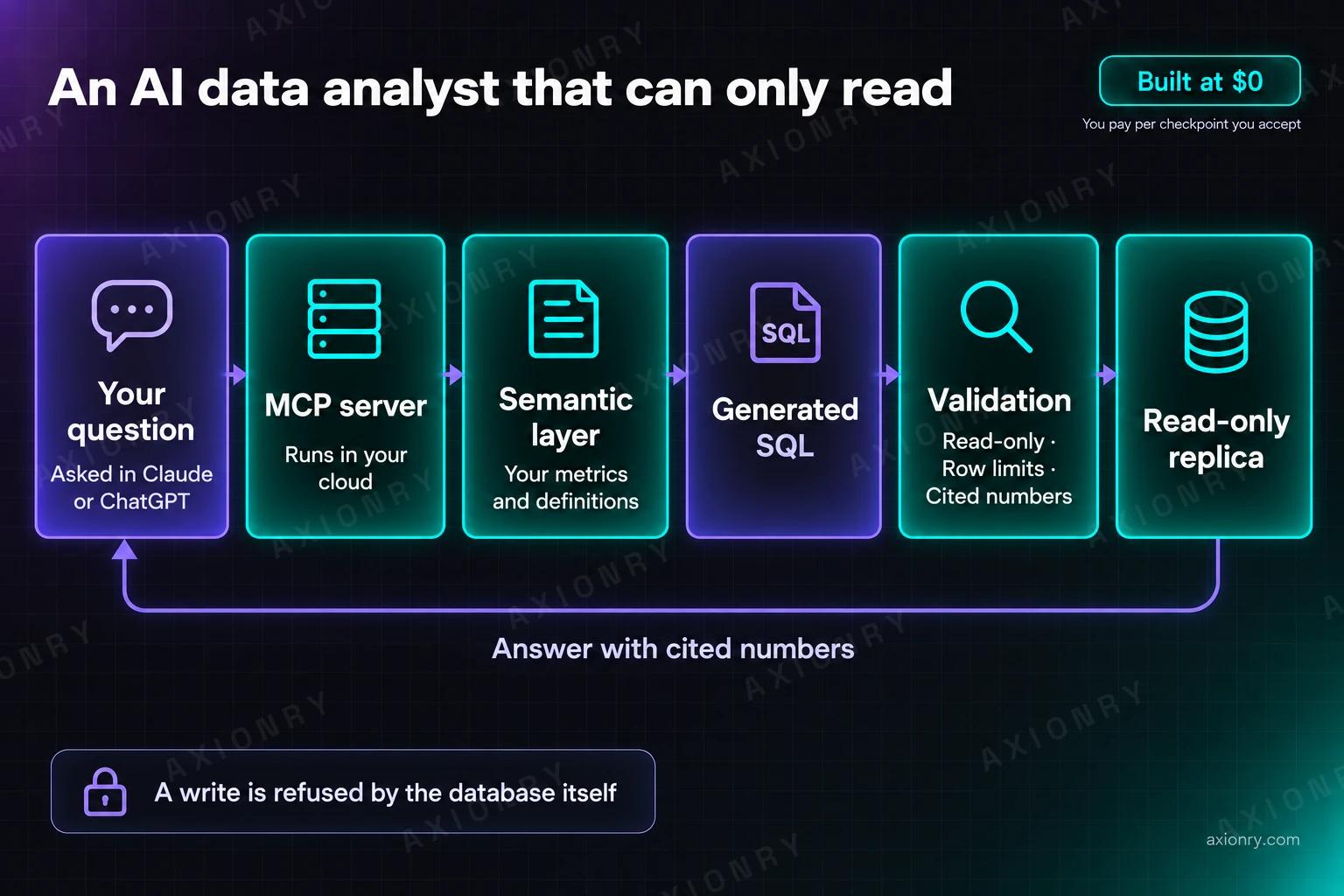
What Salt Lake City companies build with us
Get it built at $0.
That is not a discount. It is when you pay. The work is split into checkpoints with acceptance criteria written down before anything starts, and each checkpoint is invoiced only after you have seen it and accepted it. No deposit.
- $0 to start
- You hold every dollar until a checkpoint is delivered and you accept it. No approval, no invoice.
- Fixed cost, unlimited features
- Or hire the team outright: one fixed monthly cost, unlimited feature development, any stack.
- The engineer takes your call
- The person on your first call is the one who architects and writes it. No account managers, no bench time.
A US agency quotes $50,000 to $150,000 for the same build and asks for 40 to 50% of it before a line is written. Account managers, project managers, sales commission and bench time. None of it appears in your product.
Three stages, nothing hidden.
Fixed-fee assessment
Five business days from the day read-only access is in place. Schema inventoried, the questions your team actually asks classified as answerable or not, the grant list drafted with whoever owns data protection, and acceptance criteria written as testable statements.
Build in checkpoints
About three weeks. Deployed in your cloud account, connected to your replica and to your assistant workspace, with the semantic layer written for the first domain. Each checkpoint has criteria agreed before work starts and is invoiced only once you accept it.
Handover and closeout
A real question from your team, answered end to end, with the SQL shown and the numbers reconciled against the source rows. Runbook, recorded handoff, code and semantic layer in your repository, and all our access removed with written confirmation.
What actually applies here.
Regulation and data
Utah was the first state to pass an AI-specific consumer law. The Utah Artificial Intelligence Policy Act requires disclosure when people interact with generative AI in certain settings: regulated professions must disclose up front in high-risk interactions, and other businesses must disclose when a person clearly asks. It was narrowed in 2025, but those disclosure duties remain. The Utah Consumer Privacy Act applies to larger businesses, with a higher threshold than most states.
Contracting and payment
You contract with an individual consultant based in India rather than a US entity. Invoices are issued in USD and paid by Wise or bank transfer, with no payroll and no benefits load on your side. Whatever documentation your finance team or counsel needs from an overseas contractor is provided before work starts.
Working hours
Calls in your morning, Mountain time, a shared window at the start of your day, and work handed over overnight so the next round is waiting when you start.
Do we have to tell users they are talking to an AI in Utah?
In a regulated profession and a high-risk interaction, yes, up front. Otherwise you must disclose when a user clearly asks. Our agents disclose by default, which also builds trust.
Can you work alongside our existing engineering team?
Yes, and that is the usual setup: one senior engineer working in your repositories, to your standards and processes, with code review from your team.
We already have a BI tool. Does this replace it?
No, and it should not. Your dashboards answer the questions somebody anticipated, and they will keep doing that. This answers the ones nobody built a chart for, which is where the waiting happens. Teams that keep both end up using the dashboards for the standing numbers and the analyst for everything else.
How long before somebody can ask a real question?
Usually inside the first week of the build, on a narrow slice of the schema. The first domain being useful early is the point of doing it in checkpoints: you see it working on your own data before most of the money is committed.
What if our schema is a mess?
Most are, and it changes the shape of the work rather than ruling it out. Undocumented columns, legacy tables nobody dares delete and two spellings of the same idea are normal. The assessment tells you plainly how much of that has to be untangled first, and if the answer is that you need a data cleanup before an analyst is worth building, you will be told that instead of sold this.
AI Data Analyst
An AI data analyst on your own read-only replica. Natural language to SQL that cannot query a table it has not read.